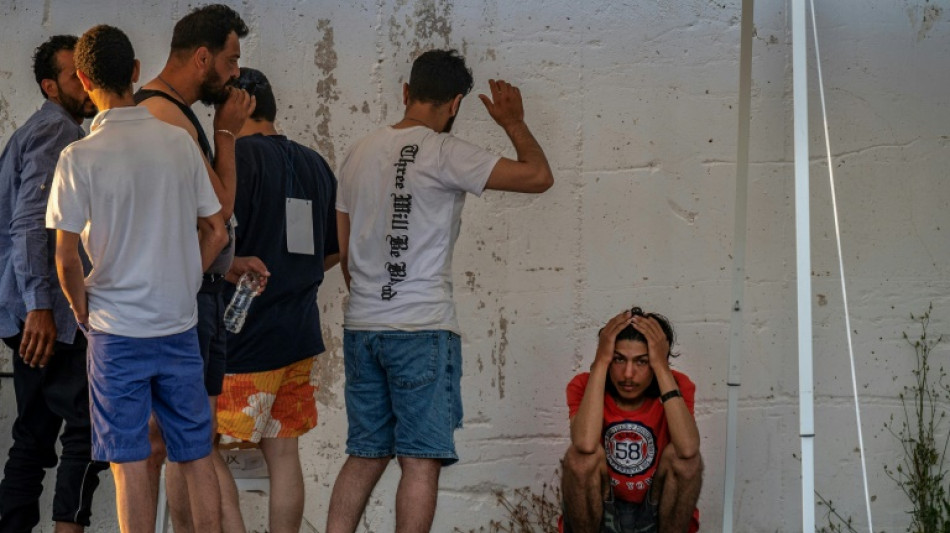
Syria to Libya to the EU: how people-smugglers operate / Photo: Angelos Tzortzinis - AFP/File

For desperate Syrians, a WhatsApp message saying "I want to go to Europe" can be all they need to start a treacherous journey to Libya and then across the Mediterranean.
Twelve years after conflict broke out when President Bashar al-Assad repressed peaceful pro-democracy protests, Syrians are still trying to escape a war that has killed more than 500,000 people, displaced millions and pulled in foreign powers and global jihadists.
At least 141 Syrians were among up to 750 migrants thought to have been on a trawler that set off from Libya and sank off Greece in June, relatives and activists told AFP. Most of the passengers are feared drowned.
AFP interviewed Syrian smugglers and migrants about the journey to migrant hub Libya, notorious for rights abuses, and then across the central Mediterranean -- the world's deadliest migrant route.
Almost everyone requested anonymity, fearing reprisals.
- 'A batch every month' -
"We finalise everything by phone," said a smuggler in Syria's southern Daraa province.
"We ask for a copy of their passport and tell them where to deposit the money. We don't have to see anyone in person," he told AFP over WhatsApp.
Daraa, the cradle of Syria's uprising, returned to regime control in 2018.
It has since been plagued by killings, clashes and dire living conditions, all of which are fuelling an exodus, activists say.
"The first year we started, we only sent one group. Today, we send a batch every month" to Libya, the smuggler said.
"People are selling their homes and leaving."
Libya descended into chaos after a NATO-backed uprising toppled and killed dictator Moamer Kadhafi in 2011, the same year Syria's war began.
The North African country is split between a UN-recognised government in the west and another in the east backed by military strongman Khalifa Haftar, who has ties to Damascus.
Syrians deposit the money -- more than $6,000 per person -- with a third party, often an exchange office which takes a commission.
The smuggler declined to disclose his cut, but said he was paid once the migrants reached Italy. His partner in eastern Libya organises the actual boat trip.
- 'Humiliated, beaten' -
One travel agent in Daraa told an AFP correspondent posing as a migrant that a package deal cost $6,500.
This included a plane ticket, eastern Libya entry document, airport pickup, transport, accommodation, the boat journey to Italy and a life jacket, a WhatsApp message said.
Migrants stay "in a hotel or a furnished apartment", it added, but Syrians said such promises were seldom kept.
They told AFP of overcrowded and disease-ridden warehouses, where armed guards subjected migrants to violence and extortion.
Omar, 23, from Daraa province, borrowed $8,000 to be smuggled to Libya and then Italy this year, saying he was desperate to leave "a country with no future".
Now in Germany, he said he spent two weeks locked in a hangar near the coast in eastern Libya with around 200 other people.
"We were abused, yelled at, humiliated and beaten," added Omar, who said guards gave them only meagre servings of rice, bread and cheese to eat.
On departure day, "around 20 armed men forced us to run" the distance from the hangar to the sea, "hitting us with the back of their rifles", he said.
"When we finally reached the shores, I was exhausted. I couldn't believe I'd made it."
- Among mercenaries -
In part of northern Syria controlled by Ankara-backed rebel groups, a recruiter of fighters said he also smuggled migrants to Libya by listing them among pro-Turkey mercenaries.
Turkey supports the Tripoli administration in Libya's west.
Ankara has largely shut down a once well-trodden route to Europe via Turkey.
"Every six months, we use the fighters' rotation to send people with them," the recruiter told AFP.
Syrians from the impoverished, opposition-held northern Idlib and Aleppo provinces, "particularly those living in displacement camps, contact us", the recruiter said.
Listed as "fighters", the Syrian migrants are entitled to a Turkish-paid "salary" of around $2,500, the recruiter said.
The armed group pockets $1,300, the recruiter takes the rest and the migrants get a free flight to Libya, he said.
Syrians first go to border camps for pro-Ankara fighters before crossing into Turkey and flying to the Libyan capital Tripoli.
They spend two weeks in Syrian militia camps in western Libya before being introduced to smugglers, who ask around $2,000 for the boat trip to Italy, he added.
- 'To hide our tracks' -
For those in regime-held Syria, getting to Libya can involve criss-crossing the Middle East on a variety of airlines and sometimes overland -- "to hide our tracks", the smuggler in Daraa said.
AFP saw a group ticket for around 20 Syrian migrants who travelled to neighbouring Lebanon and then flew from Beirut to a Gulf state, then to Egypt, before finally landing in Benghazi in eastern Libya.
Direct flights are also available from Damascus to Benghazi with private Syrian carrier Cham Wings.
The European Union blacklisted Cham Wings in 2021 for its alleged role in irregular migration to Europe via Belarus, lifting the measures in July last year.
Several Syrians told AFP that on their flights to Benghazi, direct or not, were many migrants bound for Europe.
Spokesperson Osama Satea said Cham Wings carried only travellers with valid Libyan entry documents, noting the presence of a considerable Syrian diaspora there.
He told AFP the airline is not responsible for determining whether passengers are travelling for work or for other reasons, but "it certainly doesn't fly to Libya to contribute to smuggling or migration attempts".
- 'There was terror' -
Syrians arriving in Benghazi need a security authorisation from the eastern authorities to enter.
But the Daraa smuggler told AFP this was not a problem: "In Libya, like in Syria, paying off security officials can solve everything."
"We have a guy in the security apparatus who gets the authorisations just with a click," he said.
Migrants told AFP a smuggler's associate -- sometimes a security officer -- escorted them out of Benghazi's Benina airport.
One security authorisation seen by AFP bore the logo of Haftar's forces and listed the names and passport numbers of more than 80 Syrians bound for Europe.
Once in Libya, the Syrians may wait weeks or months for the journey's most perilous part.
More than 1,800 migrants of various nationalities have died crossing the central Mediterranean towards Europe this year, according to International Organization for Migration figures.
Around 90,000 others have arrived in Italy, according to the UN refugee agency, most having embarked from Libya or Tunisia.
A 23-year-old from northern Syria's Kurdish-held Kobane was among around 100 survivors of the June shipwreck off Greece.
He paid more than $6,000 for a trip that almost cost him his life.
"There was terror," he said.
Six people died in desperate fights over food and water, and "on the fifth day, we started drinking seawater".
"I wanted to leave the war behind, live my life and help my family," he said from Europe, warning others against making the trip.
"I was promised decent lodgings and a safe trawler, but I got nothing."
(O.Joost--BBZ)