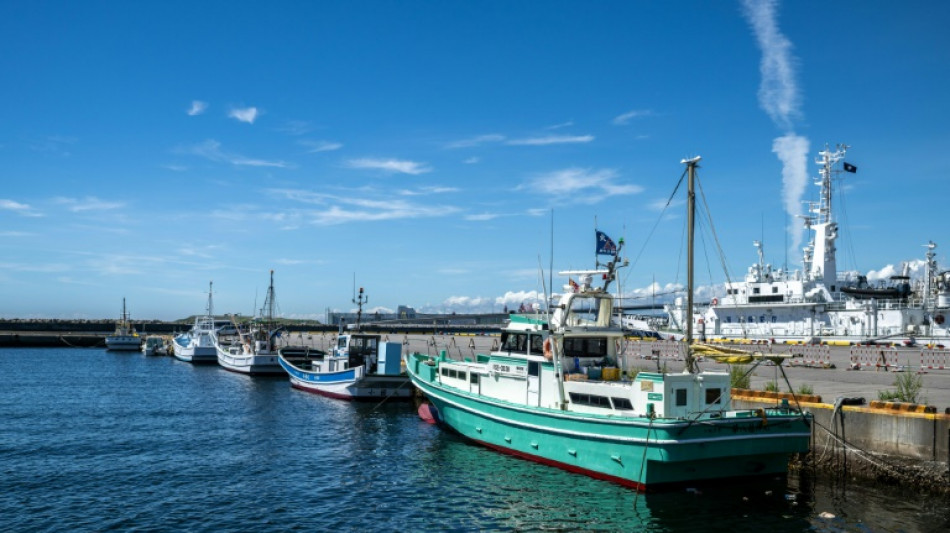
Japan to decide Tuesday on Fukushima water release / Photo: Philip FONG - AFP

The Japanese government will decide on Tuesday about the release of treated water from the crippled Fukushima nuclear plant into the sea, the government minister in charge said.
Around 1.34 million tonnes of water, equivalent to more than 500 Olympic swimming pools, have accumulated since the Fukushima plant was knocked out by an earthquake and tsunami that killed 18,000 people in 2011.
Plant operator TEPCO says that with around 1,000 steel tanks now full, space has run out and that it wants to gradually start discharging the water into the Pacific via a one-kilometre (half-a-mile) underwater pipe.
"We would like to hold a meeting of the relevant ministers tomorrow (Tuesday) in order to make a decision on the commencement of the water release after confirming the status of efforts to ensure safety and to address reputational damage," Yasutoshi Nishimura, economy, trade and industry minister, told a news conference on Monday.
"Relevant ministers will discuss and share information on what next steps should be taken, and based on these discussions, we would like to make a decision about the timing," he said.
A TEPCO official said at a separate news conference that, once the government decision is taken, the release would begin "one to two days" later.
The government had said it planned to begin releasing the water before the end of the summer.
- Diluted and filtered -
The water has collected in the past 12 years from water used to cool three melted-down reactors, combined with groundwater and rain at the site in north-east Japan.
TEPCO says that it has been diluted and filtered to remove all radioactive substances except tritium, which is far below dangerous levels.
The plan has been endorsed by the UN atomic watchdog, which said in July it would have a "negligible radiological impact on people and the environment".
"Tritium has been released (by nuclear power plants) for decades with no evidential detrimental environmental or health effects," Tony Hooker, nuclear expert from the University of Adelaide, told AFP.
Environmental pressure group Greenpeace says, however, that the filtration process is flawed and that an "immense" quantity of radioactive material will be dispersed into the sea over the coming decades.
- 'Sewer' -
Beijing has accused Tokyo of treating the ocean like a "sewer".
China -- Japan's biggest market for seafood -- has banned food shipments from 10 Japanese prefectures and imposed radiation checks on imports from elsewhere.
These time-consuming checks have already led to a 30-percent slump in Japanese seafood imports into China last month, Japanese and Chinese media reported, citing Chinese customs data.
Hong Kong, an important market for Japanese seafood exports, has also threatened restrictions.
Many in Japan's fisheries industry worry therefore that the discharge will do renewed massive damage to the reputation of Japanese seafood abroad.
"Nothing about the water release is beneficial to us," third-generation fisherman Haruo Ono, 71, whose brother was killed in 2011, told AFP in Shinchimachi, 60 kilometres (40 miles) north of the nuclear plant.
Prime Minister Fumio Kishida has promised a 30-billion-yen ($200-million) fund to compensate local fishermen for reputational damage.
He said on Monday after meeting Masanobu Sakamoto, head of the national fisheries co-operative, that the government has "made every possible preparation to ensure the safety, prevent reputational damage and help keep people's livelihood afloat, and we have been offering explanations to that end".
Japan has spent months trying to win over public opinion at home and abroad, with everything from livestreaming fish living in the treated water to efforts to counter online disinformation.
Public concern also remains high in South Korea but its government, which has sought to thaw ties with Japan, said its review of the plan found it in line with international standards.
The release of the treated water -- a maximum of 500,000 litres per day, TEPCO says -- is just one stage of the clean-up.
The far more dangerous task remains of removing radioactive debris and highly dangerous nuclear fuel from the three reactors that went into meltdown.
burs-stu/pbt
(Y.Yildiz--BBZ)