Berliner Boersenzeitung - Durban cleans up after record floods hit South Africa

EUR -
AED 4.095102
AFN 72.480008
ALL 90.801688
AMD 402.807486
ANG 1.995737
AOA 1023.635334
ARS 1721.721299
AUD 1.61933
AWG 2.007127
AZN 1.900047
BAM 1.955836
BBD 2.250342
BDT 139.162586
BGN 1.948955
BHD 0.422108
BIF 3342.96213
BMD 1.115071
BND 1.431727
BOB 13.402249
BRL 6.138357
BSD 1.117321
BTN 104.873949
BWP 15.391286
BYN 3.345962
BYR 21855.38619
BZD 2.247142
CAD 1.573644
CDF 2586.964483
CHF 0.914162
CLF 0.027822
CLP 1094.980351
CNY 7.444774
CNH 7.438418
COP 3608.76707
CRC 506.709417
CUC 1.115071
CUP 26.815498
CVE 110.267049
CZK 24.346956
DJF 198.963698
DKK 7.480457
DOP 67.891262
DZD 151.940824
EGP 59.957114
ERN 16.726061
ETB 183.378708
FJD 2.526309
FKP 0.833961
GBP 0.834166
GEL 2.893653
GGP 0.833961
GHS 13.055243
GIP 0.833961
GMD 83.077063
GNF 9896.183924
GTQ 8.538159
GYD 234.234353
HKD 8.744429
HNL 30.029558
HRK 7.547925
HTG 146.432722
HUF 363.51345
IDR 20192.258205
ILS 3.552538
IMP 0.833961
INR 104.716854
IQD 1693.83148
IRR 2108992.359359
ISK 136.919964
JEP 0.833961
JMD 177.323296
JOD 0.790629
JPY 176.710877
KES 145.192698
KGS 97.510486
KHR 4552.084602
KMF 492.86165
KPW 1003.563608
KRW 1520.737678
KWD 0.346765
KYD 0.931217
KZT 500.809308
LAK 25136.46717
LBP 100053.859534
LKR 371.556906
LRD 189.94353
LSL 18.477643
LTL 3.292514
LVL 0.674496
LYD 7.150133
MAD 10.921803
MDL 19.971371
MGA 5077.094359
MKD 61.556144
MMK 2341.311039
MNT 4015.078679
MOP 9.019368
MRU 45.108838
MUR 52.442198
MVR 17.176258
MWK 1937.436008
MXN 20.766565
MYR 4.528864
MZN 71.257178
NAD 18.477643
NGN 1502.23485
NIO 41.120764
NOK 10.548462
NPR 167.798119
NZD 2.015128
OMR 0.428348
PAB 1.117421
PEN 3.848972
PGK 5.092095
PHP 70.369926
PKR 309.016043
PLN 4.399568
PYG 6984.129802
QAR 4.084276
RON 5.343646
RSD 117.622186
RUB 91.352798
RWF 1649.13065
SAR 4.188587
SBD 8.974739
SCR 15.358485
SDG 670.719139
SEK 11.033072
SGD 1.430306
SHP 0.835103
SLE 25.591287
SLL 23382.48045
SOS 638.511867
SRD 41.908265
STD 23079.712667
STN 24.500455
SVC 9.776182
SYP 14498.149201
SZL 18.471343
THB 37.411034
TJS 10.307092
TMT 3.902748
TND 3.343362
TOP 2.684822
TRY 55.9111
TTD 7.577141
TWD 36.546782
TZS 2952.454872
UAH 50.616941
UGX 4570.084937
USD 1.115071
UYU 44.950835
UZS 13332.247784
VES 999.456181
VND 28526.296796
VUV 133.25575
WST 3.108617
XAF 655.957
XAG 0.021465
XAU 0.000274244363
XCD 3.013535
XCG 2.013637
XDR 0.788413
XOF 655.957
XPF 119.331742
YER 263.853652
ZAR 18.420333
ZMK 10036.978597
ZMW 22.703422
ZWL 359.052318
SSP 6406.644798
MXV 2.33632
  • CMSD

    -0.1200

    19.81

    -0.61%

  • JRI

    0.0000

    10.77

    0%

  • BCC

    -1.8200

    74.15

    -2.45%

  • CMSC

    -0.2228

    19.53

    -1.14%

  • BCE

    0.2000

    20.34

    +0.98%

  • RIO

    0.0100

    94.17

    +0.01%

  • AZN

    -2.7400

    161.47

    -1.7%

  • GSK

    -1.1800

    48.17

    -2.45%

  • RBGPF

    0.0000

    65

    0%

  • NGG

    0.8800

    75.82

    +1.16%

  • RYCEF

    -0.7300

    19.08

    -3.83%

  • BTI

    -0.4500

    54.4

    -0.83%

  • BP

    0.4700

    43.99

    +1.07%

  • RELX

    -0.0600

    33.18

    -0.18%

  • VOD

    -0.1800

    16.15

    -1.11%

Durban cleans up after record floods hit South Africa
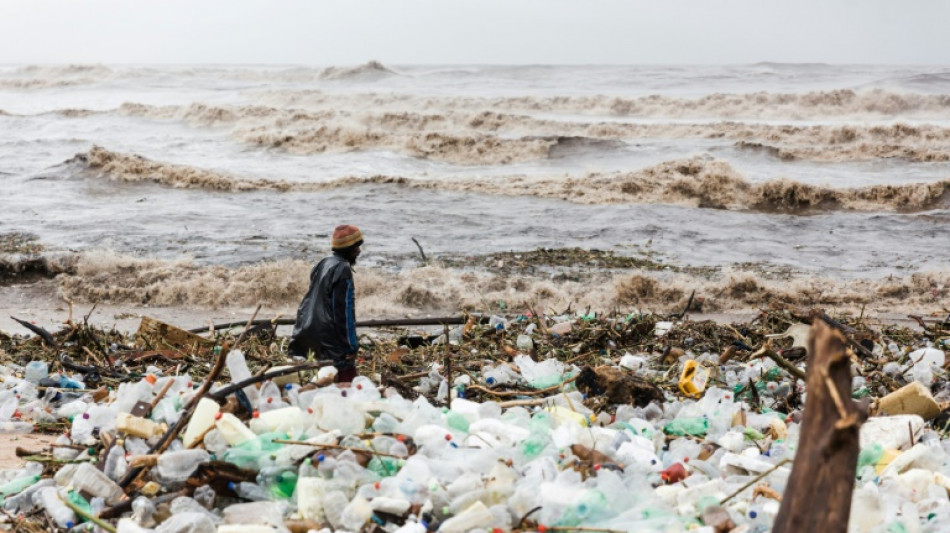
Durban cleans up after record floods hit South Africa / Photo: RAJESH JANTILAL - AFP

Durban cleans up after record floods hit South Africa

Residents on Wednesday started sifting through the remains of shattered homes after floods and landslips stoked by record rains devastated the South African city of Durban city and surrounding area, killing at least 59 and leaving many missing.

Text size:

Storms struck the southeastern province of KwaZulu-Natal as Durban, its main city, was still struggling to recover from deadly riots last July which claimed more than 350 lives.

A lull in the rain saw residents begin clearing debris from roads and fill up holes left by raging waters to allow cars pass, an AFP correspondent said.

Schools not affected by the floods re-opened Wednesday but few students turned up. A teacher at a primary in Durban's Inanda suburb said only two of 48 pupils reported for classes.

Parts of the province received more than 300 millimetres (13 inches) of rain on Monday, the heaviest one-day downpour in over 60 years, the South African Weather Service said.

"Some areas in KwaZulu-Natal have received more than double the maximum rainfall recorded during previous record rainfalls," the agency's spokeswoman, Hannelee Doubell, told AFP.

President Cyril Ramaphosa was visiting Durban on Wednesday where he was expected to declare a state of emergency.

The provincial government said the disaster "wreaked untold havoc and unleashed massive damage to lives and infrastructure."

"This is a tragic toll of the force of nature and this situation calls for an effective response by government," Ramaphosa said late Tuesday.

Days of driving rain flooded several areas, tore houses apart and ravaged infrastructure across the city, while landslides forced train services to be suspended across the province.

The rains flooded highways to such depths that only the tops of traffic lights poked out, resembling submarine periscopes.

Torrents tore several bridges apart, submerged cars and collapsed houses. A fuel tanker floated at sea after being swept off the road.

Several stacked shipping containers fell like dominoes and lay strewn round a yard, while some spilled onto a main road in the city, one of southern Africa's largest gateways to the sea.

More than 2,000 houses and 4,000 "informal" homes, or shacks, were damaged.

Rescue operations, aided by the military, evacuated people trapped in the worst-affected areas.

The city had only just recovered from July's rioting which saw shopping malls looted and warehouses set on fire, in South Africa's worst unrest since the end of apartheid.

After TV footage showed people stealing from shipping containers, the provincial government condemned "reports of the looting of containers" during the flooding.

Southern parts of the continent's most industrialised country are bearing the brunt of climate change -- suffering recurrent and worsening torrential rains and flooding.

Floods killed around 70 people in April 2019.

"We know it's climate change getting worse, it's moved from 2017 with extreme storms to supposedly having record floods in 2019, and now 2022 clearly exceeding that," University of Johannesburg development studies professor Mary Galvin said.

The South African Weather Service admitted "the exceptionally heavy rainfall... exceeded even the expectations".

(F.Schuster--BBZ)