Berliner Boersenzeitung - Two dead as cyclone batters Bangladesh and India

EUR -
AED 4.108631
AFN 72.718912
ALL 91.057672
AMD 404.138689
ANG 2.002333
AOA 1027.018171
ARS 1729.020675
AUD 1.621656
AWG 2.01376
AZN 1.909959
BAM 1.9623
BBD 2.256686
BDT 139.622493
BGN 1.955396
BHD 0.423298
BIF 3352.386487
BMD 1.118756
BND 1.435763
BOB 13.446541
BRL 6.151029
BSD 1.120471
BTN 105.220538
BWP 15.434677
BYN 3.355395
BYR 21927.614131
BZD 2.253477
CAD 1.576965
CDF 2595.514018
CHF 0.915886
CLF 0.027676
CLP 1089.229942
CNY 7.469377
CNH 7.462745
COP 3634.311854
CRC 508.137914
CUC 1.118756
CUP 26.891216
CVE 110.631461
CZK 24.354245
DJF 199.524609
DKK 7.475521
DOP 68.082658
DZD 152.34438
EGP 60.323863
ERN 16.781337
ETB 183.895683
FJD 2.534654
FKP 0.837714
GBP 0.834105
GEL 2.903189
GGP 0.837714
GHS 13.098388
GIP 0.837714
GMD 83.349337
GNF 9924.082884
GTQ 8.566376
GYD 235.008454
HKD 8.772763
HNL 30.114216
HRK 7.572869
HTG 146.824481
HUF 362.904219
IDR 20227.10528
ILS 3.543715
IMP 0.837714
INR 104.958595
IQD 1699.429275
IRR 2115962.181879
ISK 136.801282
JEP 0.837714
JMD 177.827184
JOD 0.793248
JPY 176.701327
KES 145.360104
KGS 97.835187
KHR 4564.917673
KMF 494.489717
KPW 1006.880197
KRW 1505.8227
KWD 0.347799
KYD 0.933863
KZT 502.232426
LAK 25207.443957
LBP 100335.927717
LKR 372.606055
LRD 190.571258
LSL 18.529735
LTL 3.303395
LVL 0.676724
LYD 7.17029
MAD 10.957897
MDL 20.027674
MGA 5091.407518
MKD 61.518753
MMK 2348.779066
MNT 4028.825441
MOP 9.049175
MRU 45.236008
MUR 52.670582
MVR 17.220986
MWK 1942.897957
MXN 20.773283
MYR 4.540802
MZN 71.483847
NAD 18.53015
NGN 1509.816716
NIO 41.23669
NOK 10.521328
NPR 168.271169
NZD 1.99359
OMR 0.430195
PAB 1.121114
PEN 3.861692
PGK 5.106565
PHP 70.755733
PKR 309.88721
PLN 4.384796
PYG 7003.819206
QAR 4.097774
RON 5.34374
RSD 117.634953
RUB 92.081868
RWF 1653.81688
SAR 4.207099
SBD 9.004399
SCR 15.485136
SDG 672.932625
SEK 10.994707
SGD 1.431901
SHP 0.837862
SLE 25.675065
SLL 23459.75515
SOS 640.326286
SRD 42.04676
STD 23155.986777
STN 24.570077
SVC 9.80849
SYP 14546.062858
SZL 18.523417
THB 37.472739
TJS 10.341155
TMT 3.915645
TND 3.354411
TOP 2.693695
TRY 56.138502
TTD 7.598536
TWD 36.737143
TZS 2959.106924
UAH 50.759638
UGX 4585.188208
USD 1.118756
UYU 45.099389
UZS 13376.308356
VES 1002.759193
VND 28545.614202
VUV 133.425135
WST 3.118894
XAF 655.957
XAG 0.02122
XAU 0.000272275241
XCD 3.023494
XCG 2.020292
XDR 0.791018
XOF 655.957
XPF 119.331742
YER 264.725556
ZAR 18.395545
ZMK 10070.139615
ZMW 22.767427
ZWL 360.238919
SSP 6427.512117
MXV 2.335285
  • CMSD

    -0.1200

    19.81

    -0.61%

  • JRI

    0.0000

    10.77

    0%

  • BCC

    -1.8200

    74.15

    -2.45%

  • CMSC

    -0.2228

    19.53

    -1.14%

  • BCE

    0.2000

    20.34

    +0.98%

  • RIO

    0.0100

    94.17

    +0.01%

  • AZN

    -2.7400

    161.47

    -1.7%

  • GSK

    -1.1800

    48.17

    -2.45%

  • RBGPF

    0.0000

    65

    0%

  • NGG

    0.8800

    75.82

    +1.16%

  • RYCEF

    -0.7300

    19.08

    -3.83%

  • BTI

    -0.4500

    54.4

    -0.83%

  • BP

    0.4700

    43.99

    +1.07%

  • RELX

    -0.0600

    33.18

    -0.18%

  • VOD

    -0.1800

    16.15

    -1.11%

Two dead as cyclone batters Bangladesh and India
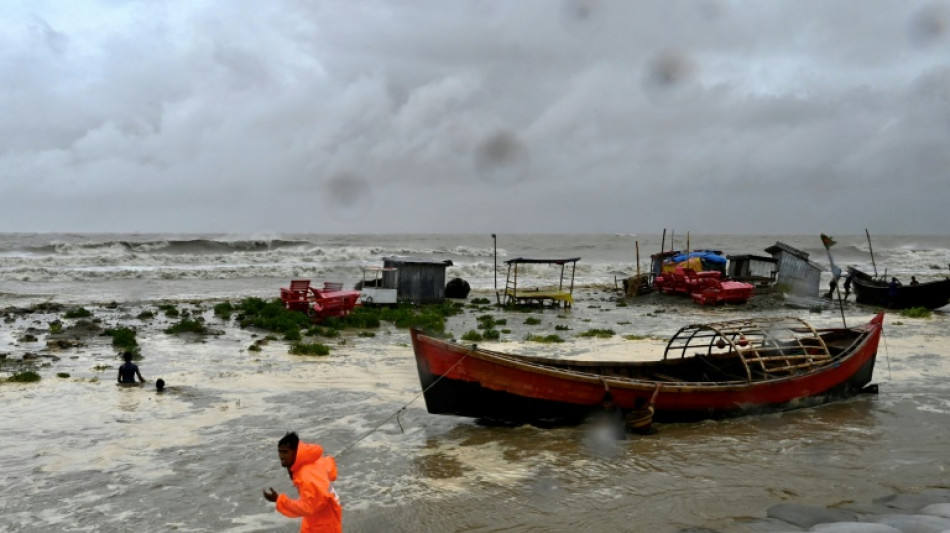
Two dead as cyclone batters Bangladesh and India / Photo: Munir Uz Zaman - AFP

Two dead as cyclone batters Bangladesh and India

Fierce gales and crashing waves smashed into the low-lying coast of Bangladesh and India on Monday, as an intense cyclone started to weaken as it progressed deeper inland.

Text size:

Two people have been killed since Cyclone Remal made landfall on Sunday night, Kamrul Hasan, secretary of Bangladesh's disaster management ministry, told AFP.

Communications are limited by the storm, with recorded wind speeds hitting 111 kilometres (69 miles) per hour, said Muhammad Abul Kalam Mallik, senior weather forecaster at the state-run Bangladesh Meteorological Department.

"The severe cyclone will continue to pound Bangladesh coast until 10:00 am (0400 GMT)," Mallik told AFP.

"The cyclone has unleashed heavy rains in many parts of Bangladesh. After more rains, the severe cyclone will weaken and turn into a storm."

Cyclones have killed hundreds of thousands of people in Bangladesh in recent decades, but the number of superstorms hitting its densely populated coast has increased sharply, from one a year to as many as three, due to the impact of climate change.

An AFP reporter in the affected area said there had been continuous heavy rain with extreme wind since Sunday evening, battering tall buildings, with trees uprooted and the tin roofs of homes torn off and blown away.

Around a million people in Bangladesh and neighbouring India took shelter, fleeing inland for concrete storm shelters away from the dangerous waves.

Most of Bangladesh's coastal areas are just a metre or two (three to six feet) above sea level and high storm surges can devastate villages.

- 'Villages are flooded' -

Authorities have raised the danger signal to its highest level.

Hasan, from the disaster management ministry, told AFP, said there were no immediate reports of damages, but said "embankments in several places have been breached or submerged, inundating some coastal areas".

But in India's West Bengal, the "cyclone has blown off the roofs of hundreds of houses", and also "uprooted thousands of mangrove trees and electricity poles", senior state government minister Bankim Chandra Hazra told AFP.

Electricity was off across large parts of the affected areas.

"Storm surges and rising sea levels have breached a number of embankments," Hazra added. "Some island villages are flooded."

At least 800,000 Bangladeshis fled their coastal villages, while more than 150,000 people in India also moved inland from the vast Sundarbans mangrove forest, where the Ganges, Brahmaputra and Meghna rivers meet the sea, government ministers and disaster officials said.

Mallik, the Bangladeshi weather expert, said the vast mangrove forests of the Sundarbans helped dissipate the worst of the storm.

"Like in the past, the Sundarbans acted as a natural shield to the cyclone," he said.

While scientists say climate change is fuelling more storms, better forecasting and more effective evacuation planning have dramatically reduced the death toll.

(B.Hartmann--BBZ)