Berliner Boersenzeitung - 35 years later, beloved East German car still sputters on

EUR -
AED 4.235108
AFN 72.638695
ALL 95.986116
AMD 435.092592
ANG 2.063949
AOA 1057.292369
ARS 1577.236365
AUD 1.673475
AWG 2.078266
AZN 1.958134
BAM 1.955386
BBD 2.320668
BDT 141.373711
BGN 1.970817
BHD 0.435957
BIF 3424.38207
BMD 1.152991
BND 1.480725
BOB 7.979516
BRL 6.049975
BSD 1.152186
BTN 108.575339
BWP 15.841123
BYN 3.460157
BYR 22598.615681
BZD 2.317349
CAD 1.59725
CDF 2635.149736
CHF 0.916506
CLF 0.027072
CLP 1068.948607
CNY 7.966185
CNH 7.980055
COP 4255.61911
CRC 534.200663
CUC 1.152991
CUP 30.554251
CVE 110.542933
CZK 24.511426
DJF 204.909943
DKK 7.471979
DOP 68.605777
DZD 153.395731
EGP 60.817599
ERN 17.294859
ETB 181.192506
FJD 2.594811
FKP 0.862247
GBP 0.865314
GEL 3.107286
GGP 0.862247
GHS 12.636424
GIP 0.862247
GMD 84.719455
GNF 10120.377686
GTQ 8.814361
GYD 241.055175
HKD 9.023247
HNL 30.577003
HRK 7.535828
HTG 150.891941
HUF 388.338432
IDR 19510.445669
ILS 3.602059
IMP 0.862247
INR 108.645093
IQD 1510.417681
IRR 1514222.549315
ISK 143.339936
JEP 0.862247
JMD 181.081615
JOD 0.817484
JPY 184.182756
KES 149.773716
KGS 100.828779
KHR 4629.257123
KMF 492.326899
KPW 1037.758177
KRW 1739.332384
KWD 0.35421
KYD 0.960221
KZT 555.084372
LAK 25063.132529
LBP 103250.307387
LKR 362.372615
LRD 211.803486
LSL 19.658594
LTL 3.404482
LVL 0.697433
LYD 7.35573
MAD 10.768576
MDL 20.238324
MGA 4813.735514
MKD 61.653053
MMK 2421.261549
MNT 4132.119635
MOP 9.284814
MRU 46.246593
MUR 53.751971
MVR 17.825775
MWK 2001.591211
MXN 20.574308
MYR 4.605027
MZN 73.687834
NAD 19.658789
NGN 1598.632905
NIO 42.337441
NOK 11.175356
NPR 173.720942
NZD 2.002185
OMR 0.443309
PAB 1.152181
PEN 3.988767
PGK 4.968807
PHP 69.448107
PKR 321.972295
PLN 4.27801
PYG 7540.995323
QAR 4.215912
RON 5.097026
RSD 117.441351
RUB 93.822176
RWF 1683.36627
SAR 4.326033
SBD 9.272321
SCR 15.995702
SDG 692.947394
SEK 10.884917
SGD 1.482394
SHP 0.865042
SLE 28.306224
SLL 24177.648784
SOS 658.93198
SRD 43.308612
STD 23864.577457
STN 24.616349
SVC 10.082038
SYP 128.492581
SZL 19.658268
THB 38.014217
TJS 11.02665
TMT 4.046997
TND 3.370773
TOP 2.776124
TRY 51.145977
TTD 7.820546
TWD 36.875174
TZS 2968.95063
UAH 50.55856
UGX 4286.184377
USD 1.152991
UYU 46.710504
UZS 14054.955391
VES 537.314539
VND 30382.455194
VUV 137.232784
WST 3.170183
XAF 655.832201
XAG 0.01708
XAU 0.000263
XCD 3.116015
XCG 2.076605
XDR 0.813367
XOF 653.172449
XPF 119.331742
YER 275.161365
ZAR 19.752487
ZMK 10378.307533
ZMW 21.632883
ZWL 371.262501
  • CMSC

    -0.1450

    22.765

    -0.64%

  • BCC

    -0.8600

    73.79

    -1.17%

  • RBGPF

    -13.5000

    69

    -19.57%

  • BCE

    -0.0300

    25.46

    -0.12%

  • RIO

    -1.7450

    85.795

    -2.03%

  • BTI

    -0.2650

    58.185

    -0.46%

  • BP

    0.6650

    46.075

    +1.44%

  • GSK

    -0.5500

    54.15

    -1.02%

  • NGG

    -1.8750

    82.415

    -2.28%

  • RELX

    -0.4150

    32.055

    -1.29%

  • RYCEF

    -0.6000

    15.3

    -3.92%

  • CMSD

    0.0550

    22.735

    +0.24%

  • AZN

    -4.0100

    183.13

    -2.19%

  • JRI

    -0.0100

    12.09

    -0.08%

  • VOD

    -0.0450

    14.675

    -0.31%

35 years later, beloved East German car still sputters on
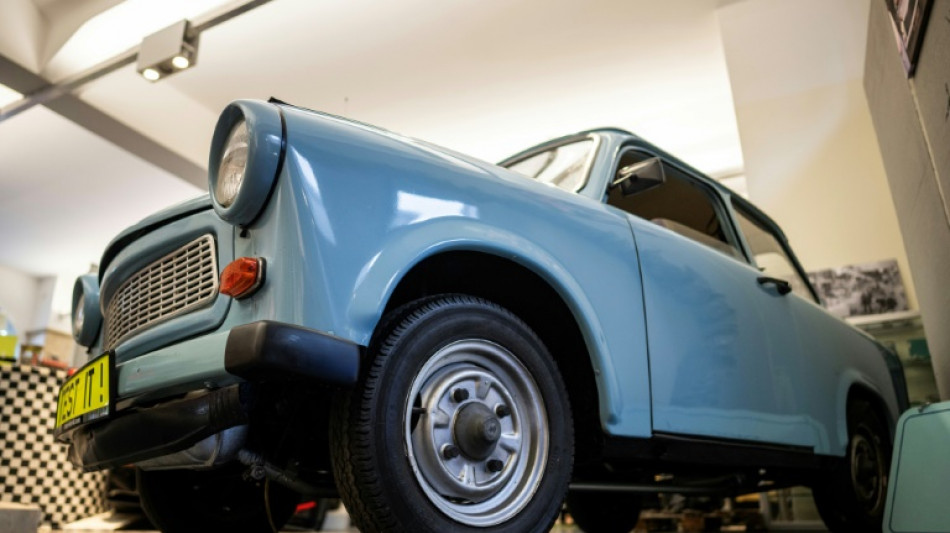
35 years later, beloved East German car still sputters on / Photo: John MACDOUGALL - AFP

35 years later, beloved East German car still sputters on

With its boxy design, cramped interior and notorious clouds of blue smoke billowing from its exhaust, the Trabant is often referred to as the worst car ever made.

Text size:

But somehow the plucky East German vehicle has refused to die out, with a dedicated group of enthusiasts still devoted to keeping refurbished models on the road.

As Germany prepares to celebrate 35 years of reunification on Friday, the number of Trabis on the streets is actually on the rise as the old rattletraps gain a new legion of fans.

There are around 40,800 so-called Trabis registered in Germany today, according to the KBA federal transport authority -- compared with about 33,000 ten years ago.

Glenn Kuschan, 58, counts several Trabant owners among the customers at his car repair shop south of Berlin.

They include "all sorts", Kuschan told AFP, from "older people who grew up with (Trabis) to young people who really want an original vehicle".

Kuschan is the proud owner of 23 Trabis himself, including a white model that once belonged to his father and has clocked up more than 500,000 kilometres (nearly 311,000 miles).

The Trabi has achieved "cult status" because of its association with German reunification and the fall of the Berlin Wall, he said.

The first Trabis were produced in 1957, three years after the communist East German regime decided to create a car for the people.

The bodywork was made of plastic mixed with paper or cotton fibre to save on steel imports.

The backseat windows did not open and the noisy two-stroke engine sent thick clouds of burnt oil and gasoline into the air.

The car's top speed of 112 kilometres (70 miles) per hour made it a laughing stock in West Germany, where the likes of BMW and Mercedes owned the road.

But the car nonetheless became a beloved symbol of everyday life in East Germany, praised for its quirky design and durability.

- 'Indestructible' -

East Germans would put their name on a list and wait up to 15 years for their Trabant to come off the assembly line in one of three colours -- ivory, sky blue or peppermint green.

When the Berlin Wall fell in 1989, many East Germans drove to the border and sat in long queues in their Trabis with the engines spewing out fumes as they waited to cross.

After reunification, many East Germans sold the cars in favour of more sophisticated models, while thousands simply gave them away or abandoned them at the border.

The last Trabant, a candy pink model, was produced in 1991.

Today, visitors to the Trabi Museum in Berlin can browse a collection of 20 of the little cars and even take a Trabant tour through the city.

Participants get to feel the thrill of driving a Trabi themselves as they are guided past some of Berlin's most famous communist landmarks.

Thomas Schmidt, 49, who works at the museum and as a driver on the tours, said he "practically grew up in a Trabi" and now sees the car as "part of my identity".

"It's like a little endurance runner, it can do anything, it's indestructible," he said.

"And if it does break, the nice thing is that you can repair everything yourself", he said, due to the "simple technology".

"People used to say: if you have a hammer, pliers and some wire, you can get to Leningrad."

(Y.Berger--BBZ)