'I know it's immoral': Child workers still common in Pakistan / Photo: Rizwan TABASSUM - AFP

From the age of 10, Amina has been scrubbing, sweeping and cooking in a middle-class home in Pakistan's megacity of Karachi.
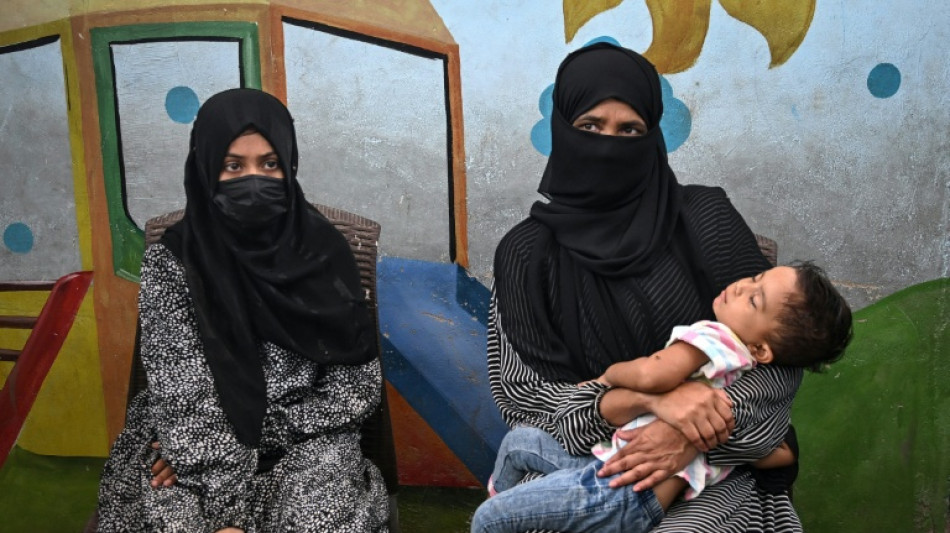
Like millions of Pakistani children, she is a household helper, an illegal but common practice that brings grief to families often too poor to seek justice.
"Alongside my mother, I cut vegetables, wash dishes, sweep the floor and mop. I hate working for this family," said the 13-year-old, who leaves her slum neighbourhood in Karachi at 7 am and often returns after dark.
"Sometimes we work on Sundays even though it's supposed to be our only day off, and that's really unfair."
One in four households in a country of 255 million people employs a child as a domestic worker, mostly girls aged 10 to 14, according to a 2022 report by the International Labour Organization (ILO).
Sania, 13, earns $15 a month helping her mother maintain a sprawling luxury home in the city, where she has been explicitly forbidden to speak to her employer's children or touch their toys.
AFP is not publishing the full names of children and parents interviewed to protect their identities.
Sania gets half the salary of her mother for the same hours, together earning $46 -- far below the minimum wage of 40,000 rupees ($140).
"I dreamed of finishing school and becoming a doctor," said the eldest of five siblings who, according to the law, should be in school until the age of 16.
- 'I know it's immoral' -
A university professor who spoke to AFP on condition of anonymity employs a 10-year-old boy because children are "cheaper and more docile".
"I know it's immoral and illegal to employ a child, but at least he has a roof and is well fed here," he said.
Hamza was sent by his parents to live with the professor in Karachi -- a 450-kilometre (280-mile) journey from his impoverished village, to which he returns only a few times a year.
His monthly salary of $35 is paid directly to his father.
"In the village, his poor parents would likely have sent him to the fields without even being able to feed him," the professor said, while also acknowledging that he feels "uneasy" when his own children go to school and Hamza stays behind to clean.
There is no unified definition of a child or child labour in Pakistan, although a federal law prohibits children under the age of 14 from working in unsafe and hazardous environments, such as factories.
In Sindh province, of which Karachi is the capital, employing a child as a domestic maid can lead to a maximum of one year in jail or a fine of up to 50,000 rupees ($177). However, few are prosecuted.
Kashif Mirza from the NGO Sparc, one of the leading child rights organisations, described it as a form of "modern slavery widely accepted in Pakistani society that makes them particularly vulnerable".
"Society prefers to hire child domestic labour because they are cheap and more obedient, and employers make the argument that they are also safeguarding them, which is not true and illegal," he told AFP.
- 'I had no choice' -
Iqra, a 13-year-old child worker, died in February from blows by her wealthy employers in Rawalpindi, Islamabad's twin city, because chocolate had disappeared from their kitchen.
Her father, Sana, who said after her death that he would seek to prosecute the employers, instead told AFP that he forgave them.
Under Islamic law, which operates alongside common law in Pakistan, the family of a killed relative can accept financial compensation from the perpetrators in exchange for forgiveness, leaving them free from prosecution.
"I had no choice. Where would I have found the money to pay legal fees? I already have more than 600,000 rupees ($2,120) in debt," he said.
"There was also some pressure from the family's relatives to pardon them, and I eventually agreed," he said.
He told AFP that he had not taken any money from the family, highly unusual under Islamic law.
He brought home his other two daughters and two sons after Iqra's death.
"I stopped sending them because I cannot bear the thought of losing another child," he said.
- Burned with an iron -
"The penalties are not strict enough," for both employers and parents, said Mir Tariq Ali Talpur, the social affairs minister for rural and impoverished Sindh.
He told AFP that authorities regularly conduct checks and take charge of young children employed illegally, but the courts often return them to their parents after a small fine of around $3.50.
"That's why these incidents keep happening again and again," he said.
A Karachi couple accused of burning a 13-year-old domestic worker named Zainab with an iron was given bail for a fee of around $105 each in September.
"I don't understand how they could be free. Doesn't anyone see Zainab's injuries?" said the teen's mother Asia, pointing to severe burns on her daughter's arms, legs, back and stomach.
Asia, who is pursuing the offenders legally, acknowledges that they are "rich and think they're untouchable".
"The poor like us have no power," she said.
(A.Berg--BBZ)