Berliner Boersenzeitung - Brazil megacity Sao Paulo struck by fresh water crisis

EUR -
AED 4.236015
AFN 75.551379
ALL 93.057443
AMD 422.178264
AOA 1057.706693
ARS 1728.28
AUD 1.635579
AWG 2.076197
AZN 1.959441
BAM 1.953848
BBD 2.325087
BDT 142.637512
BHD 0.435378
BIF 3448.230118
BMD 1.153443
BND 1.477256
BOB 13.737277
BRL 5.892878
BSD 1.154352
BTN 109.953349
BWP 15.551869
BYN 3.431986
BYR 22607.47819
BZD 2.321691
CAD 1.607213
CDF 2618.890393
CHF 0.935736
CLF 0.026821
CLP 1055.596554
CNY 7.782974
CNH 7.782722
COP 3622.560019
CRC 524.092359
CUC 1.153443
CUP 30.566233
CVE 110.15496
CZK 24.250038
DJF 205.564651
DKK 7.475613
DOP 67.304808
DZD 153.213197
EGP 57.981957
ERN 17.301641
ETB 186.667692
FJD 2.551934
FKP 0.852829
GBP 0.854182
GEL 3.010336
GGP 0.852829
GHS 13.552462
GIP 0.852829
GMD 84.779951
GNF 10138.004449
GTQ 8.808048
GYD 241.758495
HKD 9.050506
HNL 30.944027
HRK 7.533153
HTG 150.942487
HUF 365.817254
IDR 20579.725809
ILS 3.464625
IMP 0.852829
INR 110.085029
IQD 1512.289294
IRR 1585666.604091
ISK 142.196729
JEP 0.852829
JMD 183.332423
JOD 0.817808
JPY 183.840894
KES 149.220988
KGS 100.868705
KHR 4680.425919
KMF 491.367
KRW 1634.987876
KWD 0.35638
KYD 0.962039
KZT 538.192371
LAK 26070.956337
LBP 103375.580761
LKR 386.893512
LRD 208.354638
LSL 18.678541
LTL 3.405817
LVL 0.697706
LYD 7.356651
MAD 10.764946
MDL 20.063045
MGA 4944.18958
MKD 61.463601
MMK 2421.58125
MNT 4146.39691
MOP 9.328681
MRU 46.30315
MUR 54.257544
MVR 17.820789
MWK 2001.752407
MXN 19.778773
MYR 4.719904
MZN 73.710788
NAD 18.678541
NGN 1571.530811
NIO 42.478487
NOK 10.931079
NPR 175.936586
NZD 1.964388
OMR 0.4435
PAB 1.154347
PEN 3.899305
PGK 5.10399
PHP 70.667964
PKR 320.487337
PLN 4.300207
PYG 6871.165813
QAR 4.208196
RON 5.241188
RSD 117.358193
RUB 94.582717
RWF 1695.857377
SAR 4.319939
SBD 9.303319
SCR 15.828578
SDG 692.647756
SEK 10.970042
SGD 1.477762
SLE 28.373415
SOS 659.76095
SRD 43.543039
STD 23873.936439
STN 24.475974
SVC 10.10091
SZL 18.675425
THB 38.240663
TJS 10.660381
TMT 4.048584
TND 3.38392
TRY 55.065771
TTD 7.830178
TWD 37.224487
TZS 3056.621
UAH 51.784117
UGX 4299.704797
USD 1.153443
UYU 46.503344
UZS 13774.24018
VES 871.72867
VND 30146.956822
VUV 137.084112
WST 3.153204
XAF 655.319411
XAG 0.017819
XAU 0.000264
XCD 3.117237
XCG 2.080522
XDR 0.815007
XOF 655.305221
XPF 119.331742
YER 274.984033
ZAR 18.746211
ZMK 10382.370012
ZMW 21.592524
ZWL 371.4081
  • CMSC

    -0.1738

    21.57

    -0.81%

  • NGG

    -1.4000

    79.48

    -1.76%

  • CMSD

    -0.1300

    21.69

    -0.6%

  • RYCEF

    -0.2800

    20.57

    -1.36%

  • RBGPF

    -0.6200

    69.88

    -0.89%

  • RIO

    0.8100

    101.91

    +0.79%

  • VOD

    -0.4400

    15.75

    -2.79%

  • BCE

    -0.2100

    22.54

    -0.93%

  • RELX

    0.1000

    35.62

    +0.28%

  • GSK

    -0.8000

    52.16

    -1.53%

  • AZN

    0.4900

    161.91

    +0.3%

  • BCC

    -1.8500

    84.75

    -2.18%

  • JRI

    -0.0800

    12.73

    -0.63%

  • BTI

    -2.2800

    57.05

    -4%

  • BP

    1.2500

    42.88

    +2.92%

Brazil megacity Sao Paulo struck by fresh water crisis
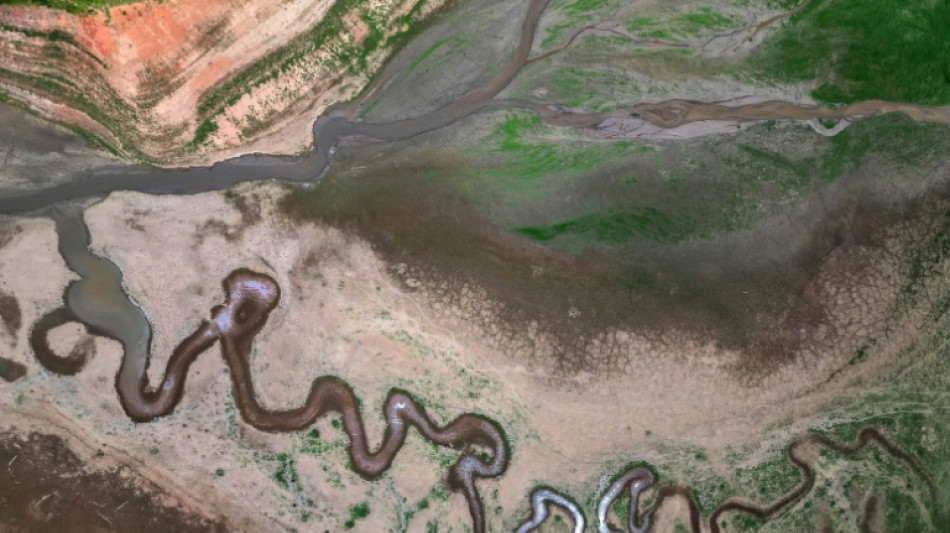
Brazil megacity Sao Paulo struck by fresh water crisis / Photo: Nelson ALMEIDA - AFP

Brazil megacity Sao Paulo struck by fresh water crisis

Brazil's megalopolis Sao Paulo faces a new water crisis as the lowest rainfall in a decade has turned its main reservoir into mere streams surrounded by cracked earth, prompting water rationing.

Text size:

Home to 22 million people, it is the most populous urban area in Latin America. Sao Paulo is often ranked alongside cities like Mexico City, Cape Town and Chennai that are extremely vulnerable to water shortages.

Sao Paulo has experienced three consecutive years of below average rainfall, according to INMET, Brazil's meteorological agency.

The nation's water and sanitation agency, ANA, reports that Sao Paulo's main reservoir, which supplies nine million people, is operating at less than 18 percent of its capacity.

This is approaching levels seen during a severe drought in 2014 when Sao Paulo's reservoirs faced collapse amid one of the worst droughts in decades to hit the region.

Much of the reservoir is dry, with only meager streams of water crisscrossing its surface and parched earth cracking on the sides, an AFP reporter witnessed.

"From August onward the water kept dropping and dropping. It's very frightening, every day we see it shrinking," said Daniel Bacci, owner of an inn next to the Jaguari–Jacarei reservoir told AFP.

"There was a little rain last week, but it wasn't enough to raise the water level."

In October, the Sao Paulo state government announced new rationing measures that could see water pressure in pipelines reduced for up to 16 hours a day, compared to 12 currently.

If water levels near zero, rolling shutdowns of water to different regions will be implemented.

In recent years, scientists have warned of hotspots around the globe where extreme drought can trigger shortages of drinking water -- often in densely populated areas with poor management of the water supply system.

South Africa's Cape Town faced the threat of a "Day Zero Drought," where the taps nearly ran dry for millions of people in 2018. India's Chennai faced a similar crisis the following year.

In 2023, residents of Uruguay's capital of Montevideo turned en masse to bottled water as reservoirs dropped so low that authorities had to mix brackish river water into the drinking supply and up the allowed levels of sodium and chloride.

Brazil is home to 12 percent of the entire planet's freshwater, but much of this lies in the Amazon and not major population centers.

Pollution, rapid urban growth and leaky infrastructure have also exacerbated the problem.

(F.Schuster--BBZ)