Hooked on the claw: how crane games conquered Japan's arcades / Photo: Philip FONG - AFP

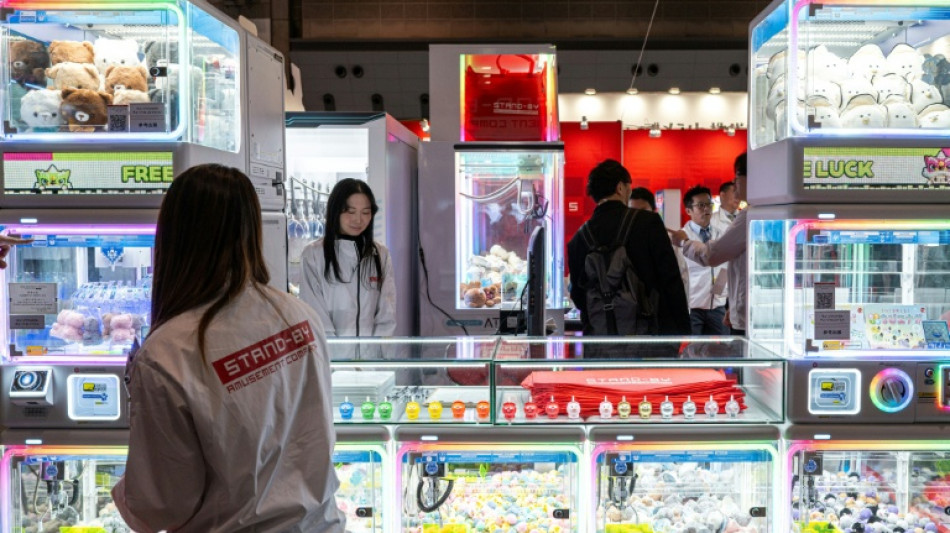
As school and work wrap up, crowds fill Tokyo's many bustling arcade halls -- not to battle it out in fighting games, but to snag plush toys from claw machines.
In one of these gaming meccas in the Japanese capital's Ikebukuro district, aisles of crane games stretch as far as the eye can see.
The crown jewels of the arcade industry, they occupy the building's first two floors, relegating video games to the basement and upper levels.
"Crane games are keeping the sector afloat," said Morihiro Shigihara, an industry expert and former arcade manager.
"Arcade operators, machine manufacturers, and even prize suppliers depend on this business," he told AFP.
Some 80 percent of the 22,000 arcades Japan had in 1989 have shut down, but revenues have held up thanks to claw machines, according to the Japan Amusement Industry Association.
Their share of revenue has climbed since 1993 from 20 percent to more than 60 percent, the association said.
Suzuna Nogi, a 20-year-old student, visits these arcades at least twice a week in search of "big plushies" on which she can spend up to 3,000 yen ($19) at 100 yen per try.
"What I like best is the sense of accomplishment," she said, even though there is no guarantee of success.
Nogi added that she enjoys "the thrill of not knowing whether you'll manage to grab something or not".
The sensitivity of the claw arms is adjusted by operators "based on the cost of the prizes and revenue targets", Shigihara said.
"You can also make the game easier to compete with a nearby arcade."
- From cigarettes to candy -
This year, the industry is officially celebrating the 60th anniversary of these construction crane-inspired machines in Japan.
But they have actually been around since before World War II, said Benoit Bottos, who wrote his doctoral dissertation on the subject at Japan's Chuo University.
Older models, installed in cafes or bowling alleys, sometimes offered lighters and cigarettes, but those prizes quickly gave way to children's candy.
In the late 1980s, the machines began to gain traction, notably with game company Sega's 1985 invention of the "UFO Catcher", which switched up the older version that forced players to lean in and look down.
"The old ones were a bit dark. So we opted for a brighter, showcase-like style where you can see the prizes right in front of you," said Takashi Sasaya, a Sega executive.
But the real stroke of genius "was putting plush toys in the claw games", said Bottos.
Manufacturing giants like Sega or Bandai, involved in both video games and toys, then began negotiating licenses for anime and manga characters, with Sega notably securing Disney rights.
"That largely explains the success of these machines," said Bottos, who describes them as "somewhere between a vending machine, a game of chance and a game of skill".
- 'Transformation' -
The success of claw games also feeds on Japan's booming fan culture of "oshikatsu", with many people devoting more and more time and money to supporting their favourite idol.
Part of asserting their fan identity involves collecting character merchandise.
"I love Pokemon, so I often come looking for plush toys and merch from the franchise," said professional Pokemon card player Akira Kurasaki, showing off nails decorated with his most beloved characters.
Arcade operators have taken this enthusiasm to heart, tailoring their prize selections to the demographics of their neighbourhood and organising events around certain characters.
"New prizes are introduced almost every day," said Sasaya, the Sega executive.
The hegemony of claw machines has also gone hand in hand with a gradual transformation of urban hangouts.
Arcades -- seen in the 1970s and 1980s as dark, male-dominated places linked to crime -- "tried to attract a new audience" of women and families, Bottos said.
"The crane game is emblematic of that transformation."
(S.G.Stein--BBZ)