In Sicily, drones at work to predict volcanic eruptions / Photo: Marco Bertorello - AFP

Hovering over the volcano, a buzzing drone pauses in front of a laser beam on the crater's edge, as researchers test whether the devices can measure gases to predict eruptions.
On the Aeolian island of Vulcano, off the coast of Sicily, German researcher Marius Schaab, from the Technical University of Munich (TUM), stands next to a gas sensor mounted on a tripod, waiting for the drone his colleague has just launched to draw closer.
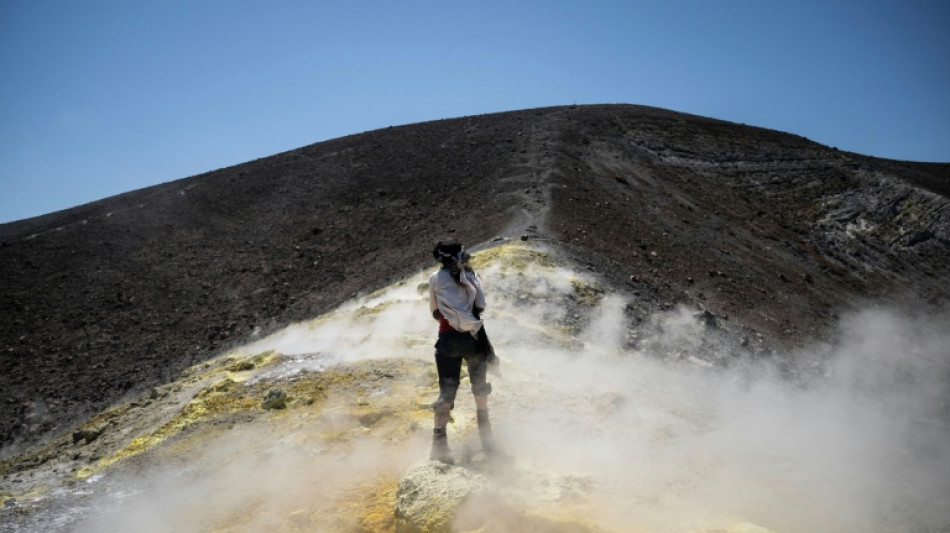
In this remote lunar landscape, where hot volcanic gases and steam smelling of sulphur rise eerily from the earth, the small propeller-driven device catches the eye.
The last eruption of the island's Grand Crater occurred in the late 19th century but the volcano continues to show intense degassing activity -- to the awe of the visitors who are allowed to walk around the rim.
Soon, the drone positions itself along the axis of the sensor, which transmits an invisible laser beam that passes through the volcanic gas emissions before being reflected by the drone, and travelling back.
The sensor works by "sending a laser beam through some gas and then onto some reflector that measures the intensity of the driving light", Schaab said,
The drone can move around and switch angles to take full measurements.
Using a laser allows the sensor to avoid the gas plume, the researcher told AFP.
"Our drone flies behind the plume and also our ground unit is not in the plume," said Schaab, noting that the corrosive nature of the plume would require any sensor inside it to be constantly recalibrated.
Based on the signals sent back to the sensor, an algorithm calculates a map of gas concentration in the 10 or 15 minutes it takes for the drone to follow a predefined path at a distance of up to 60 metres (nearly 200 feet).
- First tries -
Although drones have been used in monitoring volcanoes for about 15 years, scientists are now looking to develop gas measurement tools that are increasingly accurate and risk-free.
Further around the crater, another team of German scientists from the University of Mainz is using sensors carried on a drone to measure concentrations of chemical substances in the air.
"One reason for measuring gases and particles is to better understand the impact of volcanic eruptions and volcanic emissions on the atmosphere," said Tjarda Roberts, a researcher at the National Centre for Scientific Research (CNRS) in Paris, who is collaborating with the Mainz team.
"Another reason is to anticipate volcanic eruptions, because the gas composition can change before an eruption occurs," she said.
The greater the pressure exerted by lava rising from inside the Earth towards the surface, the larger the amount of gas released.
It is the first time the team from TUM has tested its drone system -- which can work at altitudes up to 3,000 metres -- on a volcano.
– Great flexibility –
A checklist in hand, Jonas Krajewski, a student at the Johannes Gutenberg University Mainz, checks that "Tina" -– the name given to the drone –- is ready to fly safely.
Soon, the drone weighing 2.5 kilograms (5.5 pounds) lifts into the air and heads towards the rising gases.
This time, following a predefined flight path lasting up to 40 minutes, the drone flies into the heart of the fumaroles, or vents where the gases and vapour escape and where temperatures range between 100 and 140C.
"Tina" is equipped with a series of sensors measuring gases, particles and halogens, elements like chlorine, bromine and others.
"We have a very constant output of gas... so we can have very reliable sensor data," said Krajewski.
For Roberts, one of the biggest advantages of the drone is its great flexibility and ability to move around more diluted parts of the plume and quickly switch direction if the plume suddenly changes angles.
With the drone, researchers no longer need to carefully enter the area of the gas emissions, a dangerous activity which requires the use of masks and other protection.
"Here we don't have a major risk of an imminent eruption but there are volcanoes where you can't reach the summit on foot," Roberts said.
But with a drone, "you can take measurements... without putting yourself in danger".
Skimming over rocks speckled with yellow sulphur crystals deposited by the fumaroles, "Tina" soon reappears on the horizon.
In the coming days, a new challenge awaits the drone -- Mount Etna, the 3,000 metre-high active volcano in eastern Sicily, where a new eruption has just occurred.
(K.Lüdke--BBZ)