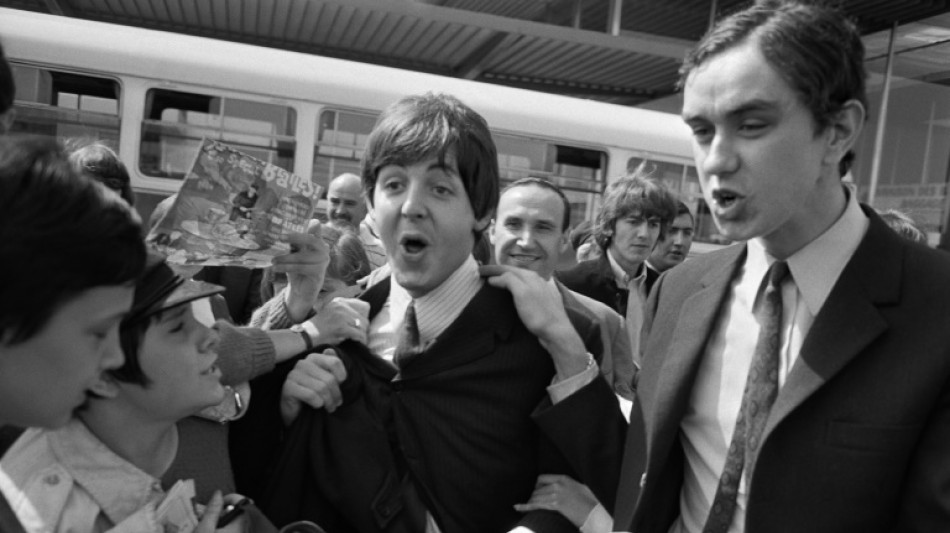
Here Comes the AI: Fans rejoice in 'new' Beatles music / Photo: - - AFP/File

When the Beatles broke up more than 50 years ago, devastated fans were left yearning for more. Now, artificial intelligence is offering just that.
From "re-uniting" the Fab Four on songs from their solo careers, to re-imagining surviving superstar Paul McCartney's later works with his voice restored to its youthful peak, the new creations show off how far this technology has come -- and raise a host of ethical and legal questions.
"I'm sobbing! This is so beautiful!!!" wrote a listener in a typical YouTube comment for a fan-created AI cover of McCartney's 2013 single, "New," which features de-aged vocals and a bridge part "sung" by his great songwriting partner and friend, the late John Lennon.
Equally impressive is a version of "Grow Old With Me," one of the last songs penned by Lennon, which was posthumously released after his 1980 murder and recently remade by an AI creator who goes by "Dae Lims."
With enhanced audio quality, an orchestral arrangement and harmonized backing vocals that evoke the Liverpudlian rockers' heyday, the song's most stirring moment comes when McCartney croons over a soaring melody with poignant lyrics about aging.
"When I hear this, I lose it. I start crying," said music YouTuber Steve Onotera, who goes by "SamuraiGuitarist" and has a million followers, in a recent video discussing the new works' unforeseen sentimental resonance.
After the most influential band in history parted ways acrimoniously, fans were deprived of a final "happy ending," he said. "So when we do get that reunion artificially yet convincingly created by AI, well, it's surprisingly emotional."
- AI here, there and everywhere -
Like an earlier track called "Heart on a Sleeve" which featured AI-generated vocals of Drake and The Weeknd and racked up millions of hits on TikTok and other platforms, these covers use scraping technology that analyzes and captures the nuances of a particular voice.
The creators would have probably then sung the parts themselves and then applied the cloned voice, in a manner similar to placing a filter on a photograph.
While the results can be astonishing, getting there isn't simple and requires skilled human operators combining new AI tools with extensive knowledge of traditional music processing software, Zohaib Ahmed, the CEO of Resemble AI, a Toronto-based voice cloning company, told AFP.
"I think we're still seeing a very small percentage of the population that can even access these tools," he said. They need to "jump through hoops, read documentation, have the right computer, and then put it all together."
Ahmed's company is one of several offering a platform that can make the technology more accessible to clients in the entertainment sector -- and counts a recent Netflix documentary series "narrated" by late art icon Andy Warhol using its technology as an early success.
For Patricia Alessandrini, a composer and assistant professor at Stanford's Center for Computer Research in Music and Acoustics, the recent spate of AI tracks represent a coming-of-age for a technology that has been advancing exponentially -- yet largely out of public view over the past decade.
"This is a great example of what AI does very well, which is anything that's resemblance: to train it on something existing," she told AFP.
But, she added, it flounders when it comes to new ideas. "There's really no expectation that it's going to replace the rich history of humans originating art and culture."
- Litigation coming -
For the music industry, the ramifications are enormous. As the technology progresses, software that will easily allow people to transform their vocals into one of their favorite singers is likely not far away.
"If they're getting paid for their vocal license, hey, everyone's happy," said Onotera. "But what if they're long since passed away? Is it up to their estate?"
AI is already proving a helter-skelter impact on the copyright world.
In the case of "Heart on a Sleeve," Universal Music Group was quick to assert copyright claims and have the track pulled down from streaming services, but that hasn't stopped it popping back up on small accounts.
Marc Ostrow, a New York-based music copyright lawyer, told AFP AI-generated music is a "gray area."
Copyright can be asserted both by songwriters whose material is used, as well as the holders of the master recordings.
On the other hand AI creators can argue it falls under "fair use" citing a 2015 court ruling that said Google was permitted to archive the world's books, because it wasn't competing with sellers and was displaying only snippets.
Last month, however, the US Supreme Court tipped the balance back the other way in ruling a Warhol print of the late pop star Prince violated the copyright of the photographer who took the original image.
Add to the mix that celebrities can protect their likeness under the "right to publicity," established when Bette Midler successfully sued Ford Motor Company in the late 1980s for using a singer that sounded like her in an ad.
Ultimately, "I think there may be voluntary industry standards... or it's going to be done by litigation," said Ostrow.
Rights holders will also need to think about the negative PR that could come with suing over works that are clearly fan-created tributes and not intended to be monetized.
(B.Hartmann--BBZ)