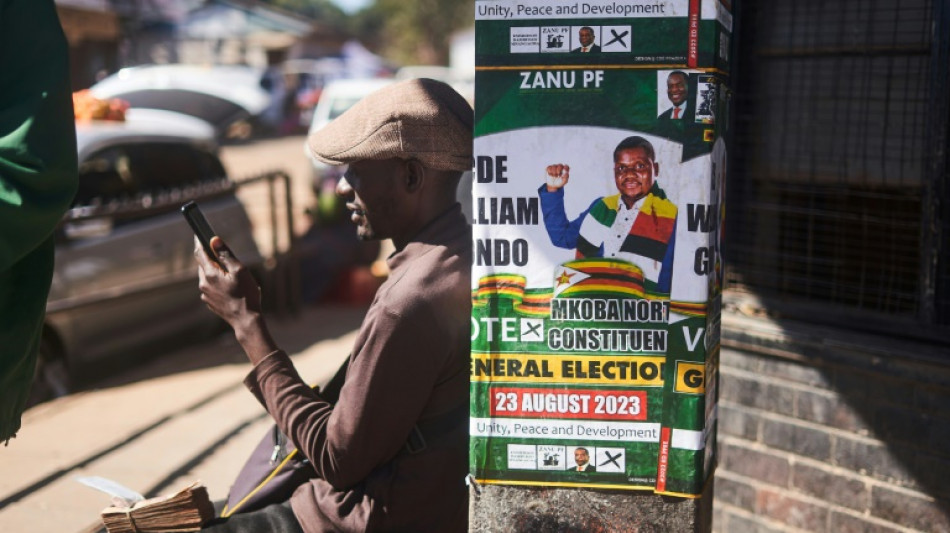
Zimbabwe election disinformation spreads on WhatsApp / Photo: Zinyange Auntony - AFP

From doctored photos making small crowds big to posts praising government accomplishments that never were, WhatsApp has become the channel of choice for disinformation in Zimbabwe before this month's elections.
The landlocked southern African country heads to the polls on August 23 to elect the president and legislature in what analysts expect to be a tense affair amid a crackdown on the opposition and rigging fears.
Large-scale disinformation campaigns in the run-up to a vote are now a staple across the continent. Zimbabwe is no exception, but the situation there is more opaque.
In Kenya and Nigeria, which recently held votes, misinformation peddlers hung out in the open, mostly on Facebook and Twitter, while in Zimbabwe WhatsApp is king of the rapid spread, analysts say.
This is because that's where most voters are -- but the app's encrypted messaging service makes fact-checking harder, as fake content proliferates undetected.
Chris Chinaka, editor-in-chief of ZimFact, a Zimbabwean fact-checking group, said staff now spend most of the time flicking through WhatsApp groups for messages to debunk.
"For most Zimbabweans, the internet is WhatsApp, and a lot of communication happens there," said Nqaba Matshazi, a journalist working at the Media Institute of Southern Africa (MISA) in Zimbabwe.
Internet penetration is quite low in Zimbabwe, where only about a third of the country's more than 15 million people are online, according to a 2023 report by DataReportal, a data analysis firm.
Only nine percent of those who have internet use social media.
WhatsApp has a much broader reach and many Zimbabweans consider it a safe means of communication -- a valued commodity in a country where criticising the government can land people in jail.
In May, Zimbabwe approved a broadly worded law imposing harsh penalties for damaging the country's "sovereignty and national interest", which critics say effectively bans government criticism.
- Bots and pseudonyms -
Few people on Twitter write about politics under their real name, as that comes with the "risk of you being arrested", said Matshazi.
But WhatsApp is not a free zone either, as messages on the app have also landed people behind bars, he added.
The law worsened "a festering wound in an environment where already freedom of expression is quite limited," said Matshazi.
Still, traditional social media are not immune from fake content.
Political analyst Jamie Mighti said Twitter was awash with bots that seem to have been commissioned to push government talking points.
Some embellish the accomplishments of the ruling ZANU-PF party, in power since independence in 1980.
Others repeat President Emmerson Mnangagwa's view that Western sanctions are to blame for the country's economic collapse.
The United States and Europe deny this, noting that the measures target specific individuals accused of graft and right abuses.
- Doctored videos -
Manipulated photos and videos are also circulating in large numbers -- with both ZANU-PF and the leading opposition party, the Citizens' Coalition for Change (CCC), making good use of them, analysts say.
"(They) have used doctored images of rallies from the past, or from totally different contexts, to project the false impression of overwhelming support," said Bhekizulu Tshuma, a media studies professor at the National University of Science and Technology in Zimbabwe.
The parties have also used the tactic to suggest their rivals have few followers, he added.
Campaign messages have been deliberately distorted.
In one example, a clip of CCC leader Nelson Chamisa was edited to make it sound as if he advocated for the reversal of radical land reforms enacted by late president Robert Mugabe -- and for the land to be returned to white farmers.
Disinformation can also be easily found on television, where experts say state broadcaster ZBC often depicts the CCC as a party with little support and takes its leader's speeches out of context.
"It is a matter of public record that ZBC refuses to give any independent or fair coverage to the CCC," the party's spokeswoman Fadzayi Mahere wrote on Twitter, which is being rebranded as "X".
"Not only is the state media's coverage unequal, but whatever token coverage is accorded to the opposition is biased, derogatory and manipulated."
Voices critical of ZANU-PF also have limited reach in South Africa, which is home to a large Zimbabwean diaspora, said Mighti.
Zimbabweans abroad, in South Africa and the UK in particular, also play a critical role in amplifying misinformation, analysts say.
"A lot of the discourse about the Zimbabwean election happens on the internet and in South African, European and American media, primarily because of the restrictions in Zimbabwe and the fear of reprisals," he said.
(B.Hartmann--BBZ)