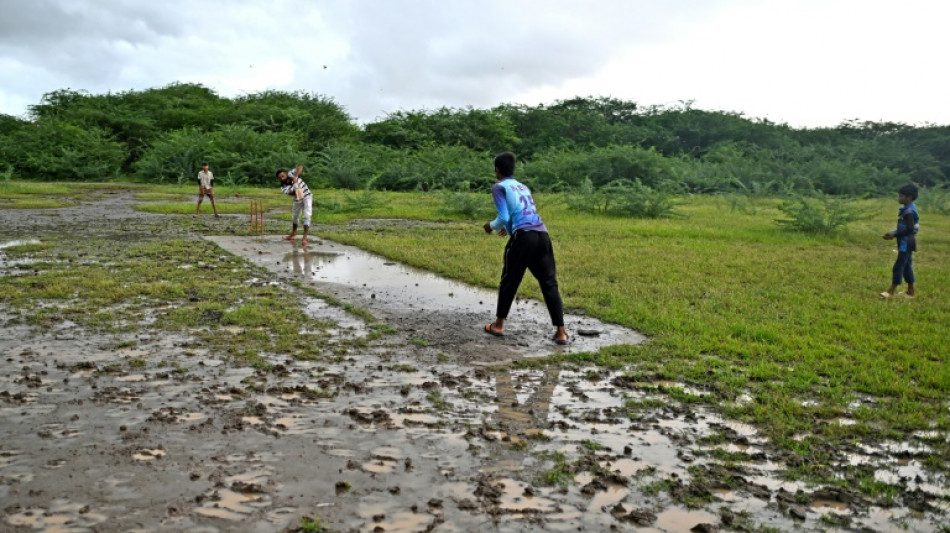
Maiden match: three centuries of India's cricket obsession / Photo: Sajjad HUSSAIN - AFP

Marooned mercenaries, gun-toting guards and sword-waving crowds; historians say the little-known tale of how cricket came to India three centuries ago shows how the game can bring people together.
When the Cricket World Cup opens on October 5 at a 130,000-seat mega-stadium in Ahmedabad, hundreds of millions of fans in the world's most populous country will unite in a national sporting obsession underpinning identity and pride.
Among those glued to the television will be residents of Tankari Bandar, a hard-scrabble fishing village some 120 kilometres (75 miles) to the south in Gujarat, which researchers say is the site of the first recorded game in India.
"I heard stories as a child from my father and grandfather that in 1721, a game of cricket was played by the Britishers near the river," said community leader Ranjit Sinh, 56.
"I'm proud that the first game of cricket was played in my village."
In the early 18th century -- a time of rival powers and rapacious European forces with pirates prowling the coast -- a ragtag bunch of foreign mercenaries and Indian marines sailed up the creek.
Among them was English sailor Clement Downing, who described how after becoming trapped by the tides, they rowed ashore and set up camp for two weeks underneath mango and tamarind trees.
- 'Flourishing their swords' -
The sailors were fearful. The last British sailor who stopped there had shot at villagers who "soon cut him to pieces and the few men he had with him", Downing wrote in his "History of the Indian Wars".
"We every day diverted ourselves with playing at Cricket and other Exercises," he added.
Soldiers guarded the boundary and sailors buying supplies went bristling with guns.
Villagers welcomed them by "flourishing their swords and making motions as if cutting off heads", he added.
But this time the strange foreigners thwacking balls seemingly defused tensions, and the visit passed off peacefully.
"Several times, four or five of the heads of the town came down on horseback with great attendance," Downing wrote, describing leaders flanked by bodyguards carrying bamboo lances and swords. "They would come and be spectators".
John Drew, a British academic, pinpointed the pitch location using ship records and historical charts.
"The sailors were expecting attack," he said. "What they got was people coming again and again to watch."
The 84-year-old believes there is a "very good chance" that Indians also took part.
There are claims by other locations -- including early 18th-century beach cricket by British soldiers in Kerala -- but Downing's account is the earliest recorded.
- 'Unites everyone' -
On the sweeping floodplains at Tankari, children with a homemade bat run on a pitch turned to mud by monsoon rains.
"Every day we play cricket," said Kaushik Ashok, 20, wearing his village team top. "We work, we fish, then we play cricket."
While few non-specialists know the story, some believe the account should be told more widely.
"In India, you have various sects, communities and languages, but this is one game that unites everyone," said theatre director P.S. Chari, 60, who is rehearsing a play about the match in the nearby city of Vadodara.
Of the sport's billion fans worldwide, more than 90 percent are in the Indian subcontinent, according to a 2018 International Cricket Council (ICC) study.
"Cricket has become so much a part of India, it's a national obsession," said art critic, cultural commentator, and Vadodara cricket association member Sandhya Gajjar, 66.
"That is why this story is important."
- 'Made it their own' -
In popular culture, the origin of Indian cricket is the story told in the 2001 Bollywood smash-hit "Lagaan", a fictional drama of villagers facing brutal British colonialists in a high-stakes match in 1893.
By then, England had codified rigid "Laws" of cricket.
But Chari notes the real game came when cricket was still played with makeshift balls and bats, meaning the "not so well refined" English sport melded easily with existing Indian games.
Those included pastimes still played today, including "gilly danda", where players use a stick to smack a smaller one, or "seven stones", where teams knock down towers of rocks.
"It was popular because it was similar to games already played," Chari said, praising India's "knack of adaptation" for cricket's rapid spread.
"They took this game of cricket and made it their own".
(L.Kaufmann--BBZ)