Tech breathes new life into endangered Native American languages / Photo: LEANDRO LOZADA - AFP

Linguistics experts are turning to cutting-edge technologies to revitalize threatened Native American languages -- and rejuvenate generations of Indigenous tradition -- through new approaches such as children's books and smartphone apps.
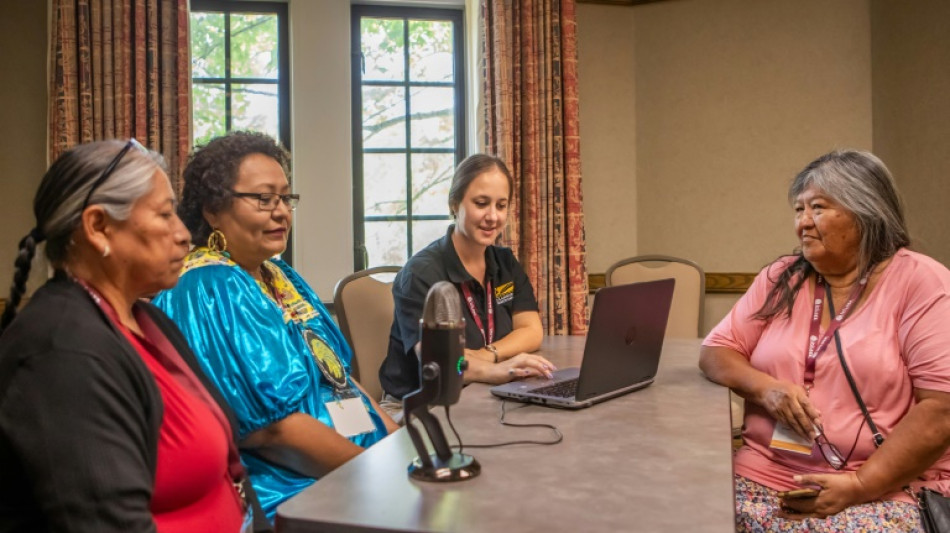
In one such endeavor, three Native American women rack their brains as they gather around a computer, trying to remember -- and record -- dozens of Apache language words related to everyday activities such as cooking and eating.
They are creating an online English-Apache dictionary, just one of several projects working to preserve endangered Indigenous languages in the United States.
The women are working with Rapid Word Collection (RWC) software, which uses an algorithm to search Apache text and audio databases for so-called forgotten words.
The words are then defined, translated into English, and their pronunciation recorded, so the dictionary's users will know how to say them properly.
Teacher Joycelene Johnson and two of her colleagues validate the definition of the word Apache word "kapas," which means potato in English.
"The applications in the written language are good for (a) non-speaker -- at least they'll have a museum of it where they can go to for reference," said Johnson, a 68-year-old who teaches Apache vocabulary and grammar.
According to her, the bilingual school on her reservation has about a thousand students -- but only one, an eleventh-grader, is fluent in Apache.
Johnson spoke at just one of several workshops at the International Conference on Indigenous Language Documentation, Education and Revitalization (ICILDER) last weekend at the University of Indiana.
Representatives from around 40 Indigenous groups from around the world gathered in the college town of Bloomington just days after the United States -- which counts about 6.8 million Native American residents, or about two percent of the population -- marked Indigenous People's Day.
- 4,500 languages at risk -
Linguists, teachers, students, researchers and Indigenous leaders spent the weekend brainstorming how exactly to rescue these vulnerable languages from the brink.
Of the more than 6,000 Indigenous languages recognized globally, nearly half of them are at risk of disappearing, with about 1,500 facing immediate extinction, according to a 2021 study from UNESCO.
The RWC was developed by The Language Conservancy (TLC), an NGO dedicated to protecting around 50 Indigenous languages around the world, in order to churn out such dictionaries at super-speed.
TLC, which has a $3 million budget, regularly teams up linguists with Native American language teachers to work on these dictionaries.
The software has "increased the efficiency in the workflow," said Wilhelm Meya, the CEO of TLC and one of the ICILDER organizers -- now, an Indigenous community can build a dictionary from scratch within a year, instead of 20.
"That allows us to serve languages quickly and build that infrastructure that they need to be able to survive moving forward," the 51-year old Austrian-American anthropologist explained.
- 'Crisis level' -
That speed is vital, because time is of the essence: in the United States and Canada, the last generation of native speakers are dying.
According to TLC, 143 out of 219 languages are in danger of extinction in the United States, while 75 of 94 are at similar risk in Canada.
Those are still just a small fraction of the 400 to 500 Indigenous languages that were spoken in the two countries before the arrival of Europeans and their decimation of native populations some 500 years ago.
"The situation is really at a crisis level," Meya said.
With the average age of Indigenous language speakers around 75, he added, there are only a few years left to document these languages before they disappear forever.
"Once it's gone, it's gone. You really can't bring it back very easily," said Meya, whose organization distributes their learning materials for free throughout the United States and on Native American reservations.
"When the language goes, so does the culture," he said.
Jacob Chavez, a 26-year-old Cherokee language learner who called himself a "really big supporter" of the language technology, said he appreciates how it allows communities to "record things a lot quicker and hold onto things for a lot longer than we could before."
- 'Identity' -
Paula Hawkins, who teaches the Tahltan language -- which is spoken in parts of British Columbia -- said she is "really excited" to see an online dictionary, just as her parents helped create the first Tahltan print dictionary in the 1980s.
But her colleague, 51-year-old Danielle North King, from the Chemehuevi, or Nuwuvi nation, fears that such projects impose a "Western way of writing" onto "an Indigenous way of speaking" -- the vast majority of human languages are solely oral, with no writing systems.
Indeed, Lakota Indigenous leaders denounced TLC last year, after the organization tried to copywrite teaching material that included recordings from the nation's elders.
"We don't own the copyright or the IP (intellectual property) for any of the languages we work with," Meya clarified, adding that his goal is to protect Indigenous culture.
"If we were at a hospital and I was a white doctor and I had an Indigenous patient, would I not be allowed to work on him or serve him because I'm not Indigenous?" Meya asked.
"Race can really become a hindrance to this type of work," Meya explained, when dealing with such a sensitive subject.
Language is "so fundamental to identity and to nationhood and sovereignty."
(F.Schuster--BBZ)