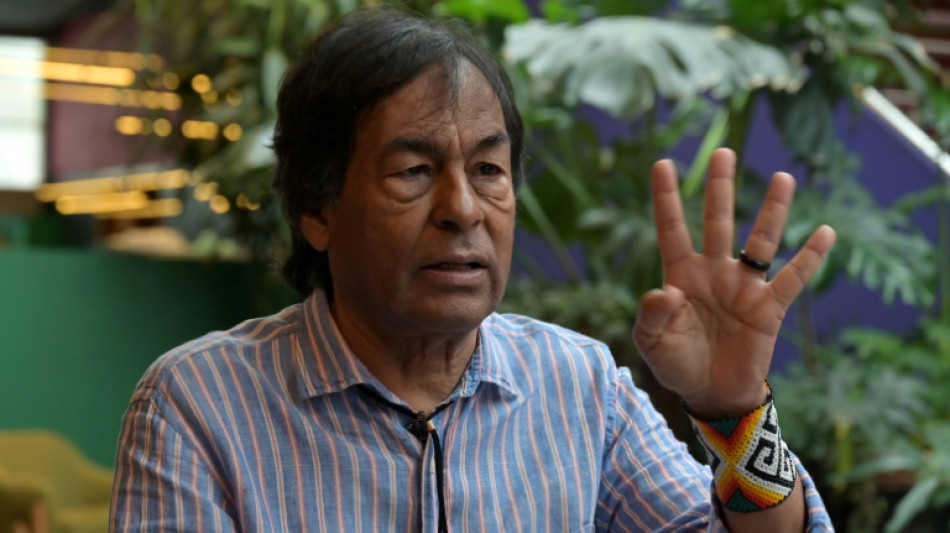
Indigenous writer Ailton Krenak, postponing the end of the world / Photo: Nelson ALMEIDA - AFP

The year was 1987, Brazil was just exiting a long military dictatorship, and Indigenous writer Ailton Krenak stood before the country's constitutional assembly in a pristine white suit, smearing black paint across his face.
"Indigenous peoples have watered every scrap of Brazil's eight million square kilometers with their blood," the handsome young activist defiantly told the assembly, using a traditional mourning ritual to protest centuries of violence against native peoples.
Thirty-six years after that memorable protest, which helped ensure the nation's new constitution protected native land rights, Krenak achieved what he calls a new "historic reparation" last month, when he was chosen as the first Indigenous member of the Brazilian Academy of Letters.
Founded in 1897, the Academy is the rough equivalent of France's hallowed Academie Francaise or Spain's Real Academia.
Seen as a standard-bearer of Brazilian language and literature, the Rio de Janeiro institution is made up of 40 members known as the "immortals," who hold their seats for life.
Known for its hushed halls and hallowed rituals -- its members convene for formal gatherings in gold-embroidered uniforms -- it is perhaps an unusual spot for life-long rabble-rouser Krenak, 70.
"We're going to bring a little noise to that century-old silence," the philosopher, writer and poet told AFP in an interview in Sao Paulo.
The Academy "has always been closed to native peoples and dominated by (Brazilian) Portuguese."
Krenak says he hopes to use his seat in the institution to help shine a spotlight on Brazil's nearly 200 Indigenous languages.
"Through language, literature and the arts, Indigenous cultures can be perceived as living things, not just something from the past," he says, speaking in calm but razor-sharp sentences.
Despite the horrors of the colonial past, "we are alive," he adds. "We won."
- In the flesh -
A member of the Krenak people of southeastern Brazil, whose surname he bears, the writer has lived the Indigenous struggle in the flesh.
His people were expelled from their land around 1970, during the dictatorship (1964-1985), forcing him and his family into exile.
At 18, he left for the southern state of Parana to study "the colonizer's language," earning a journalism degree. It is the language in which he writes his books.
After enduring torture and persecution by the military regime, the Krenak only partly recovered their lands with the return to democracy. Their 600 remaining members were scattered across several states.
Krenak's own fight is rooted in their suffering.
Considered one of Brazil's leading Indigenous intellectuals, he has written a highly regarded body of work criticizing colonialism and capitalism, including the critically acclaimed essay "Ideas to Postpone the End of the World" (2019), translated into more than 10 languages.
The Indigenous leader, who is discreet on his personal life, married fellow activist Irani Krenak in 2000. They had three children, one of whom died in an accident. Another daughter from a previous relationship also died.
- Different vision -
Krenak rejects the notion that European colonizers brought "civilization" to the Americas.
In fact, they brought a way of life that divorced humankind from nature, leading to a world where corporations "devour forests, mountains and rivers," he writes.
Krenak proposes a different way of life, akin to that of the native communities who resisted colonialism, fiercely clinging to their land.
About four years ago, he moved to his people's land on the banks of the Rio Doce river, home to around 350 Indigenous people.
But even there, what he calls the "corporate monster" is inescapable. A case in point: a notorious mine dam collapse in 2015 that caused an environmental disaster on the river, a vital source of water and food for his people.
The accelerating destruction of nature affects everyone, Krenak says.
"It's not just Indigenous peoples who are threatened by the damage anymore. Now white people are, too," he says, wearing a striped shirt and traditional feather necklace.
For now, he says, he is "biding (his) time" hoping for political and social change.
But in the end, he says, he expects the Earth to move beyond humankind.
"My hope is that we'll be discarded as quickly as possible so the planet can continue its magnificent journey."
(Y.Berger--BBZ)