Berliner Boersenzeitung - Number of spider species creeps up to 50,000

EUR -
AED 4.250279
AFN 74.068802
ALL 96.34764
AMD 436.497404
ANG 2.071711
AOA 1061.268908
ARS 1600.004406
AUD 1.671695
AWG 2.084635
AZN 1.972438
BAM 1.97433
BBD 2.329877
BDT 141.932067
BGN 1.978229
BHD 0.436895
BIF 3430.31661
BMD 1.157327
BND 1.493416
BOB 7.993016
BRL 6.011846
BSD 1.156761
BTN 110.075081
BWP 15.957768
BYN 3.439985
BYR 22683.605111
BZD 2.326434
CAD 1.608817
CDF 2644.491429
CHF 0.923229
CLF 0.027159
CLP 1072.390146
CNY 7.979419
CNH 7.966957
COP 4263.105822
CRC 537.850177
CUC 1.157327
CUP 30.66916
CVE 110.958736
CZK 24.552921
DJF 205.680104
DKK 7.472466
DOP 69.558064
DZD 153.841103
EGP 63.118638
ERN 17.359902
ETB 181.75834
FJD 2.612554
FKP 0.877298
GBP 0.873822
GEL 3.113057
GGP 0.877298
GHS 12.730622
GIP 0.877298
GMD 85.641899
GNF 10155.542917
GTQ 8.851108
GYD 242.083054
HKD 9.071826
HNL 30.788906
HRK 7.535815
HTG 151.824913
HUF 384.272974
IDR 19615.878985
ILS 3.65316
IMP 0.877298
INR 108.192174
IQD 1516.098097
IRR 1522897.391286
ISK 143.415556
JEP 0.877298
JMD 183.00757
JOD 0.820575
JPY 183.524251
KES 150.453052
KGS 101.208562
KHR 4640.880131
KMF 495.891431
KPW 1041.564799
KRW 1747.019515
KWD 0.358238
KYD 0.963947
KZT 551.132512
LAK 25403.323343
LBP 103591.285265
LKR 364.9265
LRD 212.57197
LSL 19.754877
LTL 3.417285
LVL 0.700056
LYD 7.412687
MAD 10.812329
MDL 20.486269
MGA 4835.31138
MKD 61.658148
MMK 2429.805381
MNT 4132.824234
MOP 9.340602
MRU 46.419748
MUR 54.513869
MVR 17.903632
MWK 2010.276675
MXN 20.708223
MYR 4.658262
MZN 74.010695
NAD 19.755375
NGN 1603.20969
NIO 42.50825
NOK 11.21143
NPR 176.119928
NZD 2.010769
OMR 0.444985
PAB 1.156756
PEN 4.046039
PGK 5.080212
PHP 70.11548
PKR 323.122061
PLN 4.288226
PYG 7493.32668
QAR 4.21734
RON 5.098716
RSD 117.464074
RUB 94.08702
RWF 1689.697115
SAR 4.343413
SBD 9.307265
SCR 16.268511
SDG 695.553432
SEK 10.941565
SGD 1.486679
SHP 0.868295
SLE 28.411882
SLL 24268.57668
SOS 661.409847
SRD 43.253978
STD 23954.327948
STN 25.142925
SVC 10.122042
SYP 127.948327
SZL 19.755814
THB 37.659685
TJS 11.087559
TMT 4.062217
TND 3.391403
TOP 2.786565
TRY 51.455326
TTD 7.858791
TWD 36.979944
TZS 2995.521698
UAH 50.820078
UGX 4354.890513
USD 1.157327
UYU 46.930454
UZS 14114.182851
VES 547.737136
VND 30483.987684
VUV 139.276576
WST 3.204954
XAF 662.171641
XAG 0.015452
XAU 0.000246
XCD 3.127733
XCG 2.084766
XDR 0.822804
XOF 660.25318
XPF 119.331742
YER 276.195876
ZAR 19.537285
ZMK 10417.327975
ZMW 22.111522
ZWL 372.658755
  • RBGPF

    -13.5000

    69

    -19.57%

  • CMSC

    -0.4028

    21.9

    -1.84%

  • CMSD

    -0.4000

    22.1

    -1.81%

  • BCC

    0.9000

    75.85

    +1.19%

  • RYCEF

    0.7400

    15.09

    +4.9%

  • BCE

    0.0100

    25.24

    +0.04%

  • NGG

    0.9100

    84.6

    +1.08%

  • GSK

    0.9600

    55.19

    +1.74%

  • RIO

    4.4700

    93.29

    +4.79%

  • BTI

    0.2100

    58.47

    +0.36%

  • RELX

    0.4000

    33.15

    +1.21%

  • JRI

    0.3800

    12.3

    +3.09%

  • VOD

    0.3200

    15.02

    +2.13%

  • AZN

    3.3400

    197.22

    +1.69%

  • BP

    -0.3500

    47

    -0.74%

Number of spider species creeps up to 50,000


Number of spider species creeps up to 50,000

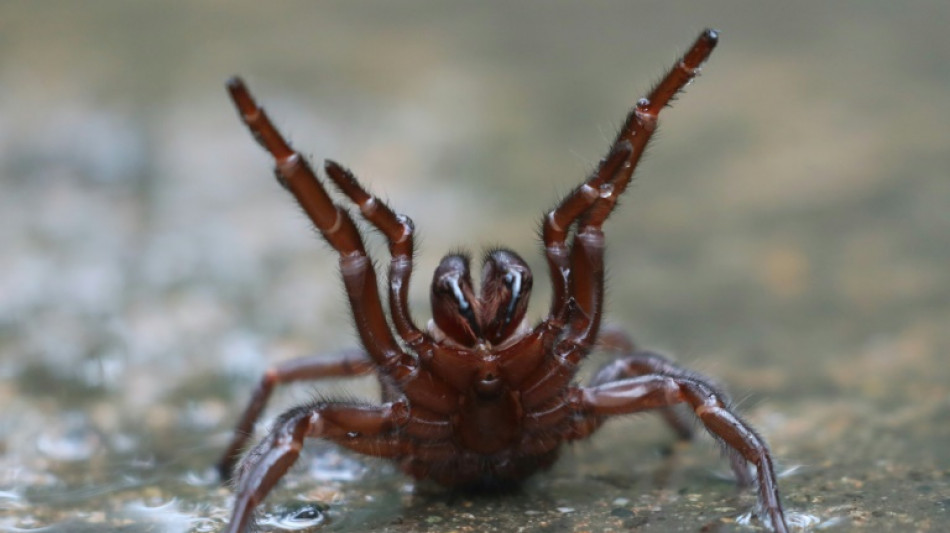
There are now 50,000 known different species of spider crawling the Earth, the World Spider Catalog announced Wednesday -- and there might be another 50,000 out there.

Text size:

The WSC, based at the Natural History Museum of Bern in the Swiss capital, said the 50,000th spider registered is the Guriurius minuano, which belongs to the Salticidae family of jumping spiders and hunts its prey on shrubs and trees in southern Brazil, Uruguay, and around Buenos Aires.

It was described by the arachnologist Kimberly S. Marta and her colleagues from Brazil and is named after the now-extinct Minuane people who lived in the area.

The first scientific description of a spider was in 1757 and while it has taken 265 years to reach 50,000, the rate of discovery is steadily increasing, and it is thought it could take less than 100 years to discover the same number again.

"We estimate that there are still approximately 50,000 more spider species out there to discover," said the WSC's publishers.

The spider catalogue is freely available on the museum's website.

"Spiders are the most important predators in Earth's terrestrial habitats, and their ecological significance should not be underestimated," the museum said.

"Consuming some 400 to 800 million tonnes of insects every year, they are the most important regulators of insect populations. Accordingly, they are also of fundamental importance to humans."

(A.Berg--BBZ)