Exiled Tibetans guard heritage from 'cultural genocide' / Photo: Sajjad HUSSAIN - AFP

From teaching centuries-old crafts to cataloguing their language, exiled Tibetans guard the cultural identity of a homeland most have neither seen nor dare visit, and where they say Beijing is eradicating their heritage.
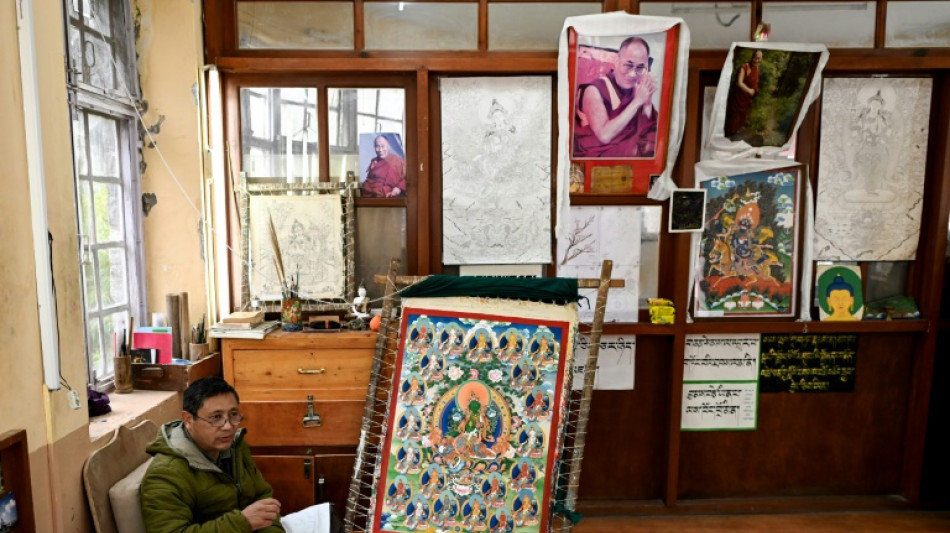
Crouched over a minutely detailed devotional "thangka" painting depicting Buddha, artist Lobsang Tenzin teaches students in northern India.
"It is important to keep the traditions of our history," said the 49-year-old, dipping a needle-thin brush into rich blue paint made from crushed lapis lazuli as six young Tibetan trainees watch.
"These skills were nearly lost, but we pass on the skills by teaching young artists."
Tibetans will on March 10 mark the 65th anniversary of the 1959 uprising against Chinese forces that led to their spiritual leader the Dalai Lama fleeing into exile, followed by tens of thousands of compatriots.
Inside Tibet, the chaos of China's 1966-76 Cultural Revolution left temples razed and monasteries reduced to ruins, destruction that continued in the decades that followed.
Today, activists decry what they say are Beijing's determined efforts to erase what is left of Tibet's cultural and religious identity.
Lhadon Tethong, head of the Tibet Action Institute, condemns what she calls "cultural genocide" -- including Beijing's sharp restrictions on Tibetan language, with children "indoctrinated" at state-run boarding schools.
Beijing, which maintains "Tibet is part of China", fiercely rejects the accusations.
Chinese foreign ministry spokeswoman Mao Ning this week said that people in Tibet are "living a happy life", in response to UN rights chief Volker Turk's assertion that China was violating fundamental rights.
Tibet enjoys "social stability, economic growth, solidarity among all ethnic groups and harmony among various religious beliefs", she said.
- 'Former glory' -
Tibet scholar Robert Barnett, from SOAS University of London, called Beijing a "foreign ruler deciding what's best for a people whose culture it barely knows".
"There is a gradual whittling away of a culture and a history," Barnett said.
"It is a process where you gradually eliminate all the elements of a history, a people, culture and of a society that are inconvenient to the new rulers."
Tibetan authorities say there are 130,000 Tibetan exiles, many in India and Nepal but also in more than 25 countries worldwide -- just a fraction of the seven million living under China's control.
As the decades pass, that makes the preservation of cultural identity even more challenging.
Tenzin studied and now teaches at the Norbulingka Institute, a social enterprise centre training more than 300 men and women in painting, embroidery, weaving and woodcarving.
The complex of red and green Tibetan-style buildings, close to the Dalai Lama's base in India's Himalayan hill town of Dharamsala, was launched in 1995 to employ highly skilled artisans eking out a living with repair jobs.
"After the great masters came to India, they ended up doing odd jobs, trying to build their lives in a new country," said Tsultrim Dorjee, a senior manager at the institute.
"The institute helped them use their skills... the goal was to return Tibetan art to its former glory."
Others take a more modern approach, like 29-year-old artist Tashi Nyima, with his bright cartoon-style canvases that nonetheless still reflect his people's heritage and political battles.
Born and brought up in Dharamsala, where red-robed monks and nuns crowd streets alongside Tibetans in baseball caps and jeans, Nyima said younger generations struggle with a "very mixed identity".
But he remains committed to the cause.
"I've always believed that Tibet will be free one day," he said, in front of his painting of a shackled monk.
"If I didn't have this belief in me, I wouldn't have done these kinds of works -- I would have just stopped."
- 'Long haul' -
Another battle is keeping the language alive.
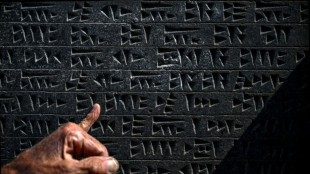
While Google Translate offers 133 languages, Tibetan is not among them -- but exiles in 2022 released their own 223-volume dictionary, available online.
"Once the language is preserved, then everything falls in place," said Dorji Damdul, director of Tibet House in New Delhi, founded by the Dalai Lama to promote his people's heritage.
"Language is like the medium through which all the flow of culture and philosophy happens."
But young Tibetans in India are increasingly seeking opportunities in Europe and North America.
Damdul, born in India in 1968 and a former translator for the Dalai Lama, admits that keeping an identity alive is a "major challenge".
"In Tibet, assimilation by force happens with the communist Chinese," said the Buddhist scholar. "In the West, natural assimilation can happen because it's too free."
Tibet's Dharamsala-based government in exile says it is looking to keep the increasingly scattered community connected, including via online conferences teaching younger generations about their history.
"If they understand Tibet a little more, they could be the best advocates," said Penpa Tsering, elected as the government's sikyong, or leader, by Tibetans worldwide.
"Even though we are physically distant, we are mentally close together."
Tsering's administration oversees more than 60 Tibetan language schools in India and Nepal and supports nearly 300 monasteries and nunneries.
"We are here for the long haul," said Tsering. "Don't think that we'll vanish just like that."
(Y.Yildiz--BBZ)