Berliner Boersenzeitung - Reviving a traditional art form in Rwanda after genocide

EUR -
AED 4.246655
AFN 73.370436
ALL 95.85756
AMD 436.183723
ANG 2.069944
AOA 1060.363353
ARS 1591.997113
AUD 1.665235
AWG 2.084013
AZN 1.966403
BAM 1.949821
BBD 2.330235
BDT 141.986474
BGN 1.976541
BHD 0.436604
BIF 3434.327888
BMD 1.156339
BND 1.479029
BOB 7.994866
BRL 6.05679
BSD 1.156943
BTN 108.829124
BWP 15.767403
BYN 3.429104
BYR 22664.251381
BZD 2.327115
CAD 1.597489
CDF 2636.453561
CHF 0.915202
CLF 0.02686
CLP 1060.582781
CNY 7.980477
CNH 7.983586
COP 4280.13231
CRC 537.971372
CUC 1.156339
CUP 30.642993
CVE 110.574938
CZK 24.465772
DJF 205.504507
DKK 7.47252
DOP 69.814005
DZD 153.473986
EGP 60.744358
ERN 17.34509
ETB 181.886277
FJD 2.576551
FKP 0.864047
GBP 0.865283
GEL 3.116362
GGP 0.864047
GHS 12.661969
GIP 0.864047
GMD 84.988596
GNF 10152.659388
GTQ 8.855078
GYD 242.07657
HKD 9.041244
HNL 30.66647
HRK 7.536674
HTG 151.720034
HUF 387.345955
IDR 19705.641505
ILS 3.602979
IMP 0.864047
INR 109.375885
IQD 1514.804557
IRR 1518447.025122
ISK 143.189913
JEP 0.864047
JMD 182.245914
JOD 0.819814
JPY 184.257476
KES 150.034967
KGS 101.120955
KHR 4640.390011
KMF 493.756627
KPW 1040.72201
KRW 1739.191954
KWD 0.354522
KYD 0.964189
KZT 558.249982
LAK 24959.585362
LBP 103550.188888
LKR 363.877402
LRD 212.361533
LSL 19.588134
LTL 3.414369
LVL 0.699458
LYD 7.371702
MAD 10.785752
MDL 20.230929
MGA 4821.934928
MKD 61.639763
MMK 2428.506437
MNT 4127.516433
MOP 9.317536
MRU 46.404003
MUR 53.7238
MVR 17.865244
MWK 2008.561579
MXN 20.556765
MYR 4.584305
MZN 73.885704
NAD 19.577233
NGN 1602.061835
NIO 42.460666
NOK 11.201245
NPR 174.129602
NZD 1.99154
OMR 0.444574
PAB 1.157007
PEN 4.001516
PGK 4.983245
PHP 69.387276
PKR 322.676366
PLN 4.275582
PYG 7527.982307
QAR 4.213741
RON 5.094947
RSD 117.421631
RUB 93.661073
RWF 1688.25546
SAR 4.338214
SBD 9.299324
SCR 15.841485
SDG 694.960276
SEK 10.814438
SGD 1.481311
SHP 0.867554
SLE 28.387799
SLL 24247.870647
SOS 660.270118
SRD 43.178292
STD 23933.890033
STN 24.745662
SVC 10.124088
SYP 128.293837
SZL 19.516839
THB 37.892986
TJS 11.078991
TMT 4.047188
TND 3.396748
TOP 2.784187
TRY 51.294885
TTD 7.867183
TWD 36.946082
TZS 2971.860396
UAH 50.797502
UGX 4280.984429
USD 1.156339
UYU 46.837397
UZS 14107.339876
VES 534.333269
VND 30469.542036
VUV 138.191887
WST 3.16629
XAF 653.980002
XAG 0.016298
XAU 0.000256
XCD 3.125065
XCG 2.085287
XDR 0.812319
XOF 651.594744
XPF 119.331742
YER 275.960467
ZAR 19.642349
ZMK 10408.441873
ZMW 21.665598
ZWL 372.340801
  • RBGPF

    -13.5000

    69

    -19.57%

  • CMSC

    0.0400

    22.91

    +0.17%

  • VOD

    0.0600

    14.72

    +0.41%

  • BCE

    -0.3400

    25.49

    -1.33%

  • RELX

    0.0100

    32.47

    +0.03%

  • RIO

    0.7700

    87.54

    +0.88%

  • NGG

    1.9600

    84.29

    +2.33%

  • GSK

    1.7500

    54.7

    +3.2%

  • AZN

    1.3600

    187.14

    +0.73%

  • BTI

    0.6900

    58.45

    +1.18%

  • BCC

    1.0800

    74.65

    +1.45%

  • CMSD

    0.0500

    22.68

    +0.22%

  • JRI

    0.2400

    12.1

    +1.98%

  • RYCEF

    0.3000

    15.9

    +1.89%

  • BP

    0.6200

    45.41

    +1.37%

Reviving a traditional art form in Rwanda after genocide
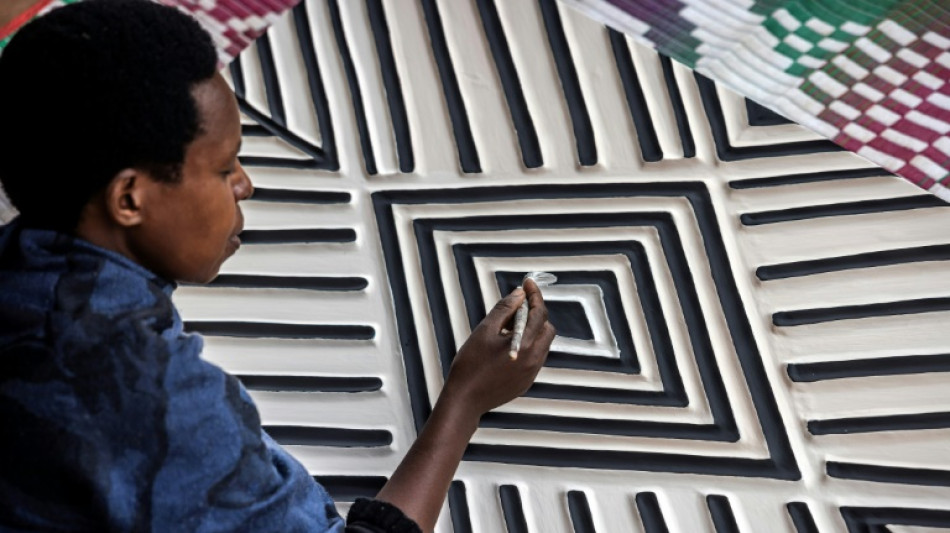
Reviving a traditional art form in Rwanda after genocide / Photo: LUIS TATO - AFP

Reviving a traditional art form in Rwanda after genocide

A 200-year-old Tutsi art form made with cow dung, Rwanda's imigongo painting tradition has experienced a revival in the Great Lakes nation three decades after the 1994 genocide, becoming a symbol of culture and unity.

Text size:

Known for its raised black and white patterns, imigongo is widely believed to have been invented by a Tutsi prince in the 19th century.

Prince Kakira mixed cow dung and ash to create a material which he used to paint three-dimensional patterns on the walls of his palace in eastern Rwanda's Gisaka kingdom.

The tradition was named after "umugongo", the Kinyarwanda word for "spine", owing to its curved lines, and became popular among rural households where women would use dung and natural pigments made with soil, clay and aloe sap to decorate their homes.

Basirice Uwamariya, founder of the Kakira Imigongo Cooperative in eastern Kirehe district, told AFP she started making art when she was 15.

But the 1994 genocide targeting the Tutsi minority nearly wiped out the tradition, with almost all 15 members of Uwamariya's cooperative killed in a bloodbath that claimed around 800,000 lives across Rwanda, including moderate Hutus.

She lost her husband and multiple relatives, leaving her to fend for herself and her two sons.

"I lived in darkness, in silence," the 53-year-old said, recalling the loneliness that pushed her to revive the cooperative in 1996 and invite other genocide survivors to join her.

Since then, imigongo has evolved.

Traditional patterns exist side by side with modern designs featuring various colours. Natural pigments have been replaced by commercial paints.

Imigongo designs have made their way to upmarket studios and fashion boutiques, adorning garments and wooden artefacts alike, with a market that includes foreigners and Rwandans.

According to Theoneste Nizeyimana, manager of Azizi Life Studio in the capital Kigali, the tradition was once largely limited to eastern Rwanda.

"But after the genocide destroyed everything... people started thinking about how they can bring back their culture. Today, imigongo is appreciated by all Rwandans, not just Tutsi," he told AFP.

"Imigongo is something that brings people together," he said, pointing out that the Kigali boutique and studio holds painting classes for students whose ages range from four to 75 years old.

It also makes business sense, he said, with its instantly recognisable patterns helping to market "made in Rwanda" designs around the world.

(K.Lüdke--BBZ)