How East Germany's 'traffic light man' became a beloved icon / Photo: RALF HIRSCHBERGER - AFP

As Germany readies to mark 35 years since the Berlin Wall fell, one symbol of the former communist East has become an icon of reunification, seen by millions every time they cross a street.
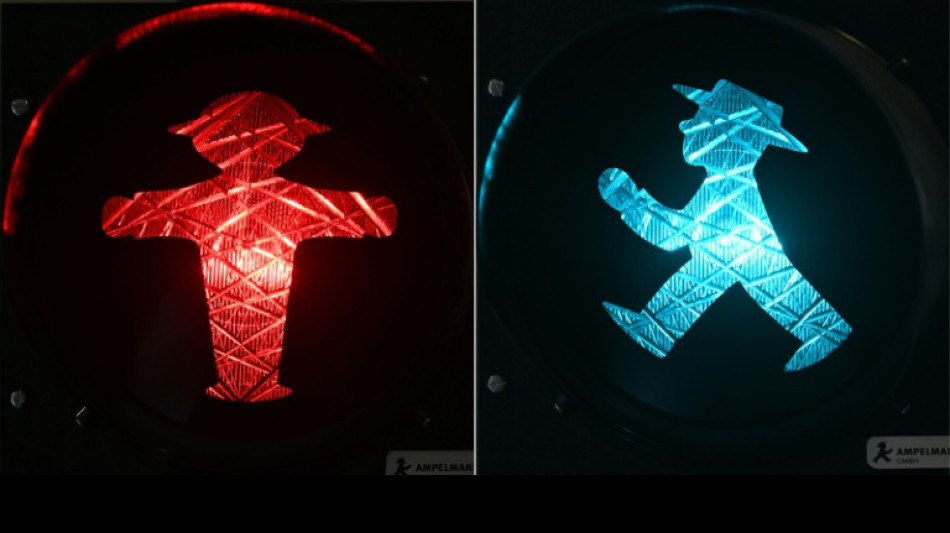
East Germany's "Ampelmann" or pedestrian "traffic light man" is now instantly recognisable thanks to his chunky outline and wide-brimmed hat.
He almost disappeared along with East Germany in the years after the Wall fell on November 9, 1989, when many other symbols of the German Democratic Republic (GDR) were swept away.
Its polluting Trabant cars were soon headed for the scrap-heap, threadbare state-run shops gave way to Western brands, and grey prefabricated tower blocks got new licks of paint.
The Ampelmann almost went the same way, said Markus Heckhausen, a businessman in his 60s from the western German city of Tuebingen.
He remembered seeing the traffic lights featuring the Ampelmann often lying on the side of the road in the early days of reunited Germany.
Despite being a "Wessi" -- the sometimes pejorative nickname for West Germans -- Heckhausen took up the cause of the Ampelmann and spotted a commercial opportunity.
- 'Modern, body-positive' -
He started collecting the chunky lights to turn them into indoor lamps, while simultaneously launching an appeal for the Ampelmann to be saved on the streets.
The campaign struck a chord with many East Germans who felt "they were losing their identity" as their country was practically subsumed into its Western neighbour, said Heckhausen.
Not only was the Ampelmann saved in the East, but he also became a rare symbol from the GDR to be adopted in parts of the West, including in the former western sectors of long-divided Berlin.
The design was created in 1961 by the state's "transport psychologist" Karl Peglau and became something of a star within East Germany, even popping up in cartoons.
"I had the feeling he was always there during my childhood," said 53-year-old Torsten Foeste, who was born in the GDR town of Greifswald but now lives in Berlin.
Fons Hickmann, a graphic designer and professor at Berlin University of the Arts, said the Ampelmann's enduring popularity is down to his figure's lovable "imperfection".
"The back leg is a little too long, the front one a little too short, the whole figure is quite bulky," he told AFP.
"One could say that it's a very modern, body-positive symbol," he quipped.
- Money-spinner -
Peglau's aim was to create a cute, eye-catching figure which would be readily noticed, especially by children and the elderly, at a time when road accidents were on the rise.
"I think in essence it's such an important idea, saying that road traffic doesn't only belong to cars, but to others too, including pedestrians," said Hickmann.
While still keeping pedestrians safe, the humble Ampelmann has become a big money-spinner too, with Heckhausen following up on the lamps with mugs, T-shirts, soft toys and even USB sticks.
Not that Foeste minds the very capitalist incarnation of his childhood memory that Heckhausen has created: "I say congratulations to him, it's a super idea!"
Heckhausen was even able to convince Peglau to work with him on the products until the latter died in 2009.
Today the Ampelmann business makes millions of euros a year and employs around 80 people, said Heckhausen.
Particularly in Berlin, Ampelmann stores have become something of an obligatory stop for many on the tourist trail.
In one, visitor Petra from the western city of Essen hailed the "chic" design, adding: "I've already bought some schnapps glasses and fridge magnets".
(K.Müller--BBZ)