Berliner Boersenzeitung - Eid festivities in north Nigeria make UNESCO heritage list

EUR -
AED 4.244679
AFN 76.884463
ALL 93.191831
AMD 421.972449
AOA 1059.869723
ARS 1724.912124
AUD 1.6354
AWG 2.081886
AZN 1.966206
BAM 1.955209
BBD 2.320998
BDT 142.646882
BHD 0.434569
BIF 3450.157113
BMD 1.155801
BND 1.476654
BOB 13.69586
BRL 5.875747
BSD 1.152352
BTN 109.656854
BWP 15.554298
BYN 3.431363
BYR 22653.692413
BZD 2.317599
CAD 1.612515
CDF 2614.996978
CHF 0.934118
CLF 0.026812
CLP 1055.246154
CNY 7.798879
CNH 7.793437
COP 3649.648544
CRC 523.841657
CUC 1.155801
CUP 30.628717
CVE 110.23168
CZK 24.254187
DJF 205.207971
DKK 7.47562
DOP 67.269666
DZD 152.922776
EGP 57.293846
ERN 17.33701
ETB 185.995679
FJD 2.552644
FKP 0.857003
GBP 0.856685
GEL 3.016621
GGP 0.857003
GHS 13.522912
GIP 0.857003
GMD 84.945873
GNF 10120.940719
GTQ 8.792342
GYD 241.087126
HKD 9.068233
HNL 30.886664
HRK 7.535359
HTG 150.674455
HUF 363.218435
IDR 20574.407074
ILS 3.467228
IMP 0.857003
INR 110.044414
IQD 1509.543707
IRR 1589861.560911
ISK 142.614473
JEP 0.857003
JMD 183.004683
JOD 0.819461
JPY 182.465669
KES 148.856198
KGS 101.074744
KHR 4680.585188
KMF 492.370809
KRW 1629.805632
KWD 0.35675
KYD 0.96031
KZT 540.07675
LAK 26018.135435
LBP 103193.107569
LKR 386.523165
LRD 207.997128
LSL 18.721141
LTL 3.412778
LVL 0.699133
LYD 7.329784
MAD 10.739954
MDL 20.038943
MGA 4917.513571
MKD 61.511407
MMK 2426.660491
MNT 4156.088844
MOP 9.311885
MRU 46.324997
MUR 54.084519
MVR 17.857278
MWK 1998.196
MXN 19.811636
MYR 4.721676
MZN 73.861472
NAD 18.721141
NGN 1573.958077
NIO 42.407181
NOK 10.983967
NPR 175.450966
NZD 1.96296
OMR 0.442316
PAB 1.152352
PEN 3.90252
PGK 5.092461
PHP 70.290014
PKR 319.921597
PLN 4.298989
PYG 6851.928851
QAR 4.212427
RON 5.248837
RSD 117.304542
RUB 94.335971
RWF 1694.487803
SAR 4.328192
SBD 9.322337
SCR 16.700252
SDG 694.055348
SEK 10.962537
SGD 1.477805
SLE 28.431255
SOS 658.600923
SRD 43.76612
STD 23922.739558
STN 24.492597
SVC 10.082952
SZL 18.717342
THB 38.10705
TJS 10.630487
TMT 4.05686
TND 3.385377
TRY 55.150643
TTD 7.810639
TWD 37.274683
TZS 3055.431805
UAH 51.610999
UGX 4292.702434
USD 1.155801
UYU 46.385979
UZS 13781.834132
VES 873.510657
VND 30287.177696
VUV 137.028419
WST 3.15963
XAF 655.758782
XAG 0.018109
XAU 0.000266
XCD 3.123609
XCG 2.076872
XDR 0.815553
XOF 655.758782
XPF 119.331742
YER 275.513155
ZAR 18.664712
ZMK 10403.585552
ZMW 21.750425
ZWL 372.167332
  • CMSC

    0.0240

    21.744

    +0.11%

  • RIO

    1.4500

    101.1

    +1.43%

  • RYCEF

    0.2300

    20.85

    +1.1%

  • CMSD

    -0.1600

    21.82

    -0.73%

  • RBGPF

    0.7600

    70.5

    +1.08%

  • BTI

    0.6000

    59.33

    +1.01%

  • RELX

    0.0485

    35.52

    +0.14%

  • GSK

    0.7900

    52.96

    +1.49%

  • NGG

    0.4700

    80.88

    +0.58%

  • BP

    -0.6000

    41.63

    -1.44%

  • VOD

    0.1900

    16.19

    +1.17%

  • BCC

    2.3400

    86.6

    +2.7%

  • JRI

    0.1500

    12.81

    +1.17%

  • BCE

    -0.0200

    22.75

    -0.09%

  • AZN

    1.4100

    161.42

    +0.87%

Eid festivities in north Nigeria make UNESCO heritage list
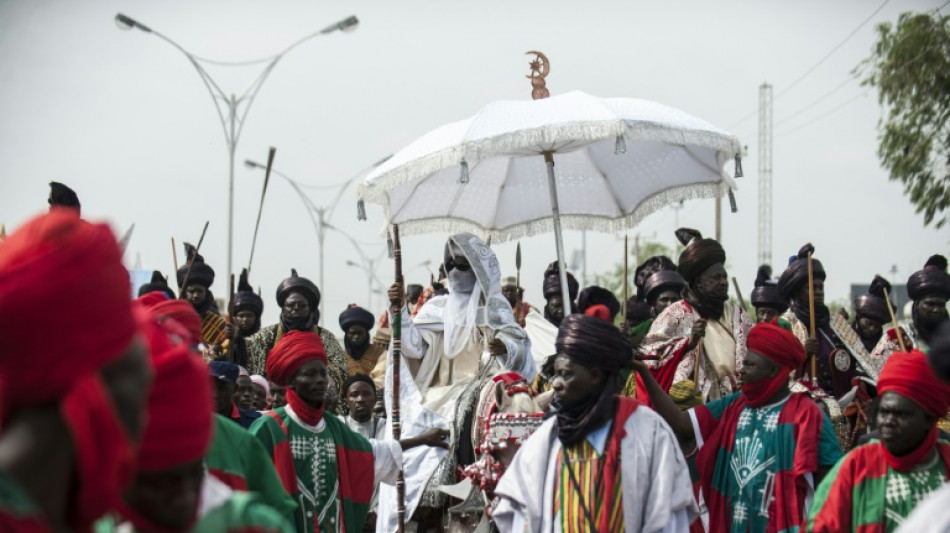
Eid festivities in north Nigeria make UNESCO heritage list / Photo: STEFAN HEUNIS - AFP

Eid festivities in north Nigeria make UNESCO heritage list

UNESCO on Thursday added a colourful parade of Nigerian knights on horseback celebrating Islam's two holiest holidays to its intangible cultural heritage list.

Text size:

Dating back to the 15th century, the processions see a prestigious religious ruler and 10,000 horse riders accompanied by musicians march through the streets of Kano, the largest city in Nigeria's predominantly Muslim north.

They take place twice a year on the Eid al-Fitr and Eid al-Adha holidays celebrated worldwide in the 10th and 12th months of the Islamic calendar, which follows the phases of the moon.

The festivities -- known as Durbar -- are also hosted by multiple cities in the Muslim-majority, Hausa-dominated north.

But they originated in Kano, Nigeria's second-largest city of four million people, home to one of the most senior religious authorities in the land.

"The Durbar is a festival of colour, respect, pride and harmony," said Hajo Sani, who represents Nigeria at the UN cultural body, at the 19th session of the Intergovernmental Committee for the Safeguarding of the Intangible Cultural Heritage in Paraguay's capital Asuncion.

"It is a powerful socio-cultural festival that brings together many ethnic groups, including the Hausa, the Fulani, Arabs, Nupe, Yoruba and Tuareg, thus integrating them into one community," she added.

- Historic religious title -

Escorted by a contingent of palace courtiers, officials and bodyguards, the opulently garbed emir is the central figure in every procession.

He and his entourage parade through the neighbourhoods of Kano, while locals pay their respects and show him support, according to UNESCO's website.

By tradition, the emir of Kano is the second most important Islamic ruler in the country after the Sultan of Sokoto, the highest religious leader in north Nigeria.

Nigeria's many traditional rulers have no constitutional powers but are important cultural custodians, wielding enormous influence in Africa's most populous country.

Kano police banned the Durbar that had been planned for June this year over security concerns, after tensions surged between two traditional chiefs competing for the emir's historic title.

The Durbar constitutes "an industry that creates jobs, economic empowerment within the communities", Sani said.

The festival has "grown to become popular to the point that many states across northern Nigeria now practice it, including the Federal Capital Territory Abuja as a carnival", she added.

The Durbar festivities join other Nigerian cultural landmarks on UNESCO's heritage list, including the northeastern Sukur cultural landscape near the border with Cameroon and the sacred grove of Osun-Osogbo in southern Nigeria.

(K.Müller--BBZ)