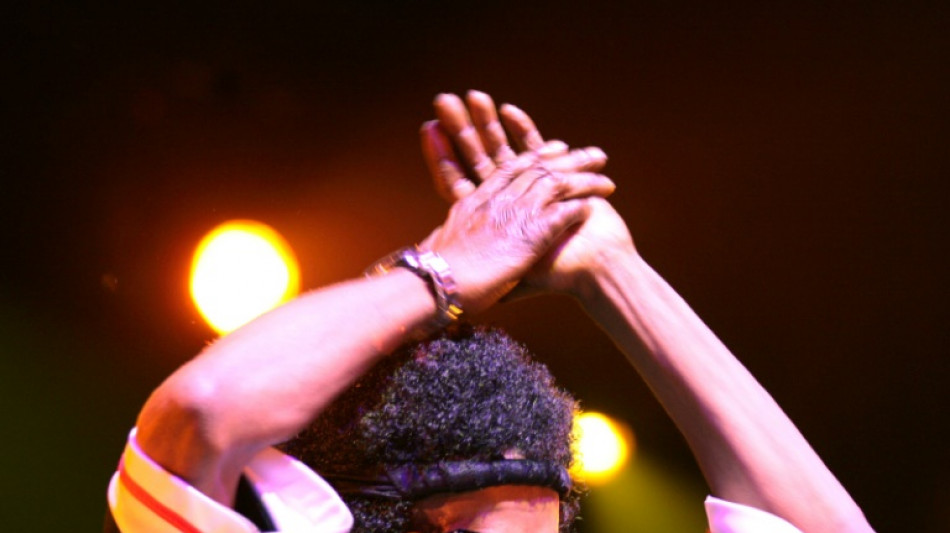
Sly Stone: soul music's groundbreaking, elusive superstar / Photo: FRANCOIS GUILLOT - AFP/File

Funk master and iconic music innovator Sly Stone, whose songs drove a civil rights-inflected soul explosion in the 1960s, sparking influential albums but also a slide into drug addiction, has died, his family said Monday. He was 82.
Stone was the multi-instrumentalist frontman for Sly and the Family Stone -- rock's first racially integrated, mixed-gender lineup.
He "passed away peacefully, surrounded by his three children, his closest friend and his extended family," after a prolonged battle with chronic obstructive pulmonary disease and other health issues, Stone's family said in a statement.
"While we mourn his absence, we take solace in knowing that his extraordinary musical legacy will continue to resonate and inspire for generations to come," it added.
With his vibrant on-stage energy, killer hooks and lyrics that often decried prejudice, Stone became a superstar, releasing pivotal records that straddled musical genres and performing a memorable set at Woodstock.
But he retreated to the shadows in the early 1970s, emerging sporadically for unfulfilling concert tours, erratic TV appearances and a flopped 2006 reunion on the Grammy Awards stage.
An effervescent hybrid of psychedelic soul, hippie consciousness, bluesy funk and rock built on Black gospel, Stone's music proved to be a melodic powerhouse that attracted millions during a golden age of exploratory pop -- until it fell apart in a spiral of drug use.
Over the course of five years, his diverse sound cooperative left an indelible impact, from the group's debut 1967 hit "Dance to the Music" and their first of three number one songs, "Everyday People" a year later, to the 1970s rhythm and blues masterpiece "If You Want Me To Stay."
For many, Sly was a musical genius creating the sound of the future.
It was "like seeing a Black version of the Beatles," funk legend George Clinton told CBS News of his longtime friend's stage presence.
"He had the sensibility of the street, the church, and then like the qualities of a Motown," Clinton added. "He was all of that in one person."
- Huge influence -
The Rock & Roll Hall of Fame inducted the band in 1993, saying: "Their songs were more than danceable hits -- they were a force for positive change."
But Stone struggled to contain the forces and pressures that came with fame. He slid into addiction. He missed concerts. His musical output, once bankable, became erratic.
The music, though, proved extraordinarily influential, laying the groundwork for Prince, Miles Davis, the Red Hot Chili Peppers, and OutKast.
By 1973, the band imploded.
Asked why by talk show host David Letterman a decade later, the elusive star was cryptic: "I couldn't make all the gigs, is what happened."
Multiple drug-related arrests followed. By 2011, he was homeless and living in a van.
In his 2023 memoir, Stone acknowledged he was lost in a deluge of cocaine and PCP, but that he finally went clean in 2019.
Drugs gave him "confidence" and energy, he wrote.
But he regretted "the way I let drugs run my life," he added.
"I thought I could control them but then at some point they were controlling me."
- Family affair -
Sly Stone was born Sylvester Stewart on March 15, 1943 in Denton, Texas. His parents moved the family to San Francisco's suburbs, and built ties with the Church of God in Christ.
He was a musical prodigy; by age seven, Stone was proficient at keyboards, and by 11, he played guitar, bass and drums. He sang gospel in church with his sisters and joined high school bands.
Stone studied music at California's Solano Community College, worked as a disc jockey and became a songwriter and record producer. He played keyboards for Marvin Gaye.
By 1966 Sly and the Family Stone had emerged, with brother Freddie on guitar and vocals, and sisters Rose on keyboards and Vaetta on background vocals.
White musicians Greg Errico on drums and saxophonist Jerry Martini joined them, at a time when such integration was rare.
Their first album fell flat. But when influential music executive Clive Davis urged Stone to make a more commercial record, the band stormed up the charts in 1968, with "Everyday People" reaching number one.
"We got to live together," Stone belted out.
It was a period of tumult in America, with civil rights showdowns, Martin Luther King Jr's assassination and anti-war riots.
"I was scared. At the time it was almost too much all at once," Stone, who is survived by a son and two daughters, once told an interviewer.
In 1969, Stone and his band released the album "Stand!" It was a commercial triumph including the summer smash of the same name that became a touchstone for Black empowerment.
That year, they played a frenetic post-midnight set before half a million people at Woodstock.
More than a generation later, the 2025 documentary "SLY LIVES: AKA, the Burden of Black Genius" shed light on one of soul music's groundbreaking figures.
"Sly opened the floodgates for all musicians of color," music producer Terry Lewis said in the film, "to just do whatever they felt like."
(A.Berg--BBZ)