Ancient Afghan Buddhist city threatened by Chinese copper mine / Photo: Wakil KOHSAR - AFP

An ancient Buddhist city carved out of immense peaks near Kabul is in danger of disappearing forever, swallowed up by a Chinese consortium exploiting one of the world's largest copper deposits.
Located at the confluence of Hellenistic and Indian cultures, Mes Aynak -- believed to be between 1,000 and 2,000 years old -- was once a vast city organised around the extraction and trade of copper.
Archaeologists have uncovered Buddhist monasteries, stupas, fortresses, administrative buildings and dwellings, while hundreds of statues, frescoes, ceramics, coins and manuscripts have also been unearthed.
Despite looting at the beginning of the century, Mes Aynak is "one of the most beautiful archaeological sites" in the world, says Bastien Varoutsikos, an archaeologist for the French company Iconem, which is working to digitise the city and its heritage.
But the need for the Taliban -- who returned to power in August last year -- to find new revenue streams after international aid was frozen has made mining the project a priority, and could put an end to further archaeological work.
- Mining consortium -
Objects discovered date mainly from the 2nd to 9th century AD, but an earlier occupation is also believed likely, and pottery dating back to the Bronze Age -- well before the birth of Buddhism -- has also been found.
Forgotten for centuries before being rediscovered by a French geologist in the early 1960s, Mes Aynak, in Logar province, has been compared to Pompeii and Machu Picchu in size and significance.
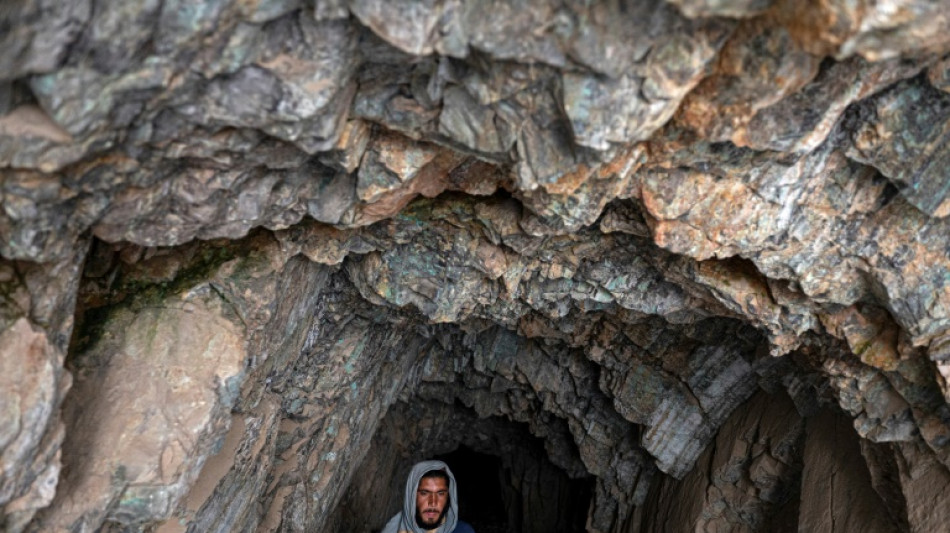
The ruins, which cover 1,000 hectares, are perched high on a massive peak whose brown flanks betray the presence of copper.
But in 2007 the Chinese mining giant Metallurgical Group Corporation (MCC) headed a state-owned consortium -- that later took the name MJAM -- and signed a $3 billion contract to mine ore over 30 years.
Fifteen years later, the mine still does not exist -- insecurity and disagreements between Beijing and Kabul over financial terms of the contract have caused delays.
The project is once again a priority for both parties, however, and talks are ongoing on how to proceed.
- Duty of preservation -
Fears are rising that a place once considered one of the most prosperous trade hubs on the Silk Road could disappear without oversight.
In the early 2010s, it was "one of the largest archaeological projects in the world", Varoutsikos told AFP.
MJAM originally suspended the start of operations for three years to allow archaeologists to focus on the area directly threatened by the mine.
That period was inadvertently lengthened as the security situation prevented the Chinese from building planned infrastructure.
As a result, thousands of objects were unearthed -- some were taken to the Kabul museum, others kept nearby.
When it was last in power the Taliban shocked the world by dynamiting the giant Buddhas of Bamiyan in March 2001, but today they say they are determined to preserve the findings of Mes Aynak.
"It is the duty of the Ministry of Information and Culture to protect them," Esmatullah Burhan, the spokesman for the Ministry of Mines and Petroleum, told AFP.
But while the rhetoric seems sincere, many of the remains are simply too bulky or fragile to be moved and seem destined to disappear.
The Chinese favour open-pit rather than underground mining. If this goes ahead, it would open up the copper mountain and bury all the fragments of the past.
- Environmental consequences -
Afghanistan is sitting on huge mineral resources of copper, iron, bauxite, lithium and rare earths estimated to be worth more than a trillion dollars.
The Taliban hope to earn more than $300 million a year from Mes Aynak -- about 60 percent of the full state budget for 2022 -- and now want to speed up the process.
"This project must begin, it must not be delayed any longer," they have repeatedly told MJAM in recent weeks, according to Burhan.
The discussions are about "80 percent finished", says the spokesman, with only technical points remaining to be settled, which should be done soon.
The Taliban are demanding that the contract -- which includes the construction of a power station to supply the mine and Kabul, and a railroad to Pakistan -- be respected.
They also insist that the copper be processed locally with an Afghan workforce.
China, whose economy is in dire need of copper, is reluctant to meet these demands.
MJAM, which did not respond to AFP, also continues to demand a reduction in royalties due.
The project is also coupled with concerns about its environmental consequences.
Copper mining is polluting and requires large quantities of water, and Logar is already an arid region.
According to Burhan, the Taliban are paying "strict attention" to these issues and will ensure that the consortium meets its obligations in this regard.
For now, the delay is some salvation for archeologists.
While there is currently no work going on at the site, Varoutsikos hopes to restart the excavation before the start of mining operations.
But even that will depend on international collaboration and funding, he notes.
(Y.Berger--BBZ)