Berliner Boersenzeitung - Ethiopia's weavers struggle to keep garment tradition alive

EUR -
AED 4.306958
AFN 75.646812
ALL 95.403289
AMD 432.28087
ANG 2.099103
AOA 1076.592737
ARS 1636.690307
AUD 1.626912
AWG 2.110966
AZN 1.988641
BAM 1.952552
BBD 2.366064
BDT 144.140212
BGN 1.956282
BHD 0.443685
BIF 3496.398396
BMD 1.172759
BND 1.487232
BOB 8.117496
BRL 5.796832
BSD 1.174746
BTN 110.726798
BWP 15.729637
BYN 3.319877
BYR 22986.077003
BZD 2.36267
CAD 1.6024
CDF 2716.109729
CHF 0.914872
CLF 0.02655
CLP 1044.939808
CNY 7.976931
CNH 7.983815
COP 4385.215751
CRC 538.931022
CUC 1.172759
CUP 31.078114
CVE 110.081871
CZK 24.309295
DJF 209.191994
DKK 7.472702
DOP 69.867345
DZD 154.900352
EGP 61.834187
ERN 17.591385
ETB 183.438322
FJD 2.567406
FKP 0.862531
GBP 0.865085
GEL 3.143132
GGP 0.862531
GHS 13.216014
GIP 0.862531
GMD 85.610725
GNF 10310.37544
GTQ 8.970078
GYD 245.781125
HKD 9.186046
HNL 31.207635
HRK 7.530523
HTG 153.864691
HUF 357.234311
IDR 20343.616355
ILS 3.40259
IMP 0.862531
INR 110.813888
IQD 1536.31433
IRR 1539715.33164
ISK 143.768195
JEP 0.862531
JMD 185.041637
JOD 0.831509
JPY 183.990661
KES 151.660983
KGS 102.523179
KHR 4712.181037
KMF 491.385736
KPW 1055.495919
KRW 1708.111579
KWD 0.361151
KYD 0.978971
KZT 544.034959
LAK 25780.112922
LBP 105199.592888
LKR 378.280703
LRD 215.571381
LSL 19.198146
LTL 3.462853
LVL 0.70939
LYD 7.430639
MAD 10.721954
MDL 20.211377
MGA 4878.134444
MKD 61.635489
MMK 2462.608019
MNT 4198.999511
MOP 9.475437
MRU 47.00421
MUR 54.791685
MVR 18.125013
MWK 2042.946093
MXN 20.300108
MYR 4.585732
MZN 74.937715
NAD 19.198337
NGN 1594.846267
NIO 43.046117
NOK 10.890596
NPR 177.172325
NZD 1.97319
OMR 0.450925
PAB 1.174746
PEN 4.054815
PGK 5.112756
PHP 71.362075
PKR 327.333704
PLN 4.233015
PYG 7190.038852
QAR 4.272376
RON 5.262758
RSD 117.373283
RUB 87.552578
RWF 1722.322908
SAR 4.427513
SBD 9.419903
SCR 16.322273
SDG 704.240694
SEK 10.856852
SGD 1.487762
SHP 0.875583
SLE 28.849265
SLL 24592.165999
SOS 670.234383
SRD 43.897533
STD 24273.744145
STN 24.46056
SVC 10.2789
SYP 129.646523
SZL 19.198277
THB 37.868544
TJS 10.978137
TMT 4.116384
TND 3.365231
TOP 2.823722
TRY 53.184585
TTD 7.94678
TWD 36.840461
TZS 3048.012313
UAH 51.443153
UGX 4393.690778
USD 1.172759
UYU 46.971859
UZS 14235.318521
VES 581.933656
VND 30855.290099
VUV 138.495454
WST 3.179951
XAF 654.901031
XAG 0.014959
XAU 0.00025
XCD 3.16944
XCG 2.117178
XDR 0.814487
XOF 654.867581
XPF 119.331742
YER 279.825462
ZAR 19.301245
ZMK 10556.231807
ZMW 22.378771
ZWL 377.627929
  • CMSC

    -0.0400

    22.97

    -0.17%

  • RBGPF

    0.0000

    63.18

    0%

  • JRI

    -0.0200

    13.15

    -0.15%

  • RYCEF

    -0.0500

    17.45

    -0.29%

  • BCC

    -1.4800

    72.76

    -2.03%

  • CMSD

    0.0000

    23.42

    0%

  • GSK

    -0.0300

    50.5

    -0.06%

  • NGG

    -1.9400

    85.91

    -2.26%

  • BCE

    0.3400

    24.57

    +1.38%

  • RIO

    -2.4000

    103.11

    -2.33%

  • RELX

    -1.5900

    34.16

    -4.65%

  • AZN

    -2.4000

    182.52

    -1.31%

  • VOD

    -0.4400

    15.69

    -2.8%

  • BTI

    -1.4800

    58.08

    -2.55%

  • BP

    -0.8200

    43.81

    -1.87%

Ethiopia's weavers struggle to keep garment tradition alive
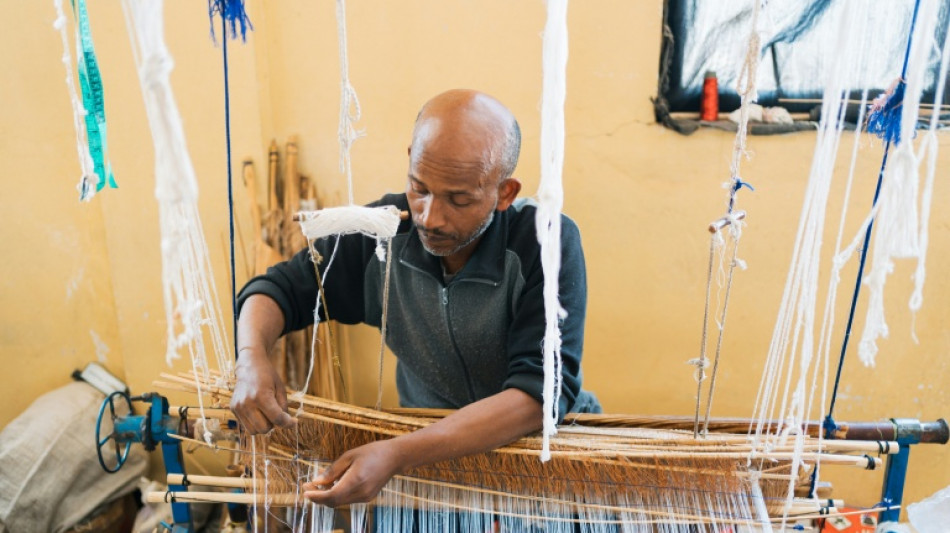
Ethiopia's weavers struggle to keep garment tradition alive / Photo: Sehin Tewabe - AFP

Ethiopia's weavers struggle to keep garment tradition alive

Behind the looms of a workshop in the heart of Addis Ababa, dozens of weavers deftly repeat the same motions to craft traditional dresses -- a centuries-old skill now threatened by Ethiopia's economic hardships.

Text size:

For generations, the "habesha kemis" -- long white cotton dresses often adorned with colourful embroidery -- have been handwoven. Their elaborate designs serve as attire for festivities and religious ceremonies.

It takes a week to weave the simplest dresses, and twice as long for those adorned with intricate embroidery -- a meticulous, painstaking craft, several artisans say in a workshop where the steady clink of looms fills the air.

"The work is exhausting... we live day by day," said Asefaw Yemu, 45, a weaver with three decades of experience who earns between 10,000 and 15,000 birr ($68–102) a month, before deducting the cost of raw materials.

In the dimly lit room, men hunch over their looms, shuttling cotton threads back and forth as their feet work a complex pedal system that never seems to rest.

Asefaw said he works nine hours a day, six days a week -- but with inflation hovering around 21.5 percent this year, according to the International Monetary Fund, demand has slowed sharply.

- 'No Future' -

About 39 percent of Ethiopia's 130 million people lived below the poverty line -- less than $3 a day -- in 2021, a figure the World Bank projected will rise to 43 percent this year.

At the same workshop, Getu Derza, 48, carefully embroiders colourful silk threads into intricate patterns.

"What we produce with so much effort can now be made instantly by machines in factories... It affects our income," said Derza, who began the craft at the age of 14.

An influx of cheaper machine-made habesha kemis from China years ago undercut Ethiopia's traditional weavers. Government restrictions came too late for many, who had already turned to other jobs.

In this struggling economy, Derza said what was once a skill passed down from generation to generation now "ends with us".

At 23, Abush Dubule, the youngest among the weavers, is already considering a career change

"There's no future," he said. "The economy isn't what it used to be... it's not just Chinese products. People are buying less overall."

- 'Special moment' -

A habesha kemis can cost several hundred euros -- a considerable sum in Ethiopia.

Belhu Belta, 48, runs a small shop selling traditional dresses and scarves.

He said he struggles to attract customers but stays in business, hoping there are still those who value handmade garments.

"If the market continues like this, the craft might disappear," Belhu said.

Adanech Daniel, 50, was shopping for a wedding dress and refused to compromise on quality -- representing the kind of customer who keeps Belta optimistic.

"When you wear these traditional clothes together as a family or couple, it brings vibrance and joy to the occasion," she said.

"It's beautiful, it shines and makes the moment special."

(B.Hartmann--BBZ)