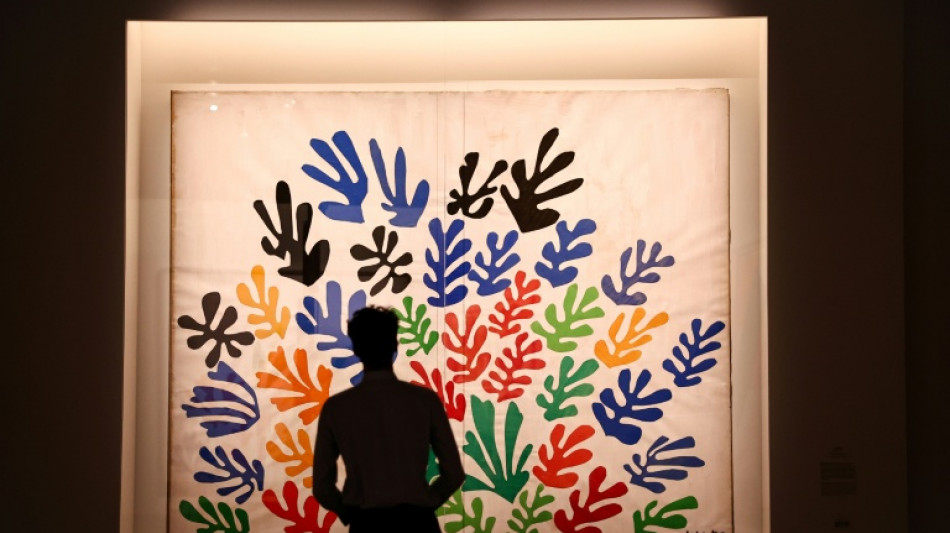
Matisse's last years cut out -- but not pasted -- at Paris expo / Photo: Anne-Christine POUJOULAT - AFP

The final years of Henri Matisse's artistic life, marked by the Nazi occupation of France and a brush with death and surgery, will light up a twilight retrospective opening next week.
From Tuesday, the Grand Palais in Paris will see a reunion of seminal series by the late French master, such as "Blue Nudes", "Jazz" or the monumental "La Gerbe" (The Sheaf), revealing the ageing painter's prolific work ethic despite his health woes.
The exhibition brings together 320 works, from media as varied as paintings, sketches, gouache cut-outs, textiles and stained glass, all drafted by the artist in the run-up to his death in 1954 at the age of 84.
Titled "Matisse 1941-1954", it chronicles a time when the Nazis considered Matisse a "degenerate" artist, during which he confessed to a friend that he came within a "whisker of death" after going under the surgeon's knife in 1941.
"At that time, he was therefore an elderly man, partially disabled and struggling to stand upright," said Claudine Grammont, the curator of the exhibition and a former director of the Matisse Museum in Nice.
Yet despite those woes, Matisse was about to embark on "the most prolific moment of his career", Grammont added.
"It's truly his apotheosis, meaning that the artist reaches a state of nonchalance, of detachment... in short, a moment of grace."
Grammont, who also heads the graphic art department at the French capital's famed Pompidou museum, bristles at the long-standing accusation that Matisse abandoned the art of painting for cut-outs in his old age.
"It has often been said, wrongly, that during this period Matisse stopped painting and did nothing but cut-out gouaches.
"Well, no: Matisse painted 75 paintings between 1941 and 1954."
Nonetheless, Matisse's supposed dotage was marked by an outbreak of inspiration.
"In 1950 alone, 40 works were produced. That's a lot for an 80-year-old man," Grammont said.
- 'Intimacy' -
Visitors will have until July 26 to catch the late Matisse's essential works, including the best part of his ornamentation for the Vence Chapel in southeastern France and its dozen paintings.
It also brings together four of his now-ubiquitous "Blue Nudes", which have become a modern cultural touchstone, visible on tourist-shop T-shirts and the walls of student bedsits alike, even despite criticism of the artist's supposed colonialism from his time in Tahiti.
Matisse would often work on pieces such as 1953's "La Gerbe", with its splash of vividly coloured spiky cut-outs, at night, "because he was an insomniac", Grammont said.
For the curator, Matisse significantly altered his method in his final years, developing "a new iconographic vocabulary" through the cut-out to give his art a monumental scope.
Hence an exhibition on two floors, with spacious rooms capable of housing these large gouache cut-outs once pinned to the walls of his studio.
"What we wanted to recreate in the exhibition is this intimacy within the atelier," Grammont said.
"It's about being able to enter Matisse's studio and find yourself face to face with the artworks."
(U.Gruber--BBZ)