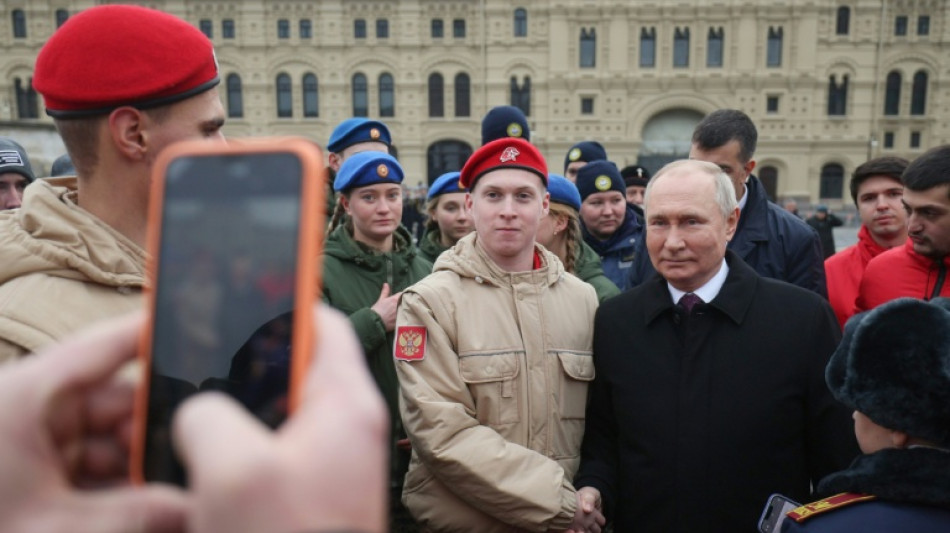
Russia trains teenage influencers to churn out pro-war content / Photo: Gavriil GRIGOROV - POOL/AFP/File

Russia is trying to produce more pro-war influencers through content creation camps, training teenagers to spread the Kremlin's hardline, anti-West narrative to the next generation.
Since invading Ukraine in 2022, Moscow has ramped up control of the domestic information space, outlawing criticism of the offensive through strict military censorship laws, throttling foreign media outlets and pushing its agenda across society.
Schools and young people have been targeted -- curricula and textbooks changed to include Russia's justification for its invasion and soldiers despatched to whip up pro-war enthusiasm in the classroom.
At one content creation camp in early April, more than 120 teenagers, clad in green sweaters and red berets, gathered in Moscow for lectures from soldiers and state media reporters on how to produce videos, use artificial intelligence and build audiences.
"We have created a huge team of kids, who understand how to broadcast government values and our organisation's values," Vladislav Golovin, a former soldier and chief of the general staff of Russia's Young Army cadets movement, said in a statement released by the group.
In a promotional video from the event, children were shown cheering a cadet racing against Golovin to see who could reload a sniper rifle the fastest.
Another organisation, the Movement of the First, runs competitions offering rewards for teenagers with the best blogs and biggest followings.
- 'Easy to radicalise' -
The training camps are part of what Keir Giles, director of the UK-based Conflict Studies Research Centre, calls a "concentrated campaign to restore the prestige of the Russian military."
"These 14–16-year-olds have grown up in an environment where they have never known anything other than Putinism. This is their reality, and so we should not be surprised if these new efforts to spread information reflect that reality," he told AFP.
The drive to instil young Russians with Kremlin-approved values comes from the very top.
In 2023, Russian President Vladimir Putin quoted Otto Van Bismarck to summarise his approach.
"Wars are not won by generals, but by schoolteachers and parish priests," Putin said in a televised press conference.
"Educating young people in the spirit of patriotism is crucial," he added.
The revival of Soviet-era youth organisations, like the Young Army, Yunarmiya in Russian, and Movement of the First -- which says it has 14 million online members and 1,100 regional initiatives -- has been integral to those efforts.
In their beige military uniforms with red berets, the rows of teenage cadets often resemble a bright poppy field at set-piece state events, like grand military parades dedicated to Soviet victory in World War II.
As Russia has clamped down on media and the internet since ordering troops into Ukraine, the campaign has moved online.
AI and disinformation expert at the Technological University of Berlin, Veronika Solopova, said social media algorithms are ripe for the Kremlin to spread its narrative, delivering individually tailored content to evoke an emotional response.
"Young people are famously easy to radicalise, easy to jump to conclusions on the nature of injustices, which, for Russia, is then all conveniently converted into army enrolments," she added.
- 'Behind the camera' -
More than half of Russians aged 18-24 say social media is their main source of news, polling by the independent Levada Centre found in March.
Young people's "shorter attention spans, combined with the effortless shareability of clips and reels, make digital content an exceptionally powerful tool," said Giorgi Revishvili, a former Senior Advisor to the National Security Council of Georgia.
Social media content can be "direct and radical" or "very subtle, aimed not at generating support for Russia, but at decreasing solidarity with Ukraine," said Dietmar Pichler, a disinformation and propaganda analyst at INVED.
At the training camp in Moscow, the Young Army cadets were quick to grasp the power of their new skills.
"When you are the one behind the camera filming the entire process, making audiences happy, you realise ... you are the one who has aroused these emotions in people," a girl said in a promotional clip published by the organisers.
"The truth lies in a frame, and we are operating the camera."
(F.Schuster--BBZ)