Istanbul cymbals: From Ottoman war tool to pulse of global music / Photo: Ozan KOSE - AFP

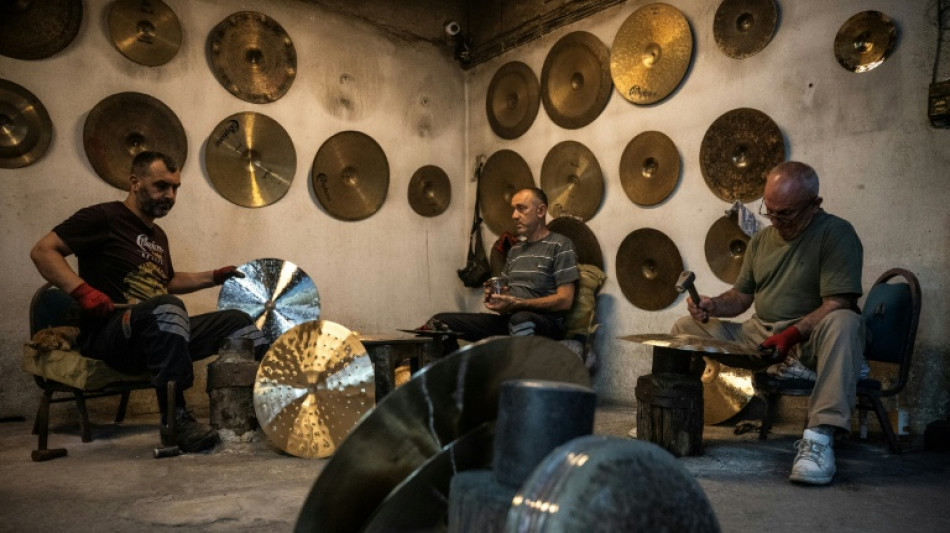
The rhythmic clanging of hammers on bronze echoes through the Istanbul workshop where three craftsmen are landing blows with astonishing precision to transform featureless metal discs into highly prized handcrafted cymbals.
First used by Ottoman military "mehter" bands to frighten and demoralise the enemy, cymbals were a useful tool for an empire on the warpath.
But it would take the skill of a 17th-century Armenian alchemist called Avedis Zildjian to transform them into a percussion instrument whose exotic sound would first captivate Europe's classical composers and then shape the world of jazz.
Although cymbals existed long before Zildjian, he developed a unique alloy and special process for treating the metals that made them less fragile, winning plaudits in 1623 from the Ottoman sultan who let him set up a workshop.
"It's really hard to make good cymbals because they're consistently being crashed, so to make something that wasn't brittle which could withstand continuous use is quite an achievement," explains ethnomusicologist Audrey Wozniak, who specialises in Turkish musical traditions.
The secret was passed down through the generations and although the original Zildjian operation left Istanbul for America in the dying days of the Ottoman Empire, others who learned from the Zildjian masters have continued the tradition.
Today, Istanbul remains the centre of excellence for cymbals, where a handful of brands still produce hand-hammered bronze using techniques developed more than 400 years ago.
- 'A cymbal's soul' -
"We are producing 100-percent handmade cymbals with traditional methods, without using electricity or gas, only coal and wood," explains Mehmet Ozturk, sales rep at Bosphorus Cymbals on Istanbul's northern outskirts, who says casting a cymbal takes up to a week.
First is the casting stage. Most cymbals are made of a copper and tin alloy that is melted into molten bronze which is poured into moulds and cooled into disc-shaped blanks.
Moving swiftly, a worker using a long-handled peel places the blanks into the glowing furnace then removes others that are put through a rolling mill in a cycle repeated up to 15 times to compress and spread the metal which is then water tempered.
"Every stage is crucial," explains master cymbalsmith Hasan Seker, a burly 56-year-old who co-founded Bosphorus Cymbals in 1996 and is sweating after hauling glowing blanks into and out of the furnace.
"We use copper and tin and one more ingredient which is secret. Even though it's in very small quantities, it gives the cymbal a different character in terms of consistency and sound," he told AFP.
After punching out the raised bell and cutting it to size, what looks like the now recognisable cymbal must undergo the all-important hammering process.
"Not a single blow is random," he explains as a trio of craftsmen land expert strikes that create the darker more complex tones so prized by jazz drummers.
This is where a man's emotional state is poured into his work, says Seker, who began working in the trade aged 12 as a summer job.
"When someone is hammering, he might hit softly, then something comes to mind, he gets angry and hit harder. Those variations in the metal's surface, the reservations, the tension patterns diversify the sound. In a way, he gives the cymbal it's soul."
Over the years, Seker has met countless grateful musicians, some of whom come on "a pilgrimage" to the workshop whose grubby walls are lined with ageing posters of jazz drummers like Jeff Hamilton, Stanton Moore and Ari Hoenig.
- 'Every one is different' -
Inside Nardis Jazz Club, a dimly lit venue with an intimate feel in the shadow of Istanbul's Galata Tower, a jazz trio is rehearsing ahead of an evening show with a singer.
For drummer Derin Bayhan, he would only ever use Istanbul-made cymbals because they're "100 percent handmade" and each one has a unique sound.
"Even if you bought two from the same series, the same weight and structure, the two cymbals wouldn't perfectly match. Because it's handmade, it's basically an adventure," the 42-year-old told AFP.
"So you search for one and when you find it, no-one else will have it: that sound is yours."
As to why the Istanbul tradition remains so popular among jazz musicians despite the Zildjian family's move to America where they set up a factory, jazz historian Berk Ozler said it was the search for uniqueness.
"Mass production started when Zildjian went to the USA whereas the ones that stayed in Istanbul were handcrafted and still are. Jazz musicians chase after that uniqueness so that's why they are very valuable."
(S.G.Stein--BBZ)