
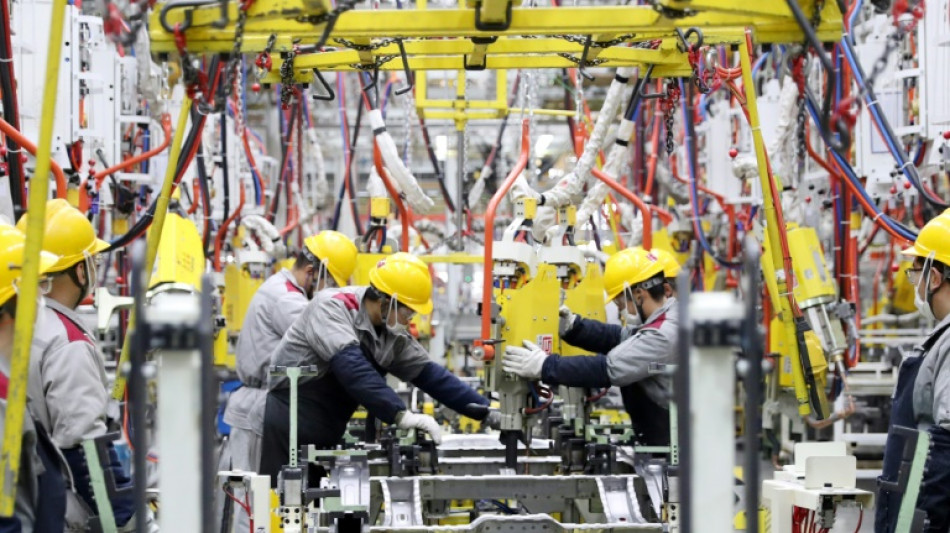
China's economy grows at slowest pace in decades but tops forecasts / Photo: STR - AFP

China's economy grew last year at its slowest pace in four decades as it was hammered by Covid lockdowns and a property crisis but the forecast-beating reading raised hopes for a strong recovery as it reopens.
Beijing's rigid adherence to its zero-Covid strategy of strict containment that effectively shut the country off from the world hammered business activity last year and threw supply chains offline, rattling the global economy.
The measures meant the growth came in at just three percent last year, the worst reading since a 1.6 percent contraction in 1976 -- when Mao Zedong died -- excluding pandemic-hit 2020.
National Bureau of Statistics official Kang Yi told reporters on Tuesday the world's number-two economy had "faced storms and rough waters in the global environment" in 2022.
While the figure missed the government's 5.5 percent target and was well down from the previous year, it was better than the 2.7 percent predicted in an AFP survey of analysts. The fourth-quarter reading also topped forecasts, providing some optimism for 2023.
Meanwhile, retail sales shrank just 1.8 percent in December, compared with the 9.0 percent estimated, as the lifting of restrictions allowed consumers to go back to the high street.
Industrial output and fixed-asset investment also beat expectations, while unemployment fell last month from November.
"The good news is that there are now signs of stabilisation, as policy support doled out towards the end of 2022 is showing up in the relative resilience of infrastructure investment and credit growth," Louise Loo, Senior Economist at Oxford Economics, said in a note.
- 'Zero-Covid' scrapped -
China's economic woes last year sent reverberations across a global supply chain already struggling with waning demand caused by surging inflation and central bank interest rate hikes.
Strict lockdowns, quarantines and compulsory mass testing prompted the abrupt closures of manufacturing facilities and businesses in major hubs -- including Zhengzhou, home of the world's biggest iPhone factory.
Beijing abruptly loosened pandemic restrictions in December in the wake of some of the biggest protests in years but the move has sent infections soaring across the country, sparking concerns about the near-term effects on the economy.
The World Bank has forecast China's GDP will rebound to 4.3 percent in 2023 -- still below expectations.
Problems in the property industry are also still weighing on growth.
The sector, which along with construction accounts for more than a quarter of China's GDP, has been hit hard since Beijing started cracking down on excessive borrowing and rampant speculation in 2020.
The regulatory tightening marked the beginning of financial worries for Evergrande, the former Chinese number one in real estate giant that is now struggling with a mountain of debt.
Real estate sales have since fallen in many cities and many developers are struggling to survive.
But the government appears to be taking a more conciliatory approach to reviving the sector.
Measures to promote "stable and healthy" development were announced in November, including credit support for indebted developers and assistance for deferred-payment loans for homebuyers.
Jing Liu, chief economist for Greater China at HSBC, said the "normalisation path is likely to be bumpy", warning of a "big setback in the near term" followed by a strong rebound.
"The roll-out of a series of measures to ensure sufficient funding support to developers and revive housing demand will also help to stabilise the property sector," she said.
And Chaoping Zhu, of JP Morgan Asset Management, sounded a note of optimism, saying in a note: "Looking forward, we expect to see a sustained economic recovery in 2023 as a result of reopening and policy stimulus.
"Service sectors should be the early beneficiary when pent-up demand is released."
(S.G.Stein--BBZ)



