Berliner Boersenzeitung - EU strikes deal to boost chip production

EUR -
AED 4.099459
AFN 72.55656
ALL 90.854432
AMD 403.236651
ANG 1.997863
AOA 1024.725669
ARS 1725.716503
AUD 1.620032
AWG 2.009266
AZN 1.908969
BAM 1.95792
BBD 2.251649
BDT 139.310855
BGN 1.951032
BHD 0.422353
BIF 3344.903956
BMD 1.116259
BND 1.432558
BOB 13.416528
BRL 6.156839
BSD 1.11797
BTN 104.985685
BWP 15.400226
BYN 3.347906
BYR 21878.671669
BZD 2.248447
CAD 1.574248
CDF 2589.720669
CHF 0.914947
CLF 0.0277
CLP 1090.183107
CNY 7.452703
CNH 7.448895
COP 3616.432801
CRC 507.00375
CUC 1.116259
CUP 26.831195
CVE 110.384532
CZK 24.322276
DJF 199.07927
DKK 7.475501
DOP 67.930698
DZD 152.243187
EGP 60.341267
ERN 16.743881
ETB 183.485227
FJD 2.528995
FKP 0.835844
GBP 0.834074
GEL 2.896647
GGP 0.835844
GHS 13.069152
GIP 0.835844
GMD 83.157879
GNF 9901.932318
GTQ 8.547256
GYD 234.483915
HKD 8.751658
HNL 30.047001
HRK 7.555967
HTG 146.496769
HUF 362.944278
IDR 20214.050795
ILS 3.540654
IMP 0.835844
INR 104.731751
IQD 1695.636147
IRR 2111239.352217
ISK 136.8083
JEP 0.835844
JMD 177.430274
JOD 0.791445
JPY 176.643491
KES 145.068585
KGS 97.614372
KHR 4554.728771
KMF 493.386409
KPW 1004.632839
KRW 1507.256269
KWD 0.347224
KYD 0.931779
KZT 501.111442
LAK 25151.180911
LBP 100111.977802
LKR 371.774398
LRD 190.145903
LSL 18.488377
LTL 3.296022
LVL 0.675214
LYD 7.154286
MAD 10.933439
MDL 19.982972
MGA 5080.04349
MKD 61.557339
MMK 2343.536588
MNT 4019.833098
MOP 9.028977
MRU 45.135041
MUR 52.498031
MVR 17.176539
MWK 1938.561406
MXN 20.74952
MYR 4.533466
MZN 71.324403
NAD 18.488791
NGN 1506.414005
NIO 41.14465
NOK 10.535418
NPR 167.895587
NZD 1.993449
OMR 0.429201
PAB 1.118611
PEN 3.853072
PGK 5.095167
PHP 70.632393
PKR 309.195541
PLN 4.391217
PYG 6988.186673
QAR 4.088627
RON 5.333257
RSD 117.643055
RUB 91.531628
RWF 1650.125559
SAR 4.197709
SBD 8.984301
SCR 15.692146
SDG 671.429609
SEK 11.013898
SGD 1.42957
SHP 0.835992
SLE 25.617714
SLL 23407.392948
SOS 638.897077
SRD 41.952909
STD 23104.302586
STN 24.515236
SVC 9.786598
SYP 14513.596028
SZL 18.482073
THB 37.355611
TJS 10.318073
TMT 3.906906
TND 3.346924
TOP 2.687683
TRY 56.014648
TTD 7.581576
TWD 36.663741
TZS 2954.045111
UAH 50.646343
UGX 4574.954062
USD 1.116259
UYU 44.998728
UZS 13346.452419
VES 1000.52103
VND 28480.784096
VUV 133.12733
WST 3.111933
XAF 655.957
XAG 0.021125
XAU 0.000270979015
XCD 3.016745
XCG 2.015783
XDR 0.789253
XOF 655.957
XPF 119.331742
YER 264.134779
ZAR 18.399961
ZMK 10047.670755
ZMW 22.71661
ZWL 359.434865
SSP 6413.165902
MXV 2.332613
  • CMSD

    -0.1200

    19.81

    -0.61%

  • JRI

    0.0000

    10.77

    0%

  • BCC

    -1.8200

    74.15

    -2.45%

  • CMSC

    -0.2228

    19.53

    -1.14%

  • BCE

    0.2000

    20.34

    +0.98%

  • RIO

    0.0100

    94.17

    +0.01%

  • AZN

    -2.7400

    161.47

    -1.7%

  • GSK

    -1.1800

    48.17

    -2.45%

  • RBGPF

    0.0000

    65

    0%

  • NGG

    0.8800

    75.82

    +1.16%

  • RYCEF

    -0.7300

    19.08

    -3.83%

  • BTI

    -0.4500

    54.4

    -0.83%

  • BP

    0.4700

    43.99

    +1.07%

  • RELX

    -0.0600

    33.18

    -0.18%

  • VOD

    -0.1800

    16.15

    -1.11%

EU strikes deal to boost chip production
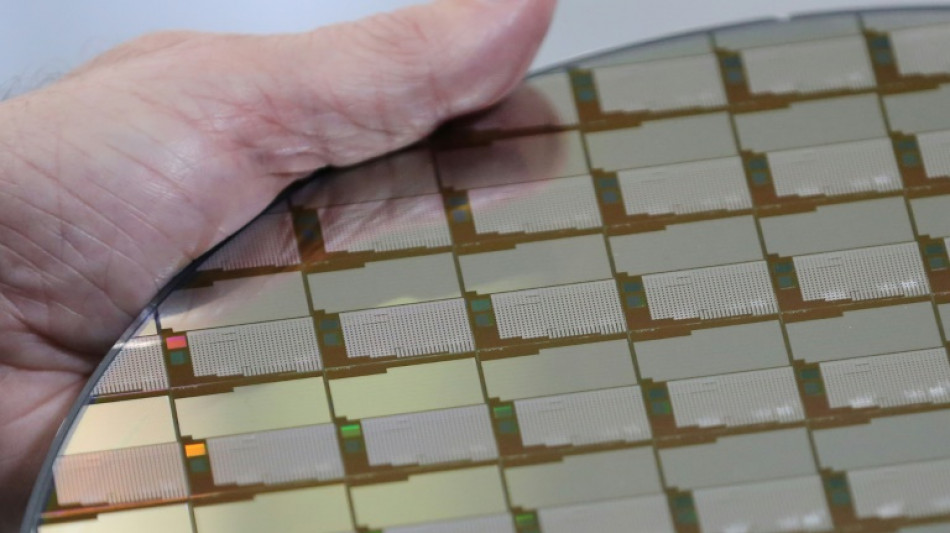
EU strikes deal to boost chip production / Photo: François WALSCHAERTS - AFP/File

EU strikes deal to boost chip production

The European Parliament and EU member states reached an agreement Tuesday on how to boost the supply of semiconductors in Europe, as the bloc races to reduce its dependence on Asian suppliers.

Text size:

The European Union has prioritised local chip production after the economic aftereffects of the coronavirus pandemic triggered supply chain shocks that led to significant shortages.

Asian industry, especially firms in China and Taiwan, currently dominate the manufacture and export of semiconductors.

"The Chips Act will boost the European ecosystem for semiconductors and play a vital part in strengthening the EU's competitiveness at the global level," the bloc's Swedish presidency announced.

Under the agreement, the EU aims to double its current global market share to 20 percent in 2030 and mobilise more than 43 billion euros ($47.2 billion) in public and private investments to feed Europe's growing appetite for chips.

Europe will need to quadruple its production to meet this target.

German MEP Henrike Hahn tweeted that the deal included 3.3 billion euros allocated to "support large-scale technological capacity building and innovation across the EU in the semiconductor sector".

The legislative text, known as the Chips Act, also forms part of the bloc's bid to produce more in Europe to reduce its vulnerability to geopolitical shocks like the war in Ukraine.

When Russia invaded Ukraine last year, the EU scurried to find alternative energy sources after years of relying upon Russian fossil fuels.

"This will allow us to rebalance and secure our supply chains, reducing our collective dependence on Asia," Thierry Breton, the EU's industry commissioner, said in a statement after the parliament and the European Council, which represents member states, reached an agreement.

- Hunger for chips -

Europe was under pressure to act fast.

In August, the United States approved its own Chips and Science Act that included around $52 billion to promote production of microchips and tens of billions of dollars more for scientific research and development.

Japan and South Korea have also vowed to spend billions on developing their countries' semiconductor production.

Washington has leaned on allies including Japan and the Netherlands this year to tighten curbs on semiconductor technology exports to China, much to Beijing's chagrin.

Brussels is racing to protect the bloc's competitive edge in the face of threats from China and the United States, which have ploughed billions into green technology.

Last month, the EU's executive arm published two proposals to push Europe to produce more clean technology including critical raw materials needed to manufacture batteries for electric vehicles.

"Europe aims to become an industrial powerhouse in the markets of the future -– the digital and clean technologies that will allow us to remain a competitive export force, generate quality jobs and ensure our security of supply," Breton said.

"Because there will be no green or digital transition without a strong manufacturing base," he added.

(K.Müller--BBZ)



