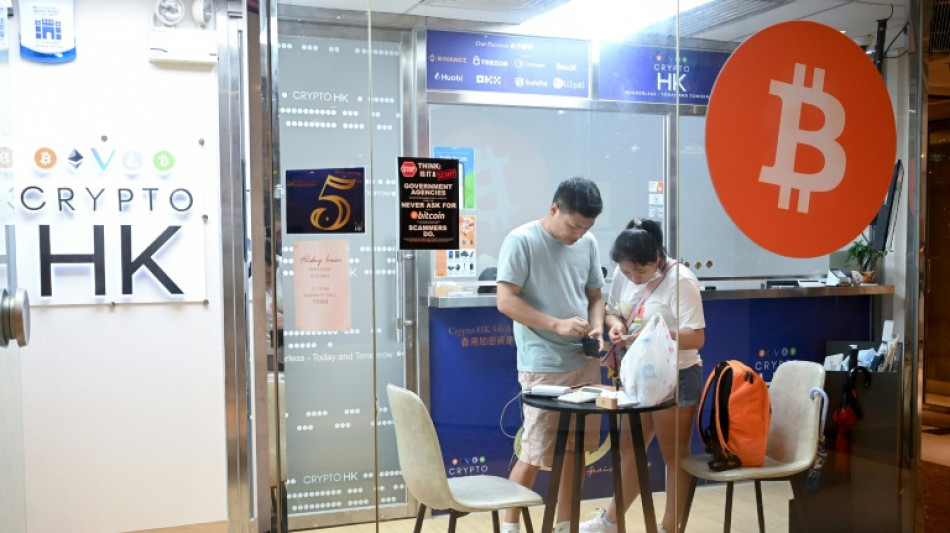
Hong Kong treads fine line on regulating retail crypto trade / Photo: Peter PARKS - AFP

Retail investors in Hong Kong may soon be able to buy popular cryptocurrencies like bitcoin at government-licensed exchanges, thanks to new rules meant to bolster the city's standing as a digital asset hub.
Global crypto markets have yet to recover from a string of high-profile failures in recent months, including the spectacular downfall of trading platform FTX and crypto-friendly US banks Signature and Silvergate.
But the so-called "crypto winter" has not deterred Hong Kong authorities from embracing the sector, a pivot that began last October and culminated with new laws for crypto exchanges starting June 1.
Officials are also hoping the shift will be a boon for the city's economy, which continues to struggle in the wake of the pandemic, social unrest and the impact on business confidence from a Beijing-imposed national security law.
Crucially, observers say it will cement Hong Kong as a key route for mainland Chinese investors looking to trade crypto, which is outlawed in the country.
Regulators are hoping to woo firms with favourable business conditions, but must balance that against the need for investor protections -- a well-developed area in traditional finance but less so in the virtual-asset space.
"There is an explicit acknowledgement that these products are becoming more and more part of our economy," Giuliano Castellano, a law professor at the University of Hong Kong, told AFP.
The city has had a voluntary licensing system for crypto trading platforms since 2019, but licensees could only service professional clients with portfolios of at least HK$8 million ($1 million).
Without licensed local options, Hong Kong's retail crypto traders are relegated to offshore websites such as Binance and Coinbase, or a raft of brick-and-mortar shops that buy and sell tokens for cash.
The client-base restriction was unpopular with Hong Kong's crypto businesses, and officials eventually dropped it when designing the incoming rules.
"The genie's out of the bottle," said Kristi Swartz, a fintech lawyer at DLA Piper, referring to retail crypto trading.
"(They) just have to face reality... If it's already there, let's try to regulate it."
- China's 'petri dish' -
Hong Kong is racing regulators around the world to figure out ground rules for crypto, which despite its crashes still has a global market capitalisation of more than $1 trillion.
The European Union earlier this month approved the world's first comprehensive rules on the sector and international securities watchdog IOSCO proposed its recommendations shortly afterwards.
In contrast to evolving attitudes on crypto worldwide, China has maintained a strict ban since 2021.
Hong Kong -- a Chinese city with financial regulations separate from the mainland -- holds special appeal for China's crypto businesses and investors, according to Leo Weese, co-founder of the Bitcoin Association of Hong Kong.
"There is a huge appetite from... (Chinese) cryptocurrency ventures to have any kind of legal presence on Chinese soil," he said, adding that firms see it as a gateway to the lucrative mainland market.
In both traditional finance and crypto, it is common for mainland Chinese investors to be recognised as Hong Kong clients if they have a bank account and address in the city.
"Once you have a Hong Kong licence, you are going to be able to convince a lot of your mainland clients... that it's safe for them to interact with you through their Hong Kong bank account," Weese told AFP.
Major crypto exchanges like Huobi and OKX, both founded in China, have announced plans to apply for a Hong Kong licence.
While Beijing's anti-crypto stance remains unchanged on paper, senior economy officials have publicly backed Hong Kong's ambitions.
"You can see that China says, 'Look, if it happens in Hong Kong, population circa seven, eight million, that's fine. We can use it as our petri dish,'" Swartz told AFP.
- Protecting investors -
Unlike the outgoing system, the retail-friendly rules taking effect in June will be mandatory, meaning all exchanges doing business in Hong Kong will eventually need to get licensed.
Hong Kong regulators said they hope to move quickly on issuing the first licences.
Some crypto businesses say the switch is not expected to disrupt day-to-day operations as authorities allow a one-year transition period.
HashKey and OSL, the two existing licensees, told AFP they will apply for fresh licences and grow their retail presence.
"There's a very significant need in the market to have platforms that are easily accessible... but are also properly managed and properly regulated," said Michel Lee, HashKey Group's executive president.
"This new regime adds a lot more clarity as to what you're getting, what's the safety standard you will be provided with."
With the memory of FTX's collapse still fresh, Hong Kong regulators said the new rules aim to "provide robust investor protection and manage key risks".
One safeguard is that exchanges can only provide "large-cap virtual assets" -- such as bitcoin and ethereum -- to retail investors, and must set up internal committees to decide which cryptocurrencies to offer.
Retail clients also have to undergo knowledge tests and risk profiling before they can trade -- though it remains unclear what level of knowledge is deemed enough.
Meanwhile, products like stablecoins and crypto derivatives are off-limits for retail investors for the time being.
"The new regulations are meant to protect investors better," said Castellano, the legal scholar.
"It's wise to have a cautionary approach."
(P.Werner--BBZ)