Anti-LGBTQ disinformation surges online in East Africa / Photo: - - AFP/File

Anti-LGBTQ bills in Kenya and Uganda have unleashed an unprecedented wave of online disinformation targeting the community, with experts accusing political leaders of spreading falsehoods that put lives at risk.
Social media platforms have been rife with false claims, including one alleging that Kenya's president called for the killing of gay people and another that the United States ordered Uganda to legalise homosexuality.
"Politicians (in Kenya and Uganda) have tapped into populist homophobia to keep themselves relevant to the masses," said Nairobi-based political analyst and journalist Patrick Gathara.
"An anti-LGBTQ stance translates into one being accepted by voters."
Homosexuality remains a taboo across much of Africa, where gay people are often forced to hide their sexual orientation out of fear for their safety.
Opinion polls show that many East Africans believe that the lifestyle of LGBTQ people threatens traditional values.
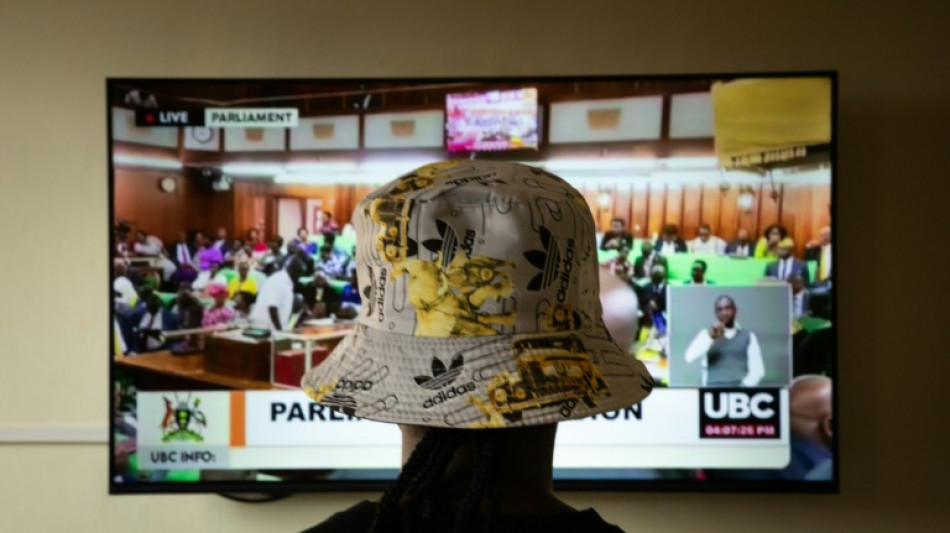
Uganda announced on Monday that President Yoweri Museveni had signed into law a draconian bill prescribing harsh measures including the death penalty for "aggravated homosexuality" in certain circumstances, although Uganda has not carried out capital punishment for many years.
Gay sex is also a crime under colonial-era legislation in neighbouring Kenya whose President William Ruto recently declared that homosexuality was a Western import incompatible with his nation's "customs, traditions, Christianity and Islam".
A proposal calling for the criminalisation of homosexuality is currently before parliament, spurring false claims that the bill had already been approved.
- 'Constant lies' -
The brutal murder in January of prominent Kenyan LGBTQ campaigner Edwin Chiloba sparked national and global outcry. While a man reported to be his lover was charged over the killing, the case put the spotlight on rising homophobia in the region.
In the aftermath of Chiloba's death, several false reports began to circulate online, such as claims that Ruto called for the killing of people in same-sex relationships.
The claim was shared via a graphic made to look like it came from local news site Kenyans.co.ke, which rejected it as fake.
"We did not publish the graphic calling for the killing of gay people, that information is false," the outlet told AFP.
In February, a ruling by Kenya's Supreme Court further stoked anti-gay discourse.
The court ruled that the National Gay and Lesbian Human Rights Commission must be allowed to register as a non-governmental organisation -- a decision which incensed conservatives.
In a rare show of agreement, Ruto and opposition leader Raila Odinga both ranks criticised the ruling, arguing that Kenya was a religious nation and that the court had overstepped its mandate.
Following the legal decision, a video emerged on social media in Kenya and Uganda purporting to show US President Joe Biden vilifying gay people.
AFP Fact Check's investigation showed the clip was a deep fake.
Another conspiracy theory that surfaced after the Supreme Court announcement claimed that Kenya was struggling economically because of LGBTQ people.
Kevin Mwachiro, an openly gay LGBTQ rights activist from Kenya, said the ruling had been misinterpreted as meaning that homosexuality would be legalised.
Political and religious leaders "have used misinformation to twist the reality and this puts LGBTQ people's lives at risk," he told AFP.
"The constant lies make queer people misunderstood. They need to be supported, not persecuted."
- Politics of homophobia -
The LGBTQ community also lacks critical legal protection in Uganda, where homosexuality was criminalised under colonial laws, although there has never been a conviction for consensual same-sex activity since independence from Britain in 1962.
Lawmakers in March approved a new bill criminalising anyone coming out as LGBTQ. It also introduced the death penalty in certain cases in what UN High Commissioner for Human Rights Volker Turk said was "probably among the worst of its kind in the world", while the United States threatened economic repercussions.
In the face of international pressure, the legislation was revised to clarify that identifying as gay without engaging in sexual acts would not be outlawed.
But it nonetheless generated disinformation, including claims that a viral video showed a White House spokesman allegedly threatening to pull US aid unless Uganda legalised homosexuality.
In reality, the clip -- which drew thousands of shares on platforms like TikTok and Facebook -- was from 2014, when Washington briefly halted financial assistance in response to Uganda's anti-gay bill.
But following Museveni's approval of the revised legislation, Biden on Monday threatened to cut aid and investment in the East African country.
Experts warn that homophobic rhetoric is unlikely to abate on the continent.
"Many people in Kenya and Uganda have strict views on sexuality and an intolerance toward homosexuality because they have been conditioned to believe that homosexuality is un-African -- they view sex through a different lens," said Melody Njuki of the Kenyan Initiative for Equality and Non-Discrimination.
(U.Gruber--BBZ)