
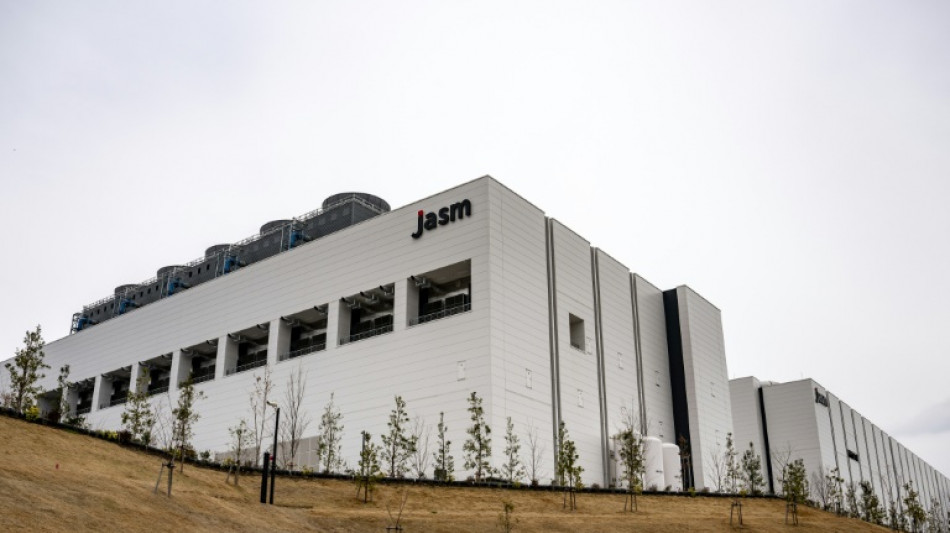
TSMC diversifies out of hotspot Taiwan with new Japan plant / Photo: Philip FONG - AFP

Surrounded by fields of carrots and cabbages, workers are putting the finishing touches to a factory opening on Saturday that is a milestone for both US ally Japan and Taiwanese chip giant TSMC.
The $8.6-billion facility in the southern Kumamoto region showcases TSMC's efforts to make some of its strategically crucial chips elsewhere than hotspot Taiwan, as well as Japan's push to revive its once-dominant semiconductor sector.
The self-ruled island is a silicon superpower but worries have grown about the global chip supply chain because of growing military and diplomatic pressure from China, which claims Taiwan.
The plant is "the most significant TSMC international investment to open in many years", said Chris Miller, Tufts University associate professor and author of "Chip War: The Fight for the World's Most Critical Technology".
"It will also solidify the political relationship between Taiwan and Japan at a time when Taiwan is looking to make sure it's got powerful friends that can help it stand up to Chinese pressure," Miller told AFP.
- Government support -
Firms like Toshiba and NEC helped Japan dominate in microchips in the 1980s but competition from South Korea and Taiwan saw its global market share slump from over 50 percent to around 10 percent.
Now the government wants to bring back the glory days and is making available up to 4 trillion yen ($26.7 billion) in subsidies to help triple the sales of domestically produced chips to more than 15 trillion yen by 2030.
The new TSMC plant in the town of Kikuyo, for which the government pledged over 40 percent of the costs -- Sony and Denso are also on board -- is just the first.
With "strong" Japanese government support, TSMC this month announced a second, $20-billion facility -- for more advanced chips -- and is reportedly eyeing a third and even a fourth plant.
Others getting state funds include Kioxia, Micron, and Rapidus, a joint venture involving IBM and Japanese firms for state-of-the art 2-nanometre logic chips.
- Speed -
Taiwan Semiconductor Manufacturing Company -- which counts Apple and Nvidia as clients -- produces half the world's chips, used in everything from smartphones to cars and missiles.
But concerns about China's intentions for Taiwan have intensified in recent years.
TSMC's customers -- and governments concerned about critical supplies -- have called for the firm to make more chips off the island.
The company is building a second factory in the US state of Arizona and plans another in Germany -- its first in Europe.
But Japan has the advantage of being geographically closer, has a wealth of experience in the sector and, for the Kumamoto plant at least which took 22 months to build, is fast.
"I have seen many factories being built by various companies, but TSMC was built with remarkable speed," Taro Imamura, a local official in Kikuyo, told AFP.
By contrast in the United States, which itself has announced subsidies of $52.7 billion to boost its own sector, the Arizona plant has been delayed and has seen disputes with unions.
- 'Silicon Island' -
"Everyone in town, from children to the elderly, now knows the words 'chips' and 'TSMC'," Imamura said at Kikuyo's town hall, where a banner reads "We welcome TSMC workers".
Regional lender Kyushu Financial Group estimates the economic impact of the plant will be 6.9 trillion yen in Kumamoto in the next decade.
Kyushu, of which Kumamoto is a part, has been known as "Silicon Island" since the 1960s, and is home to more than one-third of Japan's semiconductor companies.
But as with other sectors in ageing Japan, there are worries about finding enough workers, particularly with local students either leaving or preferring other areas than chips.
Students are "more interested in software", said Kenichiro Takakura, associate professor at the National Institute of Technology's Kumamoto College.
Another professor, Kazuyuki Nakamura at the Kyushu Institute of Technology, said students also see the highly cyclical chip industry as high-risk.
"The industry looked glorious back in my days... but it became less popular along with Japan's decline," said the former NEC employee, who runs four-day clean room training for semiconductor workers.
One of Nakamura's students, Keita Oda who plans to pursue a master's degree in semiconductor research, is keen at least.
"Chips are a big part of everyday life," the 22-year-old said. "So I want to work on the industry's front line."
(K.Müller--BBZ)



