
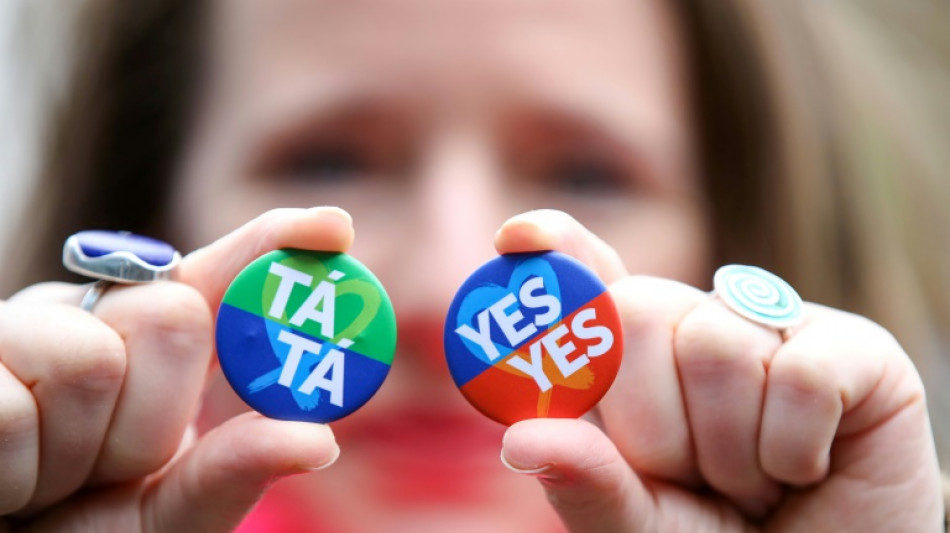
Ireland votes in family, gender equality referendums / Photo: PAUL FAITH - AFP

Ireland votes on Friday on constitutional references to the family and women's role in the home after campaigns that have honed in on vague wording, "mansplaining" and panic over polygamy.
The proposals, called the family amendment and the care amendment, would make changes to the text of Article 41 in the EU member's constitution that was written in 1937.
The first asks citizens to expand the definition of family from those based on marriage to include "durable relationships" such as cohabiting couples and their children.
The second proposes replacing old-fashioned language around the role of "women in the home" with a clause recognising care provided by family members to one another.
For Orla O'Connor, head of the National Women's Council of Ireland, the votes, which coincide with International Women's Day, are about "moving another step forward for equality in Ireland".
"It's about equality for families and equality for women and its also about putting in a value for care but it's talking about it in the context of family members," she told AFP.
The 1937 references are "archaic and outdated" said Catherine Cox, from Family Carers Ireland which is also campaigning for a double "Yes".
According to Yvonne Galligan, a political scientist at the Technological University of Dublin, the family amendment represents a "logical progression" after recent era-defining referenda in Ireland, where the Catholic Church was once all-powerful.
Votes were passed to end constitutional limits on same-sex marriage in 2015 and abortion in 2018.
- 'In the balance' -
All the major political parties support a Yes-Yes vote and until recently polls predicted a smooth passage for both referenda amid low turnout.
But surveys have logged rising unease about the vagueness of the two questions.
This week Prime Minister Leo Varadkar, 45, who heads the centre-right-green governing coalition that proposed the questions, admitted that the referenda results were "in the balance".
"Nobody knows exactly what a 'durable relationship' is, while everyone knows exactly what a marriage is," said David Quinn, founder of the conservative pro-family Iona Institute, near the Irish parliament building.
"A lot of people are going to vote "No" because of the confusion," said Quinn, adding that removing the words "women" and "mothers" from the constitution will also boost the "No" vote.
"Don't cancel women," read one "No" campaign poster on lampposts in Dublin.
Pro-equality commentators have slammed "mansplaining" about women's rights, but disability rights activist Maryam Madani, 34, also says the wording of the care amendment falls short.
"Care is much bigger than just family care, it's not strong enough for the government to say that they are just going to support carers in the home," she said.
Meanwhile ultra-conservative and fringe far-right voices have warned that the changes could protect polygamous relationships, and increase immigration via migrant family reunions.
The government has denied those claims but Varadkar added to jitters in the government-led "Yes-Yes" camp by appearing to scoff at the concept of state care instead of family during an interview last week.
- 'Not well-thought out' -
For Galligan the care amendment is the "more complex" and more likely of the twin questions to deliver a "No" vote.
"People have to think about whether they want the paternalistic and sexist status quo to remain in the wording or whether they want to change it to something else that isn't really satisfactory for anybody," she said.
On Dublin's main pedestrian thoroughfare Grafton Street, Maria Garvey said she might change her mind from "Yes-Yes" as she "isn't sure the questions have been well-thought out".
"The whole notion of a carer may be placing far too much responsibility on a family, rather than maybe the state's responsibility to provide care," said the 73-year-old teacher.
For Aidan Connolly, a 54-year-old IT company director, his probable "Yes-Yes" vote in what he called a "populist" referendum will be "without great conviction".
"Whatever way my wife would like me to vote I'll vote that way, the constitution refers to the role of a woman, if she wants that to be changed then that's OK by me," he added.
(P.Werner--BBZ)



