Berliner Boersenzeitung - Global fertility rate to keep plummeting, major study warns

EUR -
AED 4.119836
AFN 72.353425
ALL 90.796811
AMD 404.49661
ANG 2.007791
AOA 1029.817759
ARS 1733.905407
AUD 1.623323
AWG 2.022055
AZN 1.906177
BAM 1.955784
BBD 2.253581
BDT 138.968835
BGN 1.960727
BHD 0.422496
BIF 3354.486834
BMD 1.121806
BND 1.432094
BOB 13.297651
BRL 6.200257
BSD 1.118891
BTN 105.01712
BWP 15.373391
BYN 3.350272
BYR 21987.389703
BZD 2.250381
CAD 1.584865
CDF 2570.056989
CHF 0.920662
CLF 0.027626
CLP 1087.264975
CNY 7.485583
CNH 7.480351
COP 3677.469454
CRC 506.795752
CUC 1.121806
CUP 26.853775
CVE 110.26211
CZK 24.335834
DJF 199.24833
DKK 7.475432
DOP 68.079429
DZD 152.877321
EGP 59.803351
ERN 16.827084
ETB 180.778551
FJD 2.527203
FKP 0.835919
GBP 0.835526
GEL 2.905454
GGP 0.835919
GHS 13.074657
GIP 0.835919
GMD 83.013474
GNF 9912.961093
GTQ 8.549928
GYD 234.563852
HKD 8.800088
HNL 30.072212
HRK 7.593513
HTG 146.658771
HUF 363.068457
IDR 20284.488806
ILS 3.546515
IMP 0.835919
INR 104.935435
IQD 1699.53548
IRR 2133994.524707
ISK 137.208377
JEP 0.835919
JMD 177.74851
JOD 0.795313
JPY 177.506683
KES 145.744578
KGS 98.101677
KHR 4565.961728
KMF 492.472709
KPW 1009.624994
KRW 1501.705015
KWD 0.348724
KYD 0.932492
KZT 502.005792
LAK 25240.625742
LBP 100198.860137
LKR 372.036882
LRD 190.218406
LSL 18.476074
LTL 3.3124
LVL 0.678569
LYD 7.18994
MAD 10.931613
MDL 20.168831
MGA 5154.696566
MKD 61.537079
MMK 2355.45131
MNT 4040.126843
MOP 9.037024
MRU 45.417619
MUR 52.635648
MVR 17.287255
MWK 1940.183737
MXN 20.757946
MYR 4.550492
MZN 71.694922
NAD 18.476467
NGN 1511.117004
NIO 41.080517
NOK 10.591371
NPR 168.024596
NZD 1.992282
OMR 0.431334
PAB 1.118991
PEN 3.850168
PGK 5.036348
PHP 70.539693
PKR 310.28975
PLN 4.389853
PYG 6993.941377
QAR 4.090166
RON 5.344054
RSD 117.600026
RUB 92.829783
RWF 1655.386125
SAR 4.218456
SBD 9.083595
SCR 15.499005
SDG 674.769145
SEK 10.979891
SGD 1.433987
SHP 0.834708
SLE 25.745278
SLL 23523.707401
SOS 639.49464
SRD 42.12607
STD 23219.110943
STN 24.499795
SVC 9.790918
SYP 14585.71602
SZL 18.394354
THB 37.532806
TJS 10.271614
TMT 3.937538
TND 3.373835
TOP 2.701038
TRY 56.35092
TTD 7.588936
TWD 36.944982
TZS 2965.070174
UAH 50.972382
UGX 4581.879907
USD 1.121806
UYU 45.119622
UZS 13421.887498
VES 1006.461826
VND 28718.223285
VUV 134.617914
WST 3.118735
XAF 655.957
XAG 0.021385
XAU 0.000275121943
XCD 3.031736
XCG 2.016583
XDR 0.793175
XOF 655.957
XPF 119.331742
YER 265.316891
ZAR 18.390135
ZMK 10097.597076
ZMW 22.741809
ZWL 361.220945
SSP 6445.686929
MXV 2.332964
  • CMSD

    -0.1200

    19.81

    -0.61%

  • JRI

    0.0000

    10.77

    0%

  • BCC

    -1.8200

    74.15

    -2.45%

  • CMSC

    -0.2228

    19.53

    -1.14%

  • BCE

    0.2000

    20.34

    +0.98%

  • RIO

    0.0100

    94.17

    +0.01%

  • AZN

    -2.7400

    161.47

    -1.7%

  • GSK

    -1.1800

    48.17

    -2.45%

  • RBGPF

    0.0000

    65

    0%

  • NGG

    0.8800

    75.82

    +1.16%

  • RYCEF

    -0.7300

    19.08

    -3.83%

  • BTI

    -0.4500

    54.4

    -0.83%

  • BP

    0.4700

    43.99

    +1.07%

  • RELX

    -0.0600

    33.18

    -0.18%

  • VOD

    -0.1800

    16.15

    -1.11%

Global fertility rate to keep plummeting, major study warns
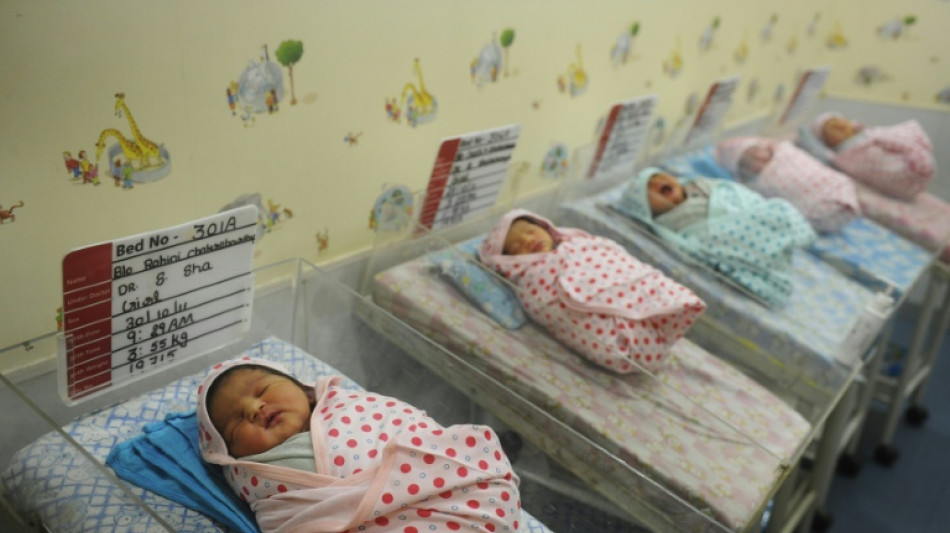
Global fertility rate to keep plummeting, major study warns / Photo: DIBYANGSHU SARKAR - AFP Photos/File

Global fertility rate to keep plummeting, major study warns

The population of almost every country will be shrinking by the end of the century, a major study said Wednesday, warning that baby booms in developing nations and busts in rich ones will drive massive social change.

Text size:

The fertility rate in half of all nations is already too low to maintain their population size, an international team of hundreds of researchers reported in The Lancet.

Using a huge amount of global data on births, deaths and what drives fertility, the researchers tried to forecast the future for the world's population.

By 2050, the population of three quarters of all countries will be shrinking, according to the study by the US-based Institute For Health Metrics and Evaluation (IHME).

At the end of the century, that will be true for 97 percent -- or 198 out of 204 countries and territories, the researchers projected.

Only Samoa, Somalia, Tonga, Niger, Chad and Tajikistan are expected to have fertility rates exceeding the replacement level of 2.1 births per female in 2100, the study estimated.

During this century, fertility rates will continue to increase in developing countries, particularly those in sub-Saharan Africa, even as they tumble in wealthier, ageing nations.

"The world will be simultaneously tackling a 'baby boom' in some countries and a 'baby bust' in others," senior study author Stein Emil Vollset of the IHME said in a statement.

- 'Implications are immense' -

"We are facing staggering social change through the 21st century," he said in a statement.

IHME researcher Natalia Bhattacharjee said the "implications are immense".

"These future trends in fertility rates and live births will completely reconfigure the global economy and the international balance of power and will necessitate reorganising societies," she said.

"Once nearly every country's population is shrinking, reliance on open immigration will become necessary to sustain economic growth."

However World Health Organization experts urged caution for the projections.

They pointed out several limitations of the models, particularly a lack of data from many developing nations.

Communication about the figures "should not be sensationalised, but nuanced, balancing between gloom and optimism," the WHO experts wrote in The Lancet.

They also pointed out that there can be benefits of having a smaller population, such as for the environment and food security. But there are disadvantages for labour supply, social security and "nationalistic geopolitics".

Teresa Castro Martin, a researcher at the Spanish National Research Council not involved in the study, also emphasised that these are just projections.

She pointed out that the Lancet study predicts the global fertility rate will fall below replacement levels around 2030, "whereas the UN predicts this to occur around 2050".

The study was an update of the IHME's Global Burden of Disease study. The organisation, set up at the University of Washington by the Bill and Melinda Gates Foundation, has become a global reference for health statistics.

(A.Lehmann--BBZ)