Berliner Boersenzeitung - Europe space telescope's sight restored after de-icing procedure

EUR -
AED 4.099809
AFN 72.553589
ALL 90.353827
AMD 402.315278
ANG 1.997773
AOA 1024.678639
ARS 1725.279987
AUD 1.626075
AWG 2.009175
AZN 1.90106
BAM 1.946164
BBD 2.248268
BDT 139.173997
BGN 1.950943
BHD 0.420978
BIF 3359.786362
BMD 1.116208
BND 1.427066
BOB 13.238627
BRL 6.235257
BSD 1.116298
BTN 104.906963
BWP 15.314377
BYN 3.342325
BYR 21877.678637
BZD 2.245034
CAD 1.583922
CDF 2584.022076
CHF 0.921429
CLF 0.02791
CLP 1098.449375
CNY 7.445498
CNH 7.453385
COP 3691.143897
CRC 504.91124
CUC 1.116208
CUP 26.790348
CVE 110.755734
CZK 24.346618
DJF 198.372112
DKK 7.475407
DOP 67.775229
DZD 152.376104
EGP 59.51856
ERN 16.743121
ETB 181.685426
FJD 2.523133
FKP 0.831748
GBP 0.83659
GEL 2.891137
GGP 0.831748
GHS 13.070484
GIP 0.831748
GMD 82.599835
GNF 9895.184976
GTQ 8.529841
GYD 233.901835
HKD 8.756965
HNL 30.005428
HRK 7.555624
HTG 146.318779
HUF 364.37831
IDR 20177.69371
ILS 3.552835
IMP 0.831748
INR 104.600963
IQD 1692.236051
IRR 2127576.342113
ISK 136.623451
JEP 0.831748
JMD 177.166727
JOD 0.791414
JPY 177.252707
KES 144.996187
KGS 97.612181
KHR 4554.129257
KMF 490.01522
KPW 1004.587241
KRW 1499.123185
KWD 0.347219
KYD 0.930207
KZT 498.369022
LAK 25125.926583
LBP 99960.545191
LKR 370.981394
LRD 189.75448
LSL 18.30025
LTL 3.295872
LVL 0.675183
LYD 7.155633
MAD 10.889075
MDL 20.058948
MGA 5064.988765
MKD 61.531389
MMK 2343.698252
MNT 4019.967714
MOP 9.01908
MRU 45.039279
MUR 52.372472
MVR 17.200606
MWK 1935.641679
MXN 20.792504
MYR 4.526222
MZN 71.337049
NAD 18.300087
NGN 1504.770995
NIO 41.077525
NOK 10.613019
NPR 167.852637
NZD 1.992482
OMR 0.429182
PAB 1.116288
PEN 3.804348
PGK 5.013311
PHP 70.522583
PKR 308.724149
PLN 4.396091
PYG 6891.033377
QAR 4.069088
RON 5.343511
RSD 117.59587
RUB 92.840226
RWF 1651.544568
SAR 4.197407
SBD 9.03827
SCR 15.657695
SDG 671.39831
SEK 11.025898
SGD 1.431045
SHP 0.830543
SLE 25.617128
SLL 23406.33053
SOS 637.94692
SRD 41.909123
STD 23103.253925
STN 24.379829
SVC 9.767853
SYP 14512.937283
SZL 18.305524
THB 37.543645
TJS 10.258223
TMT 3.91789
TND 3.326827
TOP 2.687561
TRY 56.069925
TTD 7.570683
TWD 36.83118
TZS 2950.338985
UAH 50.772166
UGX 4554.44864
USD 1.116208
UYU 45.166761
UZS 13366.93336
VES 1001.439856
VND 28574.9272
VUV 133.946208
WST 3.103174
XAF 655.957
XAG 0.021666
XAU 0.000276912872
XCD 3.016608
XCG 2.011766
XDR 0.789217
XOF 655.957
XPF 119.331742
YER 263.985148
ZAR 18.456834
ZMK 10047.217754
ZMW 22.743386
ZWL 359.418551
SSP 6413.524713
MXV 2.336848
  • CMSD

    -0.1200

    19.81

    -0.61%

  • JRI

    0.0000

    10.77

    0%

  • BCC

    -1.8200

    74.15

    -2.45%

  • CMSC

    -0.2228

    19.53

    -1.14%

  • BCE

    0.2000

    20.34

    +0.98%

  • RIO

    0.0100

    94.17

    +0.01%

  • AZN

    -2.7400

    161.47

    -1.7%

  • GSK

    -1.1800

    48.17

    -2.45%

  • RBGPF

    0.0000

    65

    0%

  • NGG

    0.8800

    75.82

    +1.16%

  • RYCEF

    -0.7300

    19.08

    -3.83%

  • BTI

    -0.4500

    54.4

    -0.83%

  • BP

    0.4700

    43.99

    +1.07%

  • RELX

    -0.0600

    33.18

    -0.18%

  • VOD

    -0.1800

    16.15

    -1.11%

Europe space telescope's sight restored after de-icing procedure
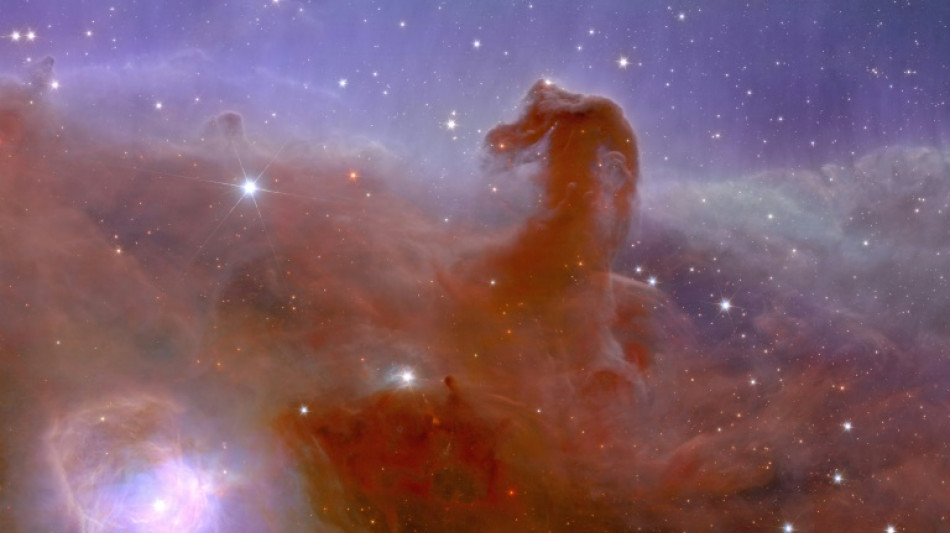
Europe space telescope's sight restored after de-icing procedure / Photo: Handout - ESA/Euclid/Euclid Consortium/NASA/AFP/File

Europe space telescope's sight restored after de-icing procedure

The vision of the Euclid space telescope has been restored following a delicate operation that successfully melted a thin layer of ice that had been clouding its sight, the European Space Agency announced on Tuesday.

Text size:

There had been fears that the creeping ice could delay the mission of Europe's space telescope, which blasted off in July on the world's first mission to investigate the cosmic mysteries of dark matter and dark energy.

However a de-icing procedure to gently warm up an optimal mirror on the telescope "performed significantly better than hoped", the ESA said.

"After the very first mirror was warmed by just 34 degrees, Euclid's sight was restored," it added.

In November, scientists on the ground noticed that they were losing a little light coming into the telescope's visible light imager.

They determined that the problem was a layer of ice -- thought to be just the width of a strand of DNA -- building up on the telescope's optical surfaces.

There are heaters onboard that can warm up the entire spacecraft, a process that was carried out shortly after Euclid launched.

But heat expands many materials, and warming up the whole spacecraft now would require careful recalibration.

That had the potential to delay the telescope's mission by months, Euclid instrument operations scientist Ralf Kohley told AFP last week.

So the team opted instead to warm up single mirrors, hoping to clear up the problem without having to heat the whole spacecraft.

Kohley had said they would move through a number of different mirrors until they found the right one.

But the ESA emphasised they had solved the problem by heating up the very first mirror attempted.

- Wide view of the universe -

Keeping out water is a common problem for all spacecraft.

Despite best efforts on the ground, a tiny amount of water absorbed during a spacecraft's assembly on Earth can smuggle its way to space.

Faced with the cold vastness of space, the water molecules freeze to the first surface they can -- in this case Euclid's mirrors.

The ice was not Euclid's first setback.

The team on the ground previously fixed a software problem in which cosmic rays confused the spacecraft's guidance sensor.

Some unwanted sunlight also interfered with the telescope's observations, a problem solved by slightly rotating the spacecraft, Kohley said.

Euclid is not far from its fellow telescope, the James Webb, at a stable hovering spot around 1.5 million kilometres (more than 930,000 miles) from Earth.

In contrast to Webb's spectacularly long-distance sight, Euclid takes in a far wider view of the cosmos.

It will use this vision to chart one third of the sky -- encompassing a mind-boggling two billion galaxies -- to create what has been billed as the most accurate 3D map ever of the universe.

Scientists hope this will help shed more light on dark matter and dark energy, which are thought to make up 95 percent of the universe but remain shrouded in mystery.

(L.Kaufmann--BBZ)