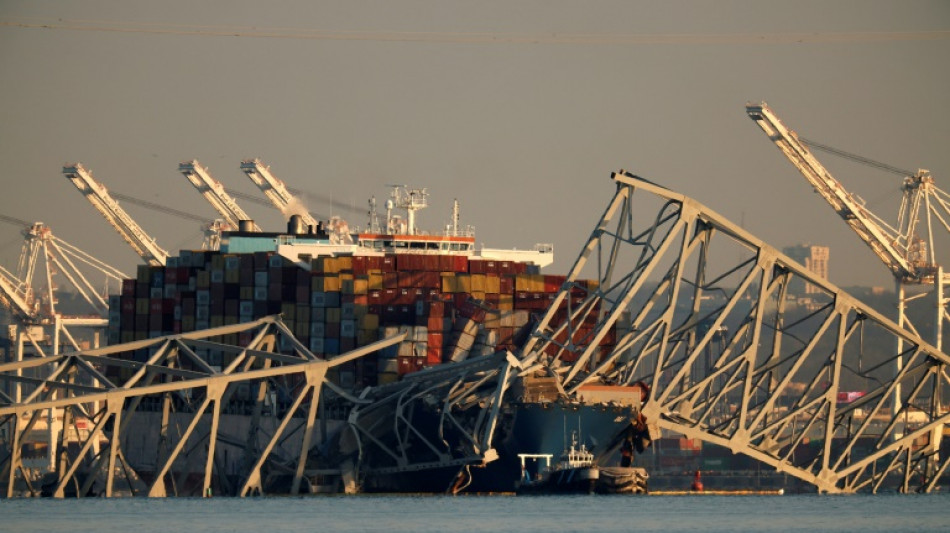
Impact of Baltimore port closure on global supply chains / Photo: CHIP SOMODEVILLA - GETTY IMAGES NORTH AMERICA/AFP

The bridge collapse that closed the Port of Baltimore has raised concerns about the disaster's potential impact on the global supply chain.
Authorities have warned that extensive work is needed before the major port can reopen following Tuesday's catastrophic cargo ship collision, which has blocked the harbour's entrance.
Here is a look at what it could mean for global trade:
- A major car terminal -
Baltimore is among the top 20 ports in the United States by tonnage and number of containers handled, according to the US Bureau of Transportation Statistics.
Last year, it handled a record 1.1 million 20-foot equivalent units (TEU) of containers -- a measure of volume for shipping containers.
Container imports via Baltimore amounted to 2.1 percent of the total for all US ports, according to Allianz Trade.
Its location deep within the Chesapeake Bay make it a "second-tier American port," said Paul Tourret, director of French maritime industry institute ISEMAR.
The port hosts transatlantic traffic, including small ships from northern Europe and the Mediterranean as well as some shipping lines from the Indian Ocean, Tourret said.
But it is a key hub for the auto industry.
Its private and public terminals handled 847,158 autos and light trucks last year, more than any other US port for the 13th year in a row, according to Maryland state figures.
It also ranked first for farm and construction machinery, as well as imported sugar and gypsum, and second for coal exports.
- Alternative routes -
German auto giants Volkswagen and BMW said their operations were not affected as the locations of their facilities were still accessible to ships.
US rival Ford said it had found alternative routes.
But the terminal for Mercedes-Benz is no longer reachable by sea as it is located behind the collapsed bridge.
The company told German media it is looking into alternative routes.
"The blockade of the Port of Baltimore will have little impact on trade between the USA and Europe," Patrick Lepperhoff, principal at Inverto consultancy, wrote in a note.
"In the last quarter of 2023, around 260,000 standard containers were loaded and unloaded at the port.
This volume can be diverted to the neighbouring ports" such as New York and Norfolk, Virginia, he wrote said.
- Coal and cobalt impact -
The port closure is expected to primarily impact US exports of coal and imports of cobalt, according to ratings agency S&P Global.
Access to coal export terminals of CSX Curtis Bay and Consol Marine Terminal has been blocked, it said.
The accident is expected to disrupt coal exports from Baltimore for 10 to 15 days but market participants suggested it would have "limited pricing impacts amid well-stocked markets", S&P added.
Coal exports from Baltimore jumped to 28 million short tons in 2023, mainly due to growing demand from Asia, according to the US Energy Information Administration.
"Even before the port's closure, we were expecting much slower growth in total US coal exports in 2024, of just one percent," the EIA said.
"The interruption in operations in Baltimore may affect the volume of exports this year," it added.
Baltimore's cobalt stocks were already under pressure due to strong demand for the mineral, a key component for electric car batteries and high-tech devices.
Yemeni rebel attacks on ships in the Red Sea have also caused delays as shipping companies have had to divert vessels to the longer and costlier route around southern Africa.
While the bridge incident will have "little to no impact" on US refined oil products, shipping fuel supplies "could tighten" on the Atlantic Coast as vessels refuel outside Baltimore, S&P said.
(L.Kaufmann--BBZ)