
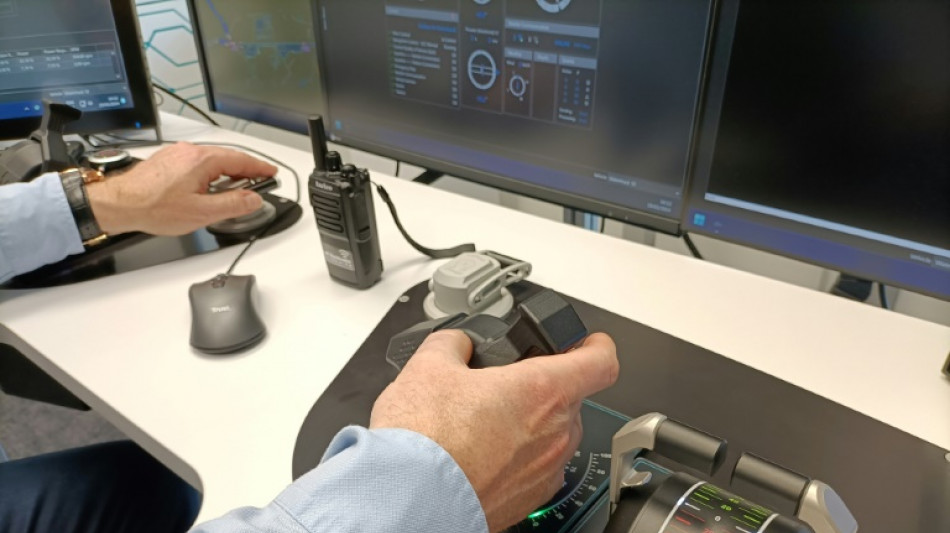
German group mulls remote-controlled ships to fix skipper shortage / Photo: Léa PERNELLE - AFP

With the flow of new recruits into the seafaring sector drying up, a German company is exploring a potentially revolutionary measure -- sending ships off without a captain on board.
HGK Shipping, based in the German port of Duisburg, is testing remote navigation from a control centre on land.
Driverless vessels are "the only solution to survive as an industry", HGK boss Steffen Bauer told AFP.
The average captain's age on HGK's 350 vessels is around 55, said Bauer, whose company claims to be the leading river cargo operator in Europe.
"If we do nothing, we'll lose 30 percent of our sailors by 2030," he said.
In search of a solution, HGK has signed a partnership agreement with the Belgian start-up Seafar, a leader in the emerging field of autonomous navigation.
Founded in 2019, Seafar already operates four pilotless vessels in Belgium and has just opened an office in Germany, which represents 30 percent of Europe's inland shipping.
The crewless ships are guided from a control centre, turning navigation from gruelling work into a potentially more attractive office job.
- Cameras and sensors -
"There is a market for remote-controlled ships," said Janis Bargsten, Seafar's commercial director, adding that establishing a regulatory framework would take less time than perfecting the technology.
In Duisburg, Seafar and HGK have already created a centre for autonomous navigation and are awaiting the approval of the German authorities to launch their first vessels.
In the initial test phase, two captains will remain on board the remotely guided ships.
The longer-term aim is to eliminate the captain's role completely while still keeping some crew on board, Bauer said.
The technology is similar to those used in self-driving cars: the ships are fitted with sensors, cameras, radar and lidar, transmitting data in real time to the command centre.
"Everything is as it would be on board a ship," navigator Patrick Hertoge told AFP in Duisburg next to 10 monitors displaying the status of a autonomous barge on its way to Hamburg.
- Life on land -
After 30 years skippering his own barge, 58-year-old Hertoge was recruited by Seafar to work on the autonomous shipping project.
The son of two sailors, he sold his vessel and found a home on dry land for the first time in his life, he said.
"On a boat, you are on standby 24 hours a day. But here, after eight hours, I can go home," he said.
Seafar wants to start more pilot schemes in Europe and is in "advanced" talks with the French inland waterways authority. It is also planning a test project in the Baltic Sea, Bargsten said.
Autonomous navigation could bring "significant relief" to an industry under pressure but would not solve "all problems", according to a spokesman for the German federation of inland shipping (BDB).
"New questions of responsibility" require legal clarification, he said.
According to Bargsten, in the event of a technical problem, Seafar would be liable, but a human error would be chalked up to the shipping company,
And remotely navigating a vessel is still a highly demanding job that could not just be left to "gamers", he said.
With years of real-life captaining under his belt, Hertoge is convinced it can work.
Much of the work of captaining a ship is the same on land as it is in a control room, he said. The only thing missing is the wind.
(L.Kaufmann--BBZ)



