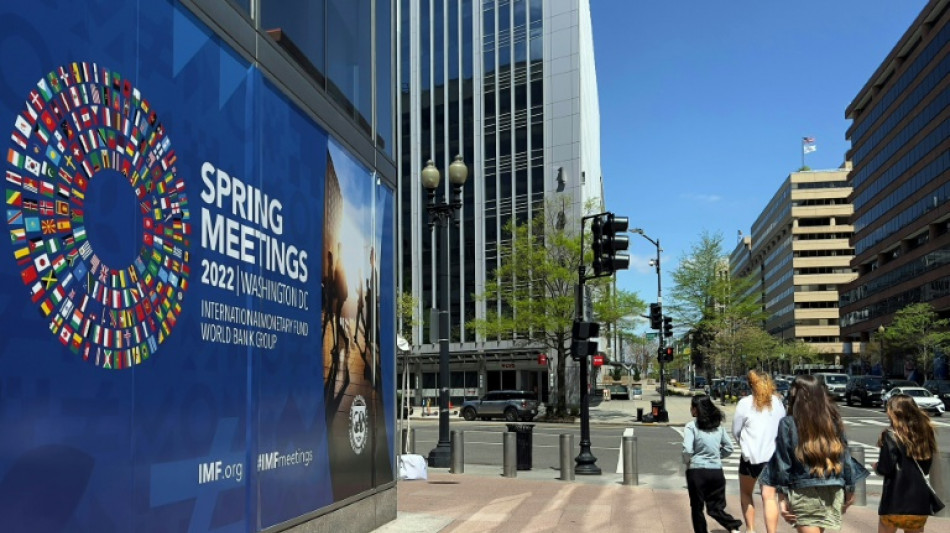
IMF slashes global growth forecasts amid Ukraine war / Photo: Daniel SLIM - AFP/File

The "seismic" impact of the war in Ukraine is spreading worldwide, causing the IMF on Tuesday to sharply downgrade its 2022 global growth forecast to 3.6 percent.
That slowdown, 0.8 points lower than its previous estimate released in January, comes amid surging prices, shortages and rising debt levels, the IMF said in its latest World Economic Outlook.
The fallout has been felt most acutely in the poorest nations, threatening to erase recent gains as the world had begun to recover from the Covid-19 pandemic, and the risks and uncertainty remain high, the Washington-based lender warned.
"The economic effects of the war are spreading far and wide -- like seismic waves that emanate from the epicenter of an earthquake," IMF chief economist Pierre-Olivier Gourinchas said in the report.
Russia invaded Ukraine in late February, devastating the country's infrastructure and ability to produce grain and other goods, while stiff sanctions on Moscow sent fuel prices higher.
The conflict also sparked a flood of refugees into neighboring countries.
The crisis will be the focus of global finance officials who gather in Washington this week -- virtually and in person -- for the spring meetings of the International Monetary Fund and World Bank.
The report shows Ukraine suffering a 35 percent collapse of its economy this year, while Russia's GDP will fall 8.5 percent -- more than 11 points below the pre-war expectations.
European nations will see much slower growth as the war drives up fuel and food prices, pushing inflation higher around the world and keeping it high for longer than expected.
The United States and China also will feel the effects of the war and the ongoing impact of the Covid-19 pandemic, with US growth expected to slow to 3.7 percent, and China's to 4.4 percent.
- Surging inflation -
The official cautioned that the overall outlook is highly uncertain, and things could get drastically worse if the war is prolonged and tougher sanctions imposed on Moscow.
"Growth could slow significantly more while inflation could turn out higher than expected if, for instance, sanctions aimed at ending the war extend to an even broader volume of Russian energy and other exports," he said.
Meanwhile, the pandemic is continuing, and lockdowns in China to defeat renewed coronavirus outbreaks are slowing activity, including in manufacturing hubs, which "could cause new bottlenecks in global supply chains."
The latest crisis hit as the global economy "was on a mending path but had not yet fully recovered from the Covid-19 pandemic," Gourinchas said.
That has fueled an acceleration of inflation -- expected to hit 5.7 percent in advanced economies this year and 8.7 percent in developing nations -- which endangers the gains of the past two years.
And inflation will be elevated for "much longer" than previously expected the report said.
The price pressures have prompted central banks in many countries to begin to raise interest rates to tamp down inflation, but that will hurt highly indebted developing nations, the report noted.
Rising prices were a concern even before the conflict and now shortages caused by the war "will greatly amplify those pressures, notably through increases in the price of energy, metals and food," Gourinchas said.
The official dismissed comparisons with the wage-price spiral seen in the 1970s, but "nevertheless, inflation is a serious concern right now in the US and in other countries," he told reporters during a briefing.
And if price pressures continue to mount "that would call for much more forceful action" from central banks.
- Debt distress -
That would hit developing nations that have seen debt loads increase with rising interest rates.
Gourinchas added his voice to the call to help countries restructure their debt by improving the G20 Common Framework adopted last year, which was meant to offer a path to restructure large debt loads.
A key hurdle has been the lack of information on the size of debt owed to China, as well as some other lenders, by private companies as well as governments, and the need for private creditors to participate in the debt relief.
It's in the interest of the borrowing country and the creditors "to have an expeditious process," he told reporters.
"We need a process that works much faster and much better in dealing with situations of insolvencies."
World Bank President David Malpass, who has been outspoken on the issue, has said 60 percent of low-income countries already face debt distress or are at high risk.
(U.Gruber--BBZ)