
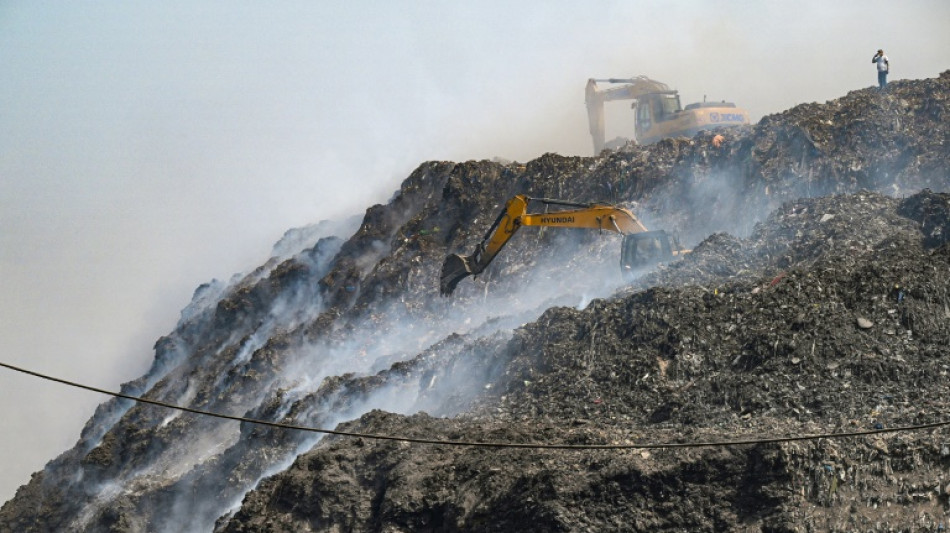
Choking and sweating around Delhi's burning hill of trash / Photo: Prakash SINGH - AFP

Living in a slum by one of New Delhi's trash landfills, Pramod is used to the stench, flies, government apathy and occasional fires. But this week's inferno as India wilts in a heatwave came too close for comfort.
"The fire was a few hundred yards from my home. It was so intense that I felt it was literally touching our skin," Pramod, 35, told AFP, at a lane not far from Bhalaswa landfill in north Delhi.
The blaze on the 60-metre (200-feet) high rubbish hill began Tuesday and lit the night sky up in an apocalyptic orange, belching out noxious black fumes.
It was still smouldering Friday, sending grey smog curling skywards as firefighters hosed it with water for a fourth day.
"I have seen many things in life, but when I saw the landfill on fire, I was terrified," Pramod said. "I've only seen fires like that on the news or on TV."
Right by the landfill, Deepti Foundation -- which educates local children -- had its building's windows melted off from the fire, said project coordinator Lalu Mathew.
"There are a lot of pollutants entering the classrooms," he told AFP. "It is not at all safe for the children to sit and learn something."
- Health issues -
Bhalaswa dump is just one of several in Delhi, testament to the city's failure to manage the 12,000 tonnes of solid trash its 20 million people produce every day.
The local neighbourhoods around it are home to thousands of the poorest of the poor, people who have migrated from grinding rural poverty to the big city in search of work.
They scratch out a living sifting through the rubbish for things to sell, wearing little or no protective clothing. Some are children.
Health problems and accidents are common, and the pay a pittance.
"My children have breathing issues, my in-laws and my husband have asthma," Zarina Khatun, a cook who lives nearby, told AFP.
City planners say the situation in Bhalaswa is a microcosm of challenges across India where new infrastructure has not kept pace with rapid urbanisation.
Untreated domestic waste burns in the landfills during the hot summer months, producing excess methane which further pollutes India's already smog-choked urban centres.
This year, summer arrived early with temperatures crossing 45 Celsius (113 Fahrenheit) in some areas.
Experts blame climate change.
Previously, India would have seen April's soaring temperatures once every 50 years, said Mariam Zachariah from the Grantham Institute at Imperial College London.
"But now it is a much more common event -- we can expect such high temperatures about once in every four years," she said.
"Until net emissions are halted, it will continue to become even more common."
- Trash power -
Prime Minister Narendra Modi has ambitious plans in renewable energy but India still uses coal for some 70 percent of its power needs.
In February he launched a pilot waste-to-gas plant in Indore -- central India's most populous city -- and announced plans for 75 other such facilities in the next two years.
The Indore one converts urban waste and cow dung to produce flammable methane gas, which would power the city's public transit system and provides fertilisers for farmers.
But promises mean little for many Indians all too used to government plans coming to nothing, especially those who have long complained about the dire living conditions around the Bhalaswa dump.
"The governments don't care and the people who could have already moved from here," said Sonu Kumar, 30, who sells eggs near the landfill amidst stray cows, dogs, pigs and drains full of excrement.
"Those who are here don't have anywhere else to go," Kumar told AFP.
(H.Schneide--BBZ)



