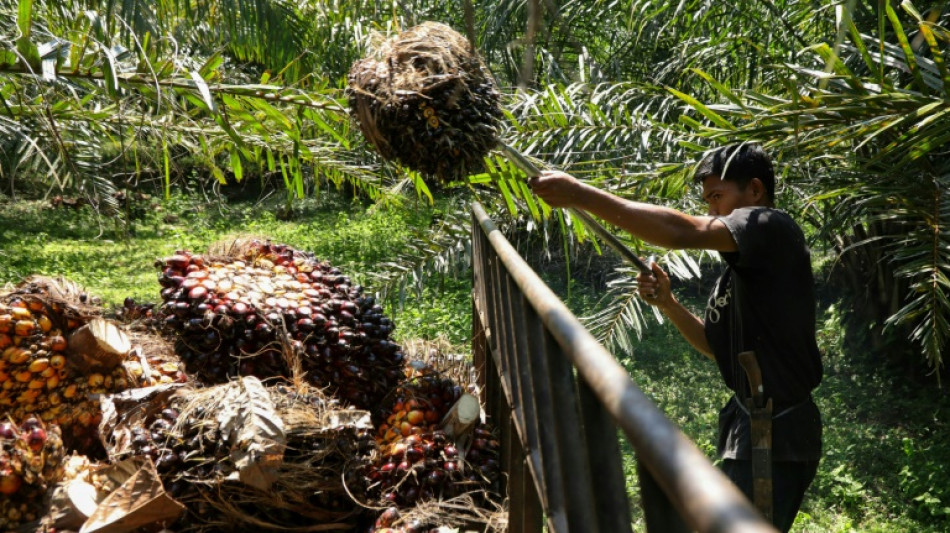
Indonesia's palm oil export ban heats up vegetable oil market / Photo: Azwar Ipank - AFP/File

Indonesia's decision to suspend palm oil exports in the face of domestic shortages has pushed vegetable oil prices to new highs, further tightening a market already on edge due to the war in Ukraine and global warming.
The prices of palm, soybean, European rapeseed and even its Canadian GMO counterpart, canola oil, have reached historic highs following Indonesia's announcement on Wednesday.
"We already had problems with soybeans in South America, with canola in Canada," said Philippe Chalmin, an economics professor at Paris-Dauphine University in France, stating that both crops had been severely affected by extended droughts.
Then came devastation for the "sunflowers in Ukraine" due to Russia's destructive invasion, he added.
Palm oil is the most consumed vegetable oil in the world, and Indonesia accounts for 35 percent of global exports, according to James Fry, chairman of LMC consulting firm.
Indonesia's export ban is designed to bring down prices in the country and limit shortages, according to authorities.
But Chalmin said the move "comes at the worst time."
"The rise in prices dates back to last year already and it is exacerbated by the Ukrainian conflict," he explained.
Rich Nelson of the agricultural market research and trading firm Allendale said "the industry believes it'll last maybe for one month, perhaps two."
But in the meantime, prices are skyrocketing in a market that was "already accelerated," he said.
Unlike other oilseeds, palm fruit does not keep once picked and has to be processed immediately, Fry said.
Indonesia's palm oil storage system, which was already holding substantial reserves, is now under further stress, Fry said.
- Vicious cycle -
Even though the price of vegetable oil, in addition to multiple other agricultural commodities, has been rising for months, demand has yet to slow.
"It's difficult to ration demand for food commodities with higher prices," said Arlan Suderman, chief commodities economist at StoneX Financial.
Palm oil, which is used heavily in processed food such as instant noodles and baked goods, is also present in other consumer products, such as personal care items and cosmetics.
"Eventually it will trickle down," said Paul Desert-Cazenave of consulting firm Grainbow, "but it's still too early to measure price increases to consumers."
In the short term, the only oilseed that might be able to provide some relief on the vegetable oil market is the soybean.
The United States and Brazil, the world's two top soybean exporters, still have available stock, even though more shipments from the countries would only have a marginal impact on edible oil prices.
The United States Department of Agriculture (USDA) announced last month that it expects soybean acreage to increase more than 4 percent from last year, while corn would shrink by a comparable amount.
The world's top rapeseed exporter, Canada, meanwhile said Tuesday that it expected a seven percent decline in acreage devoted to the GMO rapeseeds used in canola oil.
Analysts and economists say they see a need for public policy concerning the food crisis, since in addition to food, vegetable oils are also widely used in biofuels.
Based on the current crisis "we're going to see more pressure on countries to reduce their biodiesel blending mandates, and renewable diesel mandates," Suderman said.
"That's going to take time," he warned, "but that's ultimately where you're going to get your biggest demand destruction."
Europe passed a directive in 2018 excluding palm oil from renewable energy targets by 2030. Some of the bloc's countries, including France, have already stopped using it.
Despite the current turmoil, Indonesia and Malaysia, the world's second-largest exporter, have maintained their respective programs blending palm oil in their biofuels.
To make matters worse, many of the major palm oil importers, mainly Egypt, Bangladesh and Pakistan, have seen their currencies depreciate significantly in recent months, said Michael Zuzolo, president of Global Commodity Analytics and Consulting.
Some major oilseed exporters such as the United States and Brazil have, meanwhile, experienced the opposite, with the dollar reaching multi-year highs.
"This is kind of the worst-case scenario starting to develop," said Zuzolo.
Putting importers in a "negative feedback loop where they're going to have more and more difficulty keeping supplies ample, that's the potential tragedy we're walking ourselves into."
(H.Schneide--BBZ)