
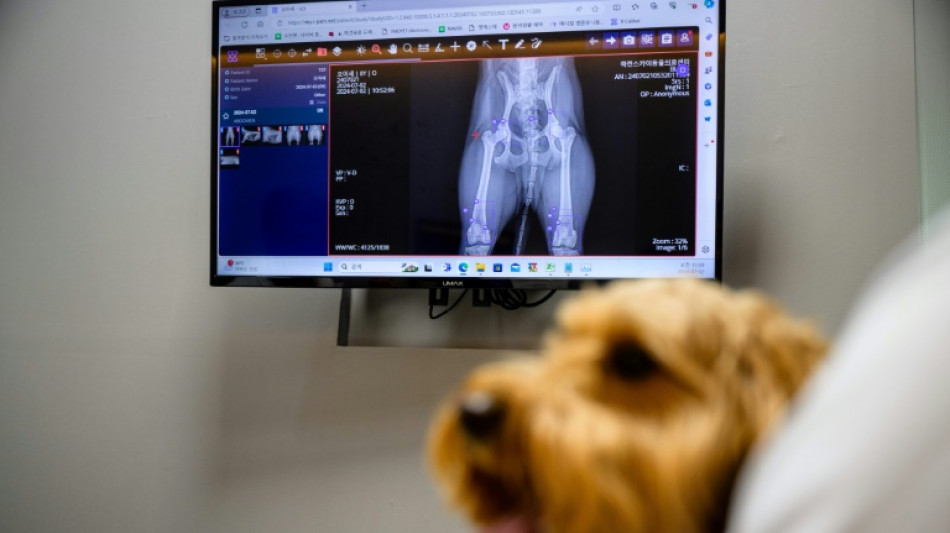
South Korean pet care goes high-tech with AI diagnostics / Photo: ANTHONY WALLACE - AFP

When five-year-old goldendoodle Mozzi started walking "unnaturally", his concerned owner rushed him to the vet in South Korea, where the problem was diagnosed not by humans but by AI.
South Korea, a global leader in the production of chips that power generative AI, has been quick to embrace novel uses of the technology.
One such application, "X Caliber", is helping vets pinpoint X-ray abnormalities in seconds, making diagnostics both quicker and easier to explain.
The AI reading of Mozzi's X-rays showed the curly-haired goldendoodle had a 22 percent chance of knee dislocation. While not an emergency, his condition needed careful management to head off surgery.
"I wouldn't have understood the results if I didn't look at the numbers," said Mo Jae-hyun, Mozzi's owner, adding that the AI program helped him understand his pet's woes.
"Of course, I trust my vet, but looking at the results myself, it seems more credible."
The software's developer, South Korean telecom provider SK Telecom, said X Caliber has a disease detection rate of up to 86 percent.
Vets say it has transformed their ability to diagnose.
"Dogs with heart disease, for example, tend to have enlarged hearts. We use a method called VHS (vertebral heart size), which used to require measuring one by one, manually," Oh I-se, CEO of Sky Animal Medical Group, told AFP.
But now AI can reveal the result in 15 seconds, so it is "much more convenient," Oh said.
- Global aims -
SK Telecom considers X Caliber "the beginning of AI healthcare", said Joo Ye-seul, manager of the software's global team. "We plan further expansion into additional domains based on this."
The service is already available in the United States, Australia and some Southeast Asian countries.
In Indonesia, veterinary hospital owner Kristanya Oen says X Caliber is helping to overcome a lack of expertise and trained staff.
"There is a shortage of radiologists in Indonesian animal hospitals and it is not easy to receive radiology education in Indonesia, so we needed X Caliber to help with our diagnostics," Oen told AFP.
SK Telecom is part of the same conglomerate as SK Hynix, which launched the first high-bandwidth memory chips -- cutting-edge semiconductors that enable faster data processing and the more complex tasks of generative AI.
While many experts are questioning the payoff of lavish AI investments following a recent fall in technology stocks, the conglomerate's CEO Chey Tae-won remains committed.
SK Group must "think fiercely about next-generation products," he told employees this month.
In June, SK Group announced plans to invest 80 trillion won ($60 billion) in AI chips, services and data centres.
- Pet nation -
In South Korea, where more and more people are turning to "pet parenthood" instead of having children, it is not necessarily surprising that AI healthcare would begin with animals.
In a country with one of the world's lowest birth rates, pet ownership has roughly doubled in the last decade, official figures show.
One in four households now have at least one furry friend, and last year more strollers were sold for pets than for human babies on popular e-commerce platform, Gmarket.
The pet care industry was worth an estimated eight trillion won ($6 billion) in 2022, a fourfold increase compared with five years earlier.
The government aims to double the industry's value by 2027 and is helping support pet food and healthcare businesses through various loans and tax incentives.
Jumping on the trend, South Korean companies are working on new ways of integrating AI into pet care, including "smart toilets" for early detection of urinary diseases and "smart leashes" that monitor pulse and body temperature.
"Devices that can monitor mild to severe diseases in the daily life of pets are expected to expand," said Kim Soo-kyung, a senior manager at the Economic Research Institute in KPMG Korea.
(T.Renner--BBZ)



