
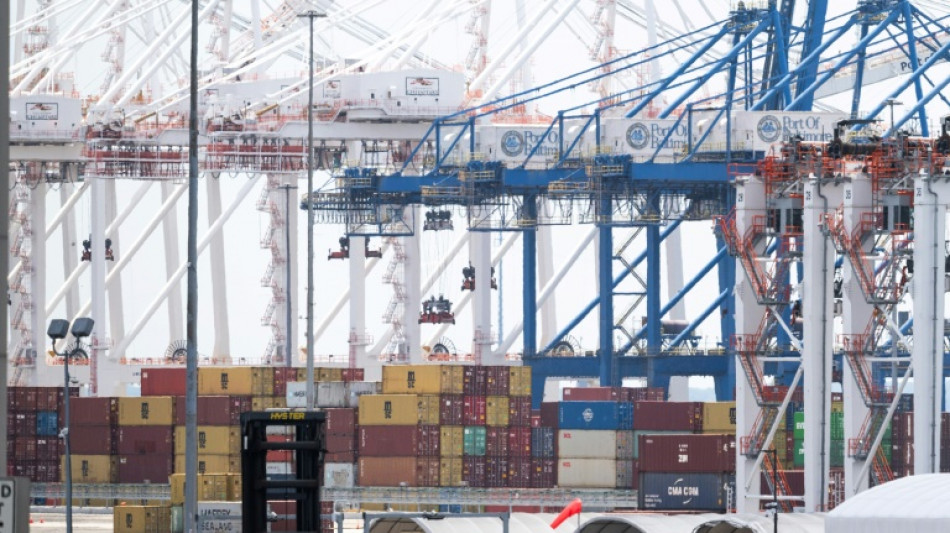
US ports brace for potential dockworkers strike / Photo: SAUL LOEB - AFP/File

Tens of thousands of US dockworkers plan to strike next week if there is no breakthrough on contract talks, just a month before November's closely contested presidential election.
A walkout affecting 14 large ports on the East and Gulf Coast could start at midnight on Tuesday October 1, posing a potentially significant headwind to the US economy.
Negotiations on a new contract began in May but have stalled in recent weeks.
The United States Maritime Alliance (USMX), which represents shipping companies and terminal operators, on Thursday asked federal officials to intervene, citing the union's "repeated refusal to come to the table."
The International Longshoremen's Association (ILA) dismissed the complaint as "another publicity stunt."
The union is pressing for protections against automation-related job loss and for hefty wage hikes after dockworkers kept providing essential services throughout the pandemic.
ILA President Harold Daggett dismissed USMX's "low-ball wage offer" as a "joke," signaling that the rank-and-file are prepared to walk off the job and follow workers at Boeing, Detroit automakers and in other sectors over the last 18 months who have launched strikes in the tight US labor market
The ILA represents 85,000 workers across 36 ports.
A walkout would be the ILA's first since 1977. The contract directly affects some 25,000 ILA members at 14 large US ports, including New York/New Jersey, Boston, Philadelphia, Savannah, New Orleans and Houston.
But a strike would affect additional workers at smaller shipping facilities and terminals all along the coast of the eastern half of the United States, from Maine to Texas.
"A strike will be very disruptive across the US economy and the global economy," said Brent Moritz, a professor of supply chain management at Penn State Smeal College of Business.
The ports that would be on strike accounted for more than half of total US imports through the first seven months of 2024, according to Lloyd's List.
Oxford Economics estimated that the strike would hit US gross domestic product by $4.5 billion to $7.5 billion per week. The overall economic hit depends on the length of the strike, analysts say.
- Federal intervention? -
Under the Taft-Hartley Act, President Joe Biden has authority to order the parties to resume talks for an 80-day "cooling off" period.
But Biden, who has embraced organized labor as president, has ruled out that option, even as White House officials have encouraged talks to resume.
On September 17, a group of nearly 180 businesses, organizations and trade groups urged Biden to work to ensure there are no disruptions, saying in a letter that a strike "would have a devastating impact on the economy, especially as inflation is on the downward trend."
Fresh fruit and produce are expected to be among the most affected items.
"You can't tell a banana to stop growing," Moritz said of the yellow fruit that would be hit by the disruption.
Automobiles are another potentially heavily impacted sector, with Baltimore and Georgia especially active hubs.
Shipping experts expect some goods to still make their way to the West Coast ports, although capacity is limited and it can be more costly.
Air transport is an option, but one that is usually employed for luxury goods, pharmaceuticals or other high-end items.
West Coast ports averted their own strike in 2023 following a contract agreement between business interests and the International Longshore and Warehouse Union.
Peak shipping season typically begins in about June or July, trailing off after October. But this year, volumes began to surge in May and approach records in August, said Judah Levine, head of research at Freightos.
Rates have been elevated in the recent period, partly due to disruptions in the Red Sea.
Shipping rates from Shanghai to New York in July 2024 were about $9,800 per container, up from $2,600 a year earlier, said Levine, who estimates that every day of the strike will lead to about a week's worth of disruption throughout the supply chain.
(A.Berg--BBZ)



