Berliner Boersenzeitung - Ethiopia's famed honeybees make slow recovery from war

EUR -
AED 4.120156
AFN 72.364884
ALL 90.803943
AMD 404.528384
ANG 2.007949
AOA 1029.898611
ARS 1734.077131
AUD 1.621035
AWG 2.022213
AZN 1.906081
BAM 1.955937
BBD 2.253758
BDT 138.979752
BGN 1.960881
BHD 0.42253
BIF 3354.750342
BMD 1.121894
BND 1.432207
BOB 13.298696
BRL 6.180617
BSD 1.118979
BTN 105.025369
BWP 15.374599
BYN 3.350535
BYR 21989.116896
BZD 2.250558
CAD 1.584148
CDF 2570.258612
CHF 0.919678
CLF 0.027618
CLP 1086.958598
CNY 7.486172
CNH 7.481113
COP 3675.536984
CRC 506.835563
CUC 1.121894
CUP 26.855884
CVE 110.270772
CZK 24.341896
DJF 199.263982
DKK 7.475391
DOP 68.084777
DZD 152.624682
EGP 60.451115
ERN 16.828406
ETB 180.792892
FJD 2.526282
FKP 0.835984
GBP 0.834594
GEL 2.90596
GGP 0.835984
GHS 13.075684
GIP 0.835984
GMD 83.020251
GNF 9913.739794
GTQ 8.5506
GYD 234.582278
HKD 8.799058
HNL 30.074574
HRK 7.59411
HTG 146.670291
HUF 362.320075
IDR 20262.354178
ILS 3.543827
IMP 0.835984
INR 104.947573
IQD 1699.668985
IRR 2134162.158274
ISK 137.16221
JEP 0.835984
JMD 177.762473
JOD 0.795385
JPY 177.333286
KES 145.756022
KGS 98.109695
KHR 4566.320402
KMF 492.511066
KPW 1009.704304
KRW 1510.529067
KWD 0.348718
KYD 0.932565
KZT 502.045227
LAK 25242.608639
LBP 100206.73114
LKR 372.066107
LRD 190.233348
LSL 18.477482
LTL 3.31266
LVL 0.678622
LYD 7.190505
MAD 10.932472
MDL 20.170415
MGA 5155.101381
MKD 61.541364
MMK 2355.63634
MNT 4040.44421
MOP 9.037734
MRU 45.421187
MUR 52.76234
MVR 17.288641
MWK 1940.336146
MXN 20.784538
MYR 4.548717
MZN 71.700386
NAD 18.477574
NGN 1510.069344
NIO 41.083519
NOK 10.545145
NPR 168.037795
NZD 1.990812
OMR 0.43133
PAB 1.119079
PEN 3.85047
PGK 5.036742
PHP 70.770227
PKR 310.314733
PLN 4.385572
PYG 6994.490778
QAR 4.090487
RON 5.342349
RSD 117.608052
RUB 92.555869
RWF 1655.516162
SAR 4.218787
SBD 9.084309
SCR 16.429785
SDG 674.81632
SEK 10.994205
SGD 1.434341
SHP 0.834773
SLE 25.747516
SLL 23525.555278
SOS 639.544875
SRD 42.129343
STD 23220.934893
STN 24.501719
SVC 9.791687
SYP 14586.861783
SZL 18.395799
THB 37.502602
TJS 10.272421
TMT 3.937847
TND 3.374093
TOP 2.701251
TRY 56.347225
TTD 7.589533
TWD 36.871595
TZS 2967.406681
UAH 50.976387
UGX 4582.239831
USD 1.121894
UYU 45.123166
UZS 13422.941839
VES 1006.540888
VND 28695.797549
VUV 134.628489
WST 3.11898
XAF 655.957
XAG 0.021165
XAU 0.000272750831
XCD 3.031974
XCG 2.016742
XDR 0.793237
XOF 655.957
XPF 119.331742
YER 265.336214
ZAR 18.376058
ZMK 10098.392022
ZMW 22.743596
ZWL 361.24932
SSP 6446.193262
MXV 2.33655
  • CMSD

    -0.1200

    19.81

    -0.61%

  • JRI

    0.0000

    10.77

    0%

  • BCC

    -1.8200

    74.15

    -2.45%

  • CMSC

    -0.2228

    19.53

    -1.14%

  • BCE

    0.2000

    20.34

    +0.98%

  • RIO

    0.0100

    94.17

    +0.01%

  • AZN

    -2.7400

    161.47

    -1.7%

  • GSK

    -1.1800

    48.17

    -2.45%

  • RBGPF

    0.0000

    65

    0%

  • NGG

    0.8800

    75.82

    +1.16%

  • RYCEF

    -0.7300

    19.08

    -3.83%

  • BTI

    -0.4500

    54.4

    -0.83%

  • BP

    0.4700

    43.99

    +1.07%

  • RELX

    -0.0600

    33.18

    -0.18%

  • VOD

    -0.1800

    16.15

    -1.11%

Ethiopia's famed honeybees make slow recovery from war
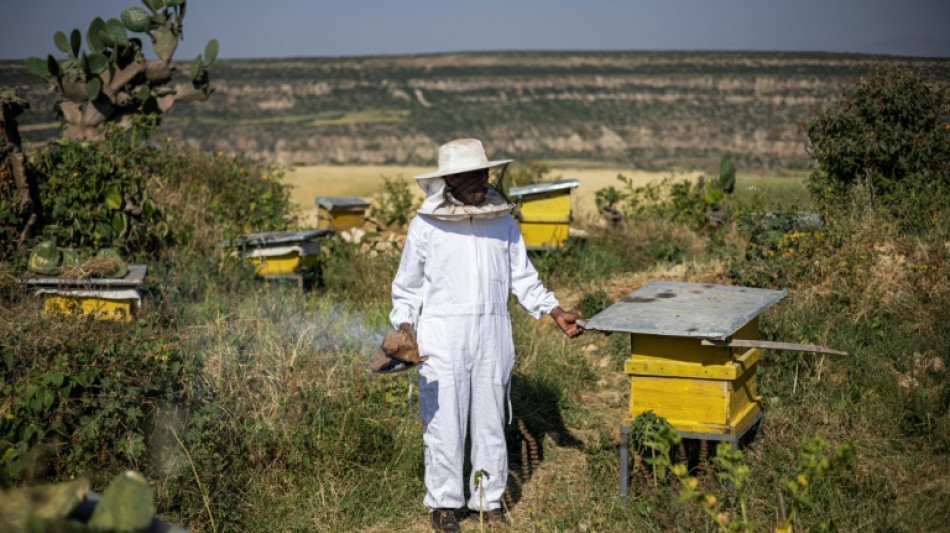
Ethiopia's famed honeybees make slow recovery from war / Photo: Michele Spatari - AFP

Ethiopia's famed honeybees make slow recovery from war

In his stone house perched on a hill in northern Ethiopia, Amanuel Hiluf puts on his protective suit, carefully adjusting the hood and gloves.

Text size:

"We have to hurry up, it starts to be hot, and the bees will be upset," he says.

In his garden in Hawidela, a village about an hour from Mekele, capital of the Tigray region, the beekeeper has about 40 hives from which clouds of bees are soon escaping.

For nearly 20 years, his hives have produced white honey, a creamy, highly prized variety for which the northernmost region of Ethiopia is famous.

Amanuel, 42, remembers a time when they produced "in abundance".

But that was before the war in Tigray between federal government troops and Tigrayan rebels that raged from 2020 to 2022, which forced him to flee with his wife and children.

"In this region, there was a lot of damage," he says, pointing to a hill from which shells were fired.

When he returned a few months later, all his hives -- and his livelihood -- had been destroyed.

Before the war, he could produce about 600 kilos (1,300 pounds) of white honey each year and earn some 900,000 birr (about $7,500 at today's rates).

That is a considerable sum in a country where more than a third of the population lives below the poverty line, according to the World Bank.

When he resumed production, Amanuel said he had lost 95 percent of his earnings. He has gradually rebuilt the hives, but still only produces 100 kilos.

- 'Sound of misery' -

The situation is replicated across Tigray.

Goshu Welealeabzgi, a specialist for the Tigray authorities' Bureau of Agriculture and Natural Resources, says 40 to 60 percent of hives were destroyed by the war.

Before the conflict, he estimates there were 500,000 colonies in Tigray, with 200,000 people directly dependent on beekeeping, in a region of around six million inhabitants.

Bees were also victim to the environmental damage caused by the conflict, especially as desperate locals were forced to cut down trees, particularly the acacias that covered the hills, to sell or use for firewood.

"If trees are lost and flowers are lost, production will decrease," says Amanuel.

"The conflict harmed everybody," he adds. "The sound of bullets has stopped, but there is still the sound of misery."

His hives are home to Apis mellifera monticola bees, a particularly productive species that can survive the region's high altitudes. Mekele sits at more than 2,200 metres above sea level.

Ethiopia, an East African country with a population of around 120 million, is the continent's largest producer of honey.

Nectar is particularly important in Ethiopian culture, with yellow honey used to produce tej, a popular local mead.

Amanuel regularly sells his honey to Birhanu Araya, who runs a small shop in Mekele where dozens of cans containing the precious nectar are piled up.

"There are only very few (bees) due to the war and drought," says 61-year-old Birhanu, who has been running his business for 25 years.

"The amount that's entering now is small and the price is very high," he adds.

Goshu says he remains optimistic.

"If resources are allocated and the community gets onboard, maybe it could recover in three to five years," he says.

"We have to look forward."

(U.Gruber--BBZ)