Trump tariffs loom large in South Korea's 'steel city' / Photo: JUNG YEON-JE - AFP

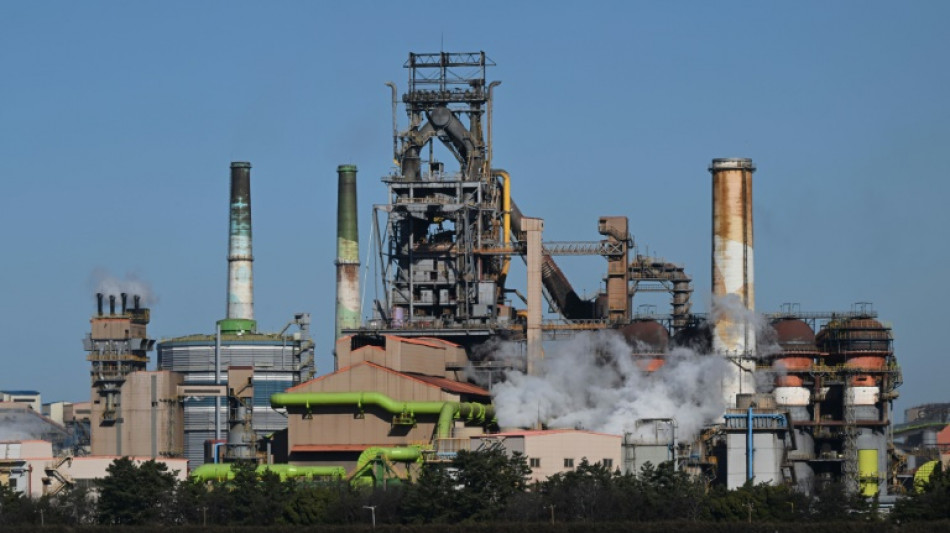
Smoke billows from chimneys as factories churn in South Korea's steelmaking heartland, now under threat from Washington's swingeing new tariffs on the port city's largest export.
The city of Pohang on South Korea's east coast for decades pumped out the steel that fuelled the country's breakneck economic rise.
South Korea was the fourth largest exporter of the metal to the United States last year, accounting for 13 percent of its total steel imports.
But the industry has faced intense strain in recent years from foreign competition.
And businesses, officials and workers in the city now fear a planned 25 percent tariff on all steel imports to the United States beginning next month could have devastating impacts -- and major knock-on effects on South Korea's economy.
"The steel industry is a vital national industry that serves as a fundamental material for key sectors such as construction, automotive and shipbuilding," Pohang's mayor Lee Kang-deok told AFP.
"If the steel industry collapses, the entire South Korean economy will be destabilised," Lee warned.
"If we fail to respond effectively to President Trump's tariff measures, our country's economy could face an even greater shock, leading to an irreversible situation."
- 'Steel city' -
Lying around 270 kilometres (168 miles) southeast of Seoul, Pohang has carved out a rare place as a key industrial hub in a country beset by deepening regional inequality -- and where most resources are tightly concentrated in the capital.
It is home to the nation's top steelmaker, POSCO, a major force in South Korea's industrialisation and development as an export powerhouse, alongside giants like Hyundai Steel and Dongkuk Steel.
"Pohang has long been a symbolic steel city that has supported South Korea for decades, serving as a backbone for the country's development," said Bang Sung-jun, a former Hyundai Steel worker and an official at the Korean Metal Workers' Union's Pohang branch.
"The steel industry has provided quality jobs and sustained the local economy," he told AFP, while acknowledging the pollution produced and the often dangerous conditions for workers in the industry.
How those workers respond to the current crisis, he added, "will determine whether the city of Pohang can sustain its steel industry, putting its very survival at stake".
- 'Significant' impact -
South Korea's steel industry has faced intense pressure in recent years as it grapples with oversupply -- particularly from China -- and a decrease in global demand.
The US tariffs are likely to intensify those challenges, and analysts warn that should cheap Chinese steel barred from the US market begin to flood regions like Southeast Asia and Europe, South Korean steel producers will face deepening price competition.
"Trump's protectionism certainly will affect South Korea's long-suffering steel industry, already squeezed by low-price exports from China and unfavourable Japanese yen exchange rate," Vladimir Tikhonov, professor of Korea studies at the University of Oslo, told AFP.
"The impact will be significant," he said.
Some suggest the tariffs could offer opportunities for South Korean firms to find new export markets.
But for workers in Pohang, where several mills have already shut down, job security and the threat of further layoffs overshadow any potential benefits.
AFP reporters visited a factory owned by Hyundai Steel which closed late last year. It did not appear to be operating and was guarded by a handful of staff at the time of the visit.
Journalists saw signs hung by unionised workers criticising the management and demanding an apology, and through an open door, what looked like debris piled up inside.
"For us workers, it has always been a crisis without any opportunities," said Bang, the unionist.
Worker Lee Woo-man, who has worked as a subcontractor for POSCO for two decades, told AFP that 20 of his colleagues have lost their jobs in the past year.
He expected employment in the city to "decrease even more" over the next four years and believes Trump's tariffs will speed up the decline of the city, which he said has lost the vibrancy it had when he was young.
Lee said he grew up watching the smoke rise from the chimneys of massive mills, thinking to himself: "POSCO is feeding Pohang".
But now that view makes him worry.
"I don't know when this will all fall apart."
(G.Gruner--BBZ)