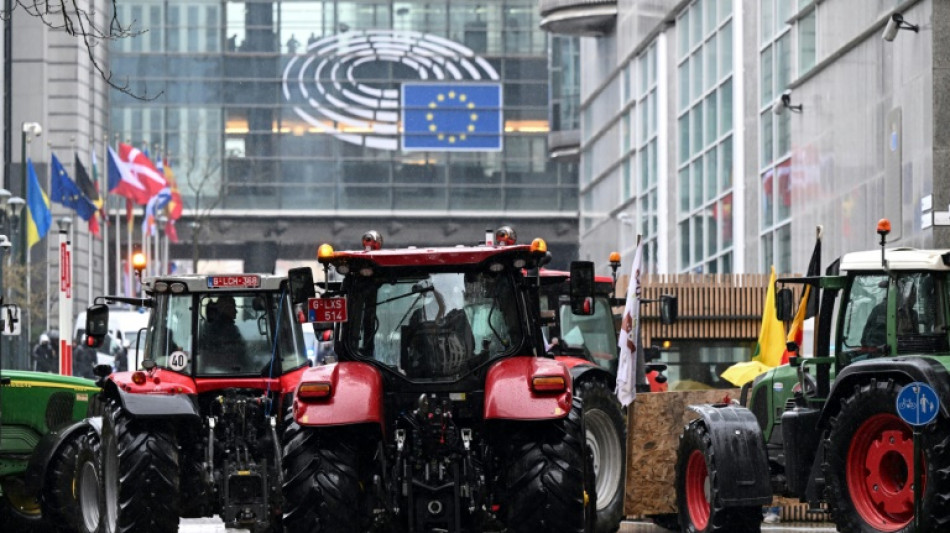
EU eyes stricter food import rules in agriculture policy review / Photo: JOHN THYS - AFP/File

The EU plans to crackdown on food imports that do not meet its standards as part of an agricultural policy review to be published Wednesday that looks to appease disgruntled farmers amid global trade tensions.
The European Commission is due to unveil a new blueprint for a sector that despite gobbling up a third of the bloc's budget has long resented Brussels's liberal approach to trade.
Months of protests last year saw farmers irked at regulatory burdens, squeezed revenues and what they see as unfair competition from less-regulated overseas rivals, hurling eggs, spraying manure and blocking the Belgian capital's streets.
Following consultations with farming lobby groups and environmental NGOs, the "Vision for Agriculture and Food" promises to address some of those concerns.
To ensure that the agricultural sector is not "put at a competitive disadvantage", the commission will pursue "a stronger alignment of production standards applied to imported products," according to a draft of the text seen by AFP.
In particular, Brussels will see to it that "the most hazardous pesticides banned in the EU for health and environmental reasons" are not allowed back in "through imported products".
The draft does not specify a timeline for that or what products or countries could be affected.
"The first mission of this vision is to reduce tensions and calm all parties," said Luc Vernet of Farm Europe, a think tank, noting the text was "extremely cautious".
The prospect of a potential ban on some imports could ruffle feathers abroad against the backdrop of a looming trade conflict.
The Financial Times reported this week US crops such as soybean could be targeted, after President Donald Trump unveiled duties that could hit European exports.
European farmers have also been uneasy at a trade deal with Latin America's Mercosur the commission announced in December.
- 'Paradigm shift' -
The draft document also vows to reform the EU's common agricultural policy (CAP), cutting red tape and better targeting mammoth subsidies towards farmers "who need it most".
This suggests Brussels will move away from the current system, which calculates financial aid based on the size of the farms, favouring large landowners.
"This is a big deal," said Celia Nyssens-James of the European Environment Bureau, an umbrella group of activists, noting that the lion's share of money is now going to a minority of farmers who don't "necessarily need it".
"It's a paradigm shift," she said.
The EU subsidises farming to make sure enough food is produced at affordable prices, and farmers are rewarded for taking care of nature.
Those subsidies are massive and prized by farming states, most notably France, Ireland and eastern European nations, where farmers have a strong political influence.
Some 387 billion euros ($460 million) was earmarked for agriculture in the EU's budget for 2021 to 2027.
Negotiations on the next instalment of the CAP for 2028-2034 are set to be one of the most sensitive subjects during EU chief Ursula von der Leyen's second term in office, which began in December.
According to the draft plans, more money should flow towards young farmers as well as those who contribute to the environmental preservation or work in areas with "natural constraints".
The document did not provide any details about how a new system could work.
Simplifying access to funding for small- and medium-sized farmers by streamlining "controls and conditions" is also envisaged.
Furthermore the text calls for the 27-nation bloc to reduce "dependencies" and diversify supply chains, with fertiliser imports from Russia highlighted as of particular concern.
Agriculture contributed 1.3 percent to the EU's GDP in 2023, according to the bloc.
Europe's agri-food sector employed 30 million people, accounting for 15 percent of EU employment.
(L.Kaufmann--BBZ)