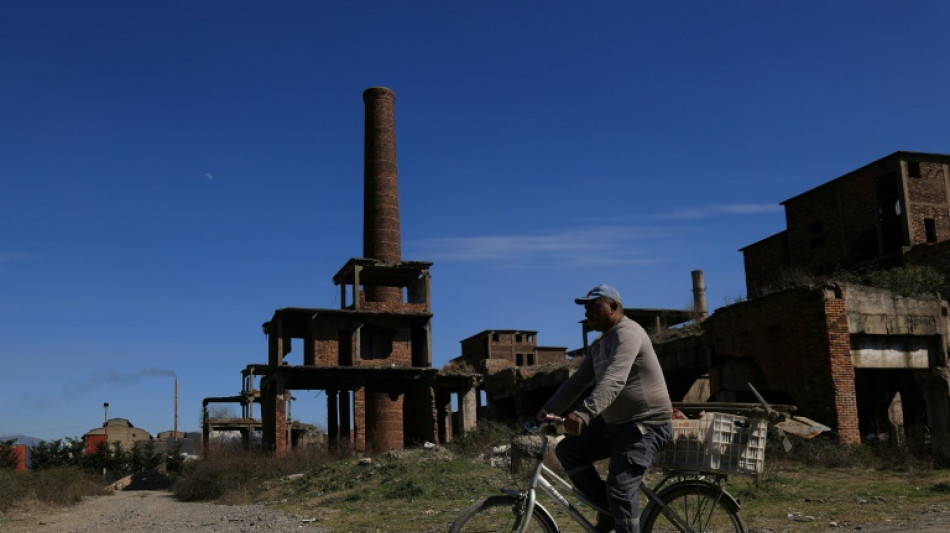
Poisoned legacy of Albania's steel city / Photo: Adnan Beci - AFP

Once the pride of Albania's communist regime, the giant Elbasan metals complex is now one of the most polluted sites in the Balkans, burdened with hundreds of thousands of tonnes of waste, much of it hazardous.
Built in the 1970s with Chinese help, the vast "Steel of the Party" site once employed 10,000 workers in 500 factories during Enver Hoxha's dictatorship.
Now only a tenth of that number work in the privatised plants that have survived, with everything that could be sold stripped from the ruins of the rest.
Despite the risks and the stench, anyone can enter large swathes of the site and many earn a living scavenging the piles of hazardous waste in search of metals to resell.
"This is an area where 1.5 to two million tonnes of hazardous waste have been stored for over 35 years, polluting the water, air and soil," Beqir Kila, a prominent Albanian environmental activist and engineer, told AFP.
Analyses carried out by various independent expert groups showed lead, nickel and chromium levels at least three times higher than European limits, he said.
The Albania's environmental agency said the complex, only five kilometres (three miles) from the town of Elbasan, tops the list of "high-risk sites with a high potential for pollution from heavy metal waste such as ferronickel and ferrochrome, a legacy that continues to pollute the waters of the Shkumbin River" in a report in January.
However, the authorities are not proposing any solutions, environmentalists warn.
"Stored in the open air, at the mercy of atmospheric conditions, this waste undergoes changes and all the dangerous and toxic elements it contains seep into the soil and water," warned Kila showing his hands covered in black dust.
For years, the area in Albania's fertile central valley has been haunted by reports of high rates of cancers and birth defects.
"Lead emissions have caused brain failure, especially in children, but also genetic problems in cattle and poultry," Kila said.
- 'Catastrophic pollution' -
The steel plants have long insisted that they are following the rules, but neither they nor the Albanian government responded to AFP requests for comment.
"We consider the pollution in the industrial zone of the former Elbasan steel complex to be catastrophic," said environmental expert Ahmet Mehmeti.
Apart from problems from the old, ruined factories, many of which are in danger of collapse, there is also pollution from the new factories, he warned.
Official figures on air pollution around Elbasan do not exist and air quality assessment is done by the factories themselves.
The "hide-and-seek game with the authorities suits the companies perfectly", Mehmeti said, as they are interested in cost-cutting rather than in pollution levels.
An AFP team witnessed a chimney spewing out black smoke at the site. But when a cameraman with a drone arrived, the smoke suddenly stopped.
"The waste contains chromium, nickel, zinc... the emissions pass into the water, flowing into the nearby river, which is used to irrigate the soil and ends up with fruit and vegetables on our plate," Mehmeti said.
Albania exports hazardous and non-hazardous waste that is not left on site since it is unable to treat it itself.
Last July, a total of 102 containers filled with waste left Albania for Thailand, where they were to be recycled.
But after a whistleblower reported that the waste was suspected of being toxic and had not been registered as such, it was turned back, and has been in Albania since November.
"Albania has a law on the export of hazardous and non-hazardous waste, but the problem lies in the lack of control over procedures and documents," said environmental activist Lavdosh Ferruni.
The public prosecutor's office in the port of Durres has opened an investigation with the European Anti-Fraud Office (OLAF) into the case.
Meanwhile, the suspected toxic waste remains in Albania.
(S.G.Stein--BBZ)