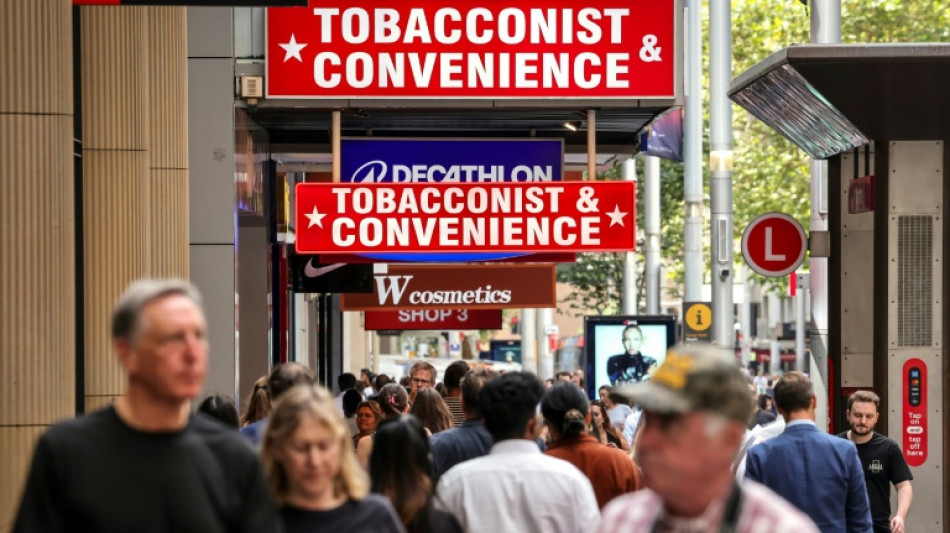
Australian black market tobacco sparks firebombings, budget hole / Photo: DAVID GRAY - AFP

Sky-high tobacco prices in Australia have created a lucrative black market, analysts say, sparking a violent "tobacco war" and syphoning away billions in potential tax revenue.
Faced with a pack of 25 cigarettes costing up to Aus$50 (US$32) or more -- including Aus$1.40 in tax on each stick -- many smokers have instead turned to readily available illicit tobacco.
At the same time, authorities have cracked down on vapes, restricting legal sales to pharmacies and opening up another illegal market for people in search of affordable nicotine.
In March, the government cut its budget forecast for tobacco tax revenue in the period to 2029 by Aus$6.9 billion.
"We've got a challenge here and too many people are avoiding the excise," Treasurer Jim Chalmers conceded after revealing the figures.
He announced an extra Aus$157 million for a multi-agency force battling organised crime groups involved in the market and a string of "tobacco war" fire-bombings.
The situation was a "total disaster", said James Martin, criminology course director at Deakin University in Melbourne.
"We have taken a public health issue, smoking, and our tobacco control policies have transformed it into a multi-fronted crisis," he told AFP.
"It is a fiscal crisis, so we are losing billions and billions of dollars in tobacco tax excise but also, more concerning for me as a criminologist, it has turned into a major crime problem."
Since the start of 2023, there had been more than 220 arson attacks targeting either black-market retailers or store owners who refuse to stock illicit tobacco products, Martin said.
- Extortion and intimidation -
"This is really serious organised crime, extortion and intimidation of otherwise law-abiding citizens."
Alleged crime figures named in local media as big players include convicted heroin trafficker Kazem Hamad, who was deported to Iraq in 2023, and an infamous Melbourne crime family.
Australian Criminal Intelligence Commission chief Heather Cook said criminals fighting over the "lucrative" illegal market were associated with "violence and dangerous behaviour".
"This is impacting communities," she told Melbourne's Herald Sun in February.
Law enforcement alone could not solve the problem, Martin said.
"If we just keep making nicotine harder to get to, people are going to turn to the black market."
Australia had made two mistakes, he said: pricing legal cigarettes so high that a pack-a-day habit cost about Aus$15,000 a year and at the same time heavily restricting sales of vapes, which were predominantly sold on the black market.
"The government needs to lower the tobacco tax excise to stop the bleed to the black market, and they need to legalise consumer vaping products."
New Zealand was the only country that had successfully introduced a similar tobacco taxation policy to Australia's, Martin said.
"But they did it by legalising vaping back in 2020," he added.
"So, New Zealand used to have a higher smoking rate than we did back just four years ago. It's now substantially lower than Australia's."
Illicit cigarettes are flowing into Australia from China and the Middle East, with vapes predominantly being sourced from Shenzhen in China, the criminologist said.
- 'War on nicotine' -
And the black market still thrives despite the Australian Border Force saying it detected huge volumes of illicit tobacco in the year to June 30, 2024 -- 1.8 billion cigarettes and more than 436 tonnes of loose leaf tobacco.
Daily tobacco smoking in Australia has fallen sharply over the past decades: from 24 percent of those aged over 14 in 1991 to 8.3 percent by 2023, according to a national household survey.
But monitoring of nicotine in Australian wastewater -- whether from cigarettes, vapes, or nicotine replacement products -- showed consumption per person had remained "relatively stable" since 2016, according to the government's health and welfare institute.
Edward Jegasothy, senior lecturer in public health at the University of Sydney, said smoking rates in Australia fell just as fast during periods of sharp price increases as they did when prices were stable.
The black market had undermined government policy by providing a cheaper alternative, he told AFP.
To address the problem, authorities would probably need to lower taxes on tobacco and strengthen law enforcement, he said.
Broader nicotine restrictions in Australia had left people with fewer less harmful alternatives to tobacco, Jegasothy said.
People switching to vapes were going to the unregulated market where concentrations of nicotine and other adulterants were unknown, he said.
"So that's another risk that's unnecessarily there because of the black market."
The high tobacco tax policy also hit people in the lowest socioeconomic groups the hardest, Jegasothy said, both because they were spending a higher proportion of their incomes on it, and because they had higher rates of smoking.
Australia's "disproportionate" focus on cutting nicotine supply rather than reducing demand and harm echoed the "War on Drugs", Jegasothy argued in a joint paper with Deakin University's Martin.
"As with Australia's broader War on Drugs, there is little evidence to suggest that our de facto War on Nicotine is an optimal strategy for reducing nicotine-related harms," it warns.
(Y.Yildiz--BBZ)