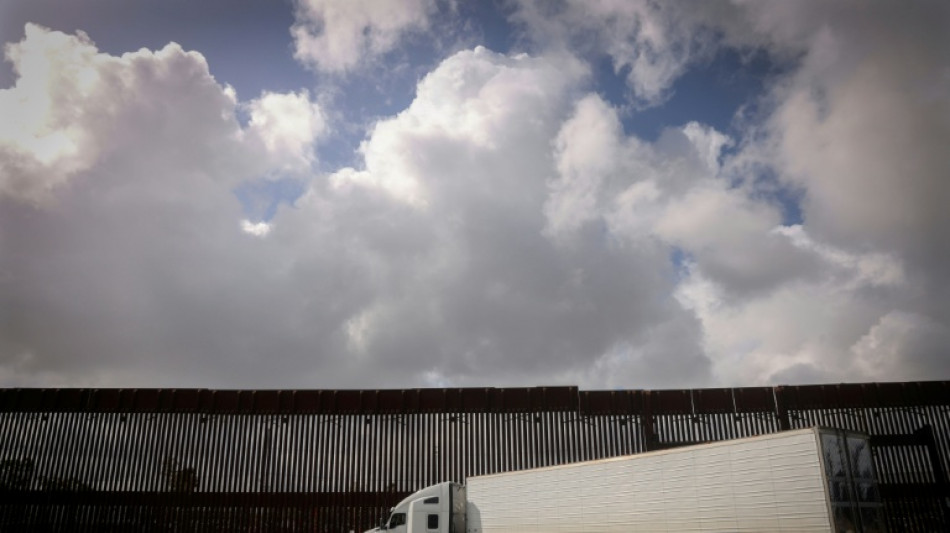
Trump tariffs on Mexico: the good, the bad, the unknown / Photo: SANDY HUFFAKER - AFP

At first glance, Mexico got off lightly from Donald Trump's "Liberation Day" tariffs blitz.
The US president has repeatedly threatened the United States' top trading partner with punishing tariffs over illegal migration and drug smuggling.
So it was a surprise when he left Mexico off the list of nations on which he imposed levies ranging from 10 to 50 percent.
The relief in Mexico, which has a free-trade deal with the United States and Canada, was tempered by concern over the 25-percent levies Trump slapped on foreign-made imported vehicles.
That includes some of the three million vehicles the Latin American country sends north across the border each year.
AFP looks at how Mexico, whose President Claudia Sheinbaum has been walking a diplomatic tightrope with Trump, fared generally:
- The good -
Mexico avoided the 10-percent blanket tariffs imposed by Trump on several Latin American countries, including ones with staunchly pro-Trump governments such as Argentina and El Salvador.
For the moment at least, some Mexican exports to the United States remain tariff-free.
Analysts at BBVA bank said the fact that Mexico faced a lower level of relative protectionism "could give it advantages in accessing the US market and, therefore, attracting investment."
They said it could act as an incentive for nearshoring -- companies moving their operations to Mexico from other countries to use it as a tariff-free or low-tariff port of entry to the United States.
"It would simply be more profitable or less expensive to export these goods from Mexico than from countries with higher tariffs," BBVA said.
During Trump's first presidency from 2017-2021, scores of Chinese companies relocated their production to northern Mexico to avoid tariffs -- a bone of contention for the Republican leader.
- The bad -
Parts of Mexico's vital automotive industry are reeling after being hit with 25 percent tariffs, which come a month after Trump imposed levies on other goods from Mexico and Canada not covered by the United States-Mexico-Canada-Agreement (USMCA) trade deal.
Mexico's steel and aluminum exports to the United States have, since March, also been subject to 25 percent tariffs.
"We shouldn't be subject to these tariffs simply because the USMCA agreement provides otherwise," Juan Francisco Torres-Landa, a partner at consulting firm Hogan Lovells in Mexico City, told AFP.
The automotive tariffs are particularly painful for Mexico.
In recent years, several major automakers including Ford, General Motors, BMW, and Audi have outsourced part of their production to Mexico because of its tariff-free access to the United States.
Under Trump's new rules, US vehicle parts will not face tariffs. But manufacturers say that with automotive components crossing the US-Mexico border multiple times during the assembly process, it is nearly impossible to ascertain which are American.
Torres-Landa called the provision "gibberish."
"A car must have about 10,000 parts; tracking them to see what you pay (tariffs) for and what you don't pay for is a very complex equation," he said.
A day after the tariffs were announced, the shockwaves are still being felt.
Stellantis (born out of the merger of Fiat Chrysler and Renault) said it would immediately pause production at some of its Mexican and Canadian plants.
Volkswagen, meanwhile, indicated it would halt rail shipments of vehicles made in Mexico to the United States, Automotive News said.
The Mexican government said Thursday that over the next 40 days it will attempt to negotiate "the best conditions" with the Trump administration for the automotive, steel, and aluminum industries.
- The unknown -
The uncertainty caused by Trump's repeated threats of steep tariffs has already caused a slowdown in manufacturing activity.
While the Mexican government has forecast economic growth of about 1.5 percent this year, analysts surveyed by the central bank said this week they expected it to come in much lower, at 0.5 percent.
In the country's northern industrial borderlands, home to thousands of factories built to serve the US market, Mexicans fear mass layoffs.
"I think difficult times are coming," trucker Omar Zepeda told AFP in the border city of Tijuana this week.
(K.Lüdke--BBZ)