Berliner Boersenzeitung - Taiwan earmarks $2.7 bn to help industries hit by US tariffs

EUR -
AED 4.322829
AFN 78.133877
ALL 96.351321
AMD 449.020923
ANG 2.107446
AOA 1079.38217
ARS 1708.507215
AUD 1.754261
AWG 2.119037
AZN 2.005708
BAM 1.95239
BBD 2.371059
BDT 143.858762
BGN 1.954427
BHD 0.444187
BIF 3481.519792
BMD 1.177079
BND 1.51146
BOB 8.152727
BRL 6.525968
BSD 1.177244
BTN 105.768284
BWP 15.474909
BYN 3.436199
BYR 23070.754691
BZD 2.367655
CAD 1.609003
CDF 2589.574932
CHF 0.929544
CLF 0.027204
CLP 1067.199432
CNY 8.273107
CNH 8.245294
COP 4351.66225
CRC 587.97315
CUC 1.177079
CUP 31.192602
CVE 110.072766
CZK 24.228888
DJF 209.191
DKK 7.469793
DOP 73.791129
DZD 152.691185
EGP 55.996065
ERN 17.65619
ETB 183.159348
FJD 2.671033
FKP 0.871425
GBP 0.872243
GEL 3.160505
GGP 0.871425
GHS 13.097071
GIP 0.871425
GMD 87.696942
GNF 10289.030994
GTQ 9.019249
GYD 246.288829
HKD 9.147378
HNL 31.030807
HRK 7.535709
HTG 154.140805
HUF 386.624698
IDR 19732.440028
ILS 3.757979
IMP 0.871425
INR 105.856514
IQD 1542.206654
IRR 49584.466809
ISK 148.006408
JEP 0.871425
JMD 187.782053
JOD 0.834596
JPY 184.255335
KES 151.784831
KGS 102.906206
KHR 4718.739039
KMF 492.019568
KPW 1059.371387
KRW 1698.419974
KWD 0.361552
KYD 0.981082
KZT 605.053321
LAK 25477.39745
LBP 105420.6431
LKR 364.423562
LRD 208.365221
LSL 19.592683
LTL 3.47561
LVL 0.712004
LYD 6.370874
MAD 10.740742
MDL 19.748427
MGA 5383.575129
MKD 61.541371
MMK 2471.973628
MNT 4187.830092
MOP 9.429692
MRU 46.617586
MUR 54.134323
MVR 18.186321
MWK 2041.326308
MXN 21.076669
MYR 4.76541
MZN 75.227583
NAD 19.592683
NGN 1705.29411
NIO 43.324337
NOK 11.792228
NPR 169.229454
NZD 2.019198
OMR 0.4528
PAB 1.177239
PEN 3.961382
PGK 5.084121
PHP 69.164597
PKR 329.771978
PLN 4.215539
PYG 7978.066916
QAR 4.291006
RON 5.086871
RSD 117.357022
RUB 93.035146
RWF 1714.598302
SAR 4.414876
SBD 9.597188
SCR 17.026229
SDG 708.017538
SEK 10.788368
SGD 1.511741
SHP 0.883114
SLE 28.33823
SLL 24682.769134
SOS 671.624207
SRD 45.123929
STD 24363.16543
STN 24.457287
SVC 10.30101
SYP 13016.600497
SZL 19.576811
THB 36.533055
TJS 10.81876
TMT 4.131548
TND 3.424919
TOP 2.834125
TRY 50.520602
TTD 8.007981
TWD 36.989016
TZS 2907.386317
UAH 49.663267
UGX 4249.578436
USD 1.177079
UYU 46.009648
UZS 14188.221356
VES 339.10341
VND 30946.592427
VUV 142.040627
WST 3.282417
XAF 654.810642
XAG 0.01541
XAU 0.000261
XCD 3.181116
XCG 2.121695
XDR 0.815619
XOF 654.813418
XPF 119.331742
YER 280.674991
ZAR 19.646637
ZMK 10595.130603
ZMW 26.575475
ZWL 379.019061
  • RBGPF

    0.0000

    81.26

    0%

  • SCS

    0.0200

    16.14

    +0.12%

  • CMSC

    0.1000

    23.12

    +0.43%

  • CMSD

    -0.0100

    23.13

    -0.04%

  • BCE

    0.0250

    23.035

    +0.11%

  • BCC

    -0.1450

    74.565

    -0.19%

  • RIO

    1.3780

    82.268

    +1.68%

  • RYCEF

    -0.1000

    15.43

    -0.65%

  • NGG

    0.0100

    77.5

    +0.01%

  • GSK

    -0.0160

    48.944

    -0.03%

  • VOD

    -0.0400

    13.06

    -0.31%

  • RELX

    -0.1100

    40.98

    -0.27%

  • JRI

    -0.0080

    13.462

    -0.06%

  • AZN

    0.0900

    92.54

    +0.1%

  • BP

    -0.1300

    34.18

    -0.38%

  • BTI

    -0.0350

    57.205

    -0.06%

Taiwan earmarks $2.7 bn to help industries hit by US tariffs
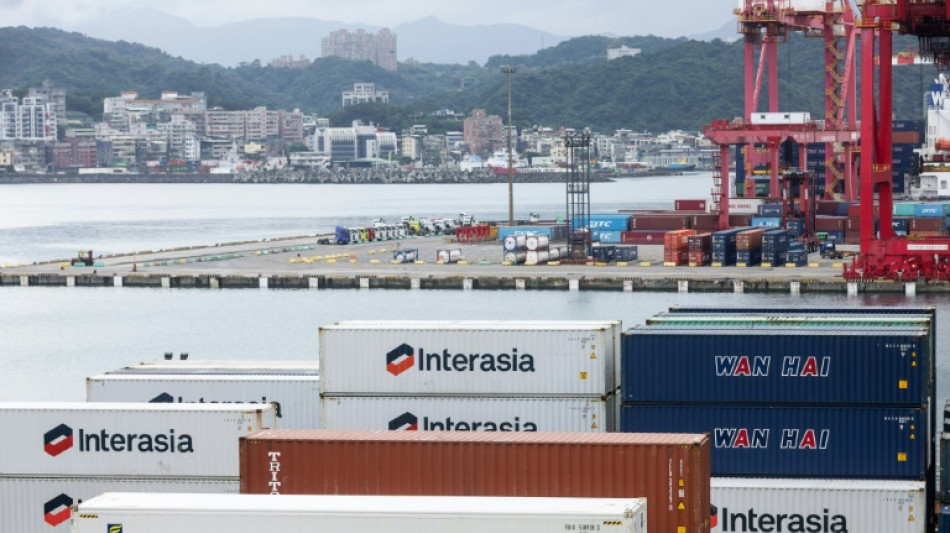
Taiwan earmarks $2.7 bn to help industries hit by US tariffs / Photo: I-Hwa CHENG - AFP

Taiwan earmarks $2.7 bn to help industries hit by US tariffs

Taiwan has earmarked $2.7 billion to help industries affected by US President Donald Trump's new tariffs, the government said Friday.

Text size:

Taipei had sought to avoid Trump's threatened levies by pledging increased investment in the United States and more purchases of US energy, but it was still hit by a 32 percent tax on its imports, excluding semiconductor chips.

The government has described the tariffs as "unreasonable" and "extreme", and plans to seek negotiations with Washington in the hope of reducing their impact.

Announcing the NT$88 billion ($2.7 billion) assistance package, Premier Cho Jung-tai said the plan was to "address various needs of industries and society in the future."

Taiwan's trade surplus with the United States is the seventh highest of any country, reaching $73.9 billion in 2024.

Around 60 percent of Taiwan's exports to the United States are information and communications technology products, or ICT, which includes chips.

The government has argued that the surplus reflected soaring demand in the United States for Taiwan's semiconductors and other tech products, further driven by US tariffs and export controls targeting China that Trump imposed during his first term.

Cho told a news conference that the industrial and agricultural sectors would be the main targets of the assistance.

The funds will be used for financial support, reducing administrative costs, improving competitiveness, offering tax incentives and diversifying markets, he said.

Products expected to be hardest hit by Trump's tariffs include ICT, electronics, steel, metal and machinery, components and building materials.

Tea, orchids and fish are also likely to be hurt, Cho said, flagging a possible "shrinking consumer market or a weakening of our competitive advantage".

Vice Premier Cheng Li-chun told reporters the government had drawn up response measures based on a possible 25 percent tariff ahead of Trump's announcement.

"I must clarify that a 32 percent tariff falls under an extreme scenario," Cheng said.

"While we did run simulations based on it, that doesn't mean we consider it reasonable. In our view, it exceeds what would be a reasonable expectation -- it's neither reasonable nor fair."

Semiconductor chips, a sector that Taiwan dominates and has been a source of friction between Washington and Taipei, were excluded from Trump's levies.

However, analysts warned that tariffs on components would have a knock-on effect for the critical chip industry that is the lifeblood of the global economy.

Trump has accused Taiwan of stealing the US chip industry and recently threatened to impose tariffs of up to 100 percent on semiconductor imports from the island.

"Taiwan will lobby for exemption or at least see what Trump wants -- Trump wants something," Andrew Kam Jia Yi, an associate professor at the National University of Malaysia told AFP.

"(Trump) gives you the worst-case scenario then batters you down to a deal that you might not want but seems more reasonable than the original threat."

(L.Kaufmann--BBZ)