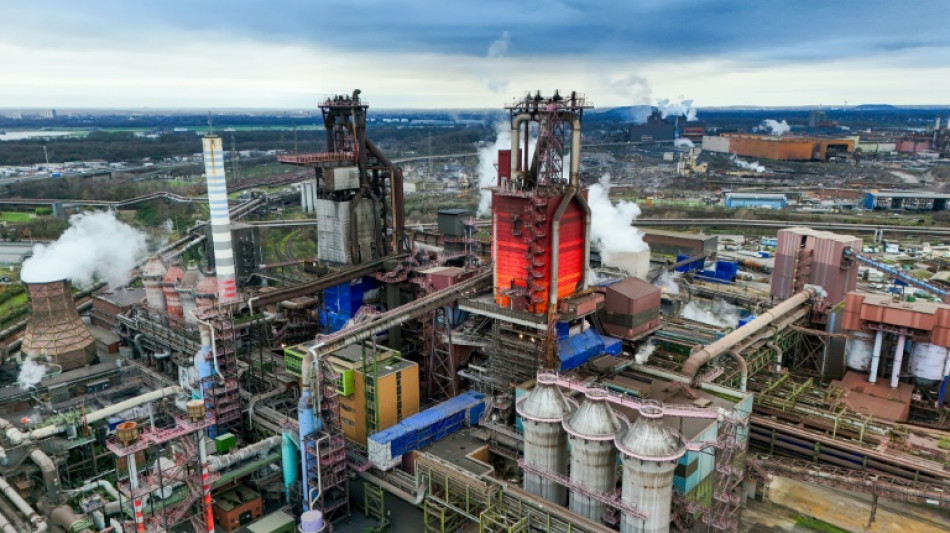
German growth better than expected but tariff turmoil looms / Photo: Ina FASSBENDER - AFP

Germany's struggling economy grew faster than expected at the start of the year, data showed Wednesday, in a boost for the incoming government of conservative Friedrich Merz even as US tariffs threaten to derail the nascent recovery.
Gross domestic product (GDP) in Europe's biggest economy expanded 0.2 percent from January to March compared to the previous quarter, according to provisional figures from federal statistics agency Destatis.
The expansion, driven by improving consumption and investment, was better than analyst forecasts and meant Germany dodged a recession -- defined as two straight quarters of negative growth -- after a contraction at the end of last year.
It was rare good news for the eurozone's traditional growth engine which has been battling a manufacturing slowdown, rising costs and weak demand in key overseas markets, prompting the economy to shrink in both 2024 and 2023.
The improving picture will come as a relief for incoming chancellor Merz as he prepares to take office next week, with the dire state of the economy one of his most pressing challenges.
Still, any celebrations are likely to be short-lived, with economists predicting that Germany will be hit hard later in the year by US President Donald Trump's tariff blitz.
"This should not be interpreted as the beginning of a sustainable recovery," said Dirk Schumacher, chief economist at German public lender KfW, warning of "uncertainty regarding American economic policy".
The Ifo institute said that the economy likely benefited in the first quarter as companies in the United States -- Germany's top trading partner last year -- rushed to import goods before tariffs kicked in this month, and the levies would weigh on growth later in 2025.
The European Union is currently facing a 10-percent tariff on its exports to the United States as part of Trump's hardball trade agenda. He earlier announced a 20-percent rate on the bloc but then paused the higher levies -- on the EU and many other trading partners -- to allow for talks.
- Deep-rooted problems -
In a further sign of economic weakness for Germany, data released Wednesday showed unemployment edging up to 6.3 percent in April -- the second straight monthly increase.
Following two years of contraction driven by surging energy prices after Russia invaded Ukraine and post-pandemic supply chain woes, the German economy was expected to start making a modest recovery this year.
But the government last week downgraded its growth forecast for 2025 to zero, blaming Trump's sweeping tariffs, in line with economic institutes who have also been slashing their estimates.
Highlighting the economy's woes, Volkswagen and Mercedes-Benz -- two major players in Germany's flagship auto industry -- reported sharp falls in first-quarter profits Wednesday, and warned of the impact of US tariffs.
Merz has vowed a barrage of measures to boost the economy, ranging from vastly increasing public spending to lowering corporate taxes and energy costs.
He has already succeeded in leading efforts to push changes to Germany's restrictive debt rules through parliament, paving the way for massive extra outlays on defence and infrastructure, which economists say should boost the economy.
But it is expected to take some time before these measures are implemented and have any kind of impact.
And ING economist Carsten Brzeski warned the spending plans, "impressive as they might be, will do very little to improve the economy's competitiveness".
"Modern infrastructure is essential for one of the world's largest economies, but it doesn't inherently drive innovation, sector transformation, or new growth opportunities."
(P.Werner--BBZ)