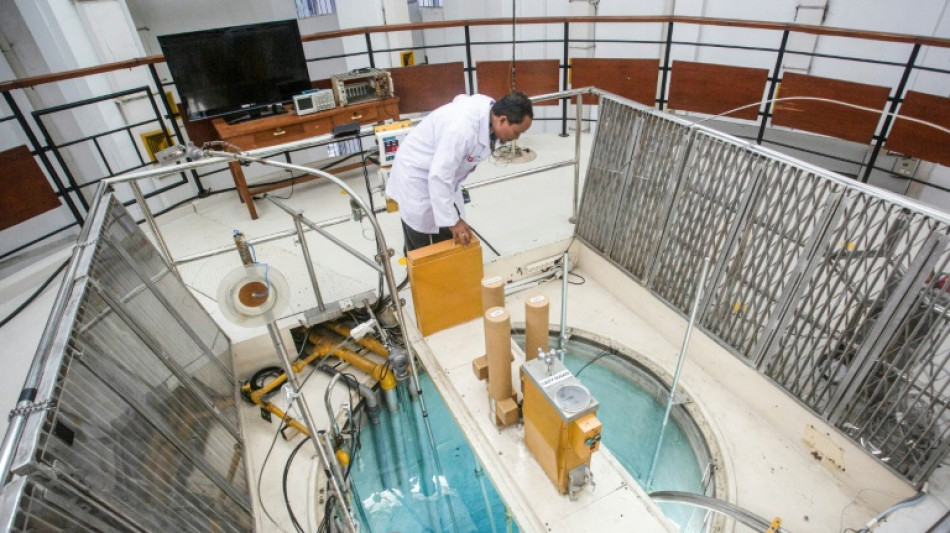
Nuclear option: Indonesia seeks to grow energy, cut emissions / Photo: DEVI RAHMAN - AFP/File

Indonesia is hoping going nuclear can help it meet soaring energy demand while taming emissions, but faces serious challenges to its goal of a first small modular reactor by 2032.
Its first experiment with nuclear energy dates to February 1965, when then-president Sukarno inaugurated a test reactor.
Sixty years later, Southeast Asia's largest economy has three research reactors but no nuclear power plants for electricity.
Abundant reserves of polluting coal have so far met the enormous archipelago's energy needs.
But "nuclear will be necessary to constrain the rise of and eventually reduce emissions", said Philip Andrews-Speed, a senior research fellow at the Oxford Institute for Energy Studies.
President Prabowo Subianto has promised to ensure energy security while meeting a pledge to eliminate coal-powered electricity generation within 15 years.
Coal accounts for around two-thirds of electricity generation in Indonesia, which targets net-zero by 2050.
The government wants 40-54GW of the 400GW it projects will be generated nationwide by 2060 to come from nuclear.
It hopes to kickstart capacity with a reactor on Borneo "by 2030 or 2032", according to Energy Minister Bahlil Lahadalia.
It will be a small modular reactor, which has a lower capacity than traditional reactors but is easier to assemble and transport.
The total number of plants planned has not been detailed, but the government has begun scouting locations -- a challenge for a country located on the seismically active "Ring of Fire".
"Currently, 29 potential locations have been identified for the construction of nuclear power plants," Dadan Kusdiana, acting secretary general of the National Energy Council (DEN) told AFP.
All are outside the country's biggest island of Java, in line with government goals to develop the archipelago's centre and east.
The sites would also put facilities near energy-hungry mining sites.
- Ring of Fire -
While Japan's quake and tsunami-triggered Fukushima disaster has stalled nuclear progress in some parts of Asia, proponents say nuclear can be done safely in Indonesia.
"North Java, East Sumatra, West Kalimantan and Central Kalimantan are considered as low-risk zones," said Andang Widi Harto, a nuclear engineering researcher at Yogyakarta University.
"These low seismic risk regions also coincide with low volcanic risk regions," he added.
Countries from Vietnam to Belgium are also growing or retaining nuclear capacity as they struggle to meet net-zero goals to combat climate change.
While Indonesia may not be alone in the nuclear pivot, it has little domestic expertise to draw on.
It will look abroad for help, said Kusdiana, citing "serious interest" from providers including Russia's Rosatom, China's CNNC and Candu Canada.
The Indonesian subsidiary of US company ThorCon is already seeking a licence for an experimental "molten-salt reactor".
It wants to use shipyards to build small reactors that will be towed to coastal or offshore locations and "ballasted" to the seabed.
Kusdiana said DEN has also visited France's EDF SA to explore possible cooperation.
French President Emmanuel Macron is due in Indonesia this week as part of a Southeast Asia tour.
EDF said there were currently "no discussions underway on nuclear with Indonesia," though its CEO Bernard Fontana will be part of Macron's delegation.
A second French firm, Orano, also said it had not discussed collaboration with Indonesia.
- 'Sceptical' -
Given the challenges, which also include connectivity issues, waste disposal and potential domestic opposition, some experts warn Indonesia's nuclear timeline is overambitious.
"I would join others who are sceptical that Indonesia can deploy nuclear power at any significant scale in the next ten years," said Andrews-Speed at the Oxford Institute.
Environmentalists would like to see Indonesia focus more on meeting its clean energy targets with renewable sources.
While hydroelectric accounts for over seven percent of Indonesia's electricity generation, solar and wind contribute tiny amounts and could be significantly ramped up, experts say.
Cost and "high corruption" are also obstacles, said Dwi Sawung, energy and urban campaign manager at NGO WALHI.
"There is not enough left in the government and PLN (state electricity company) budget," he told AFP.
The government has not said how much it expects the nuclear ramp-up to cost, but Kusdiana insists the money will be there.
"Various potential international investors... have shown interest", including Russia, the United States, Denmark, South Korea and China, he said.
(S.G.Stein--BBZ)