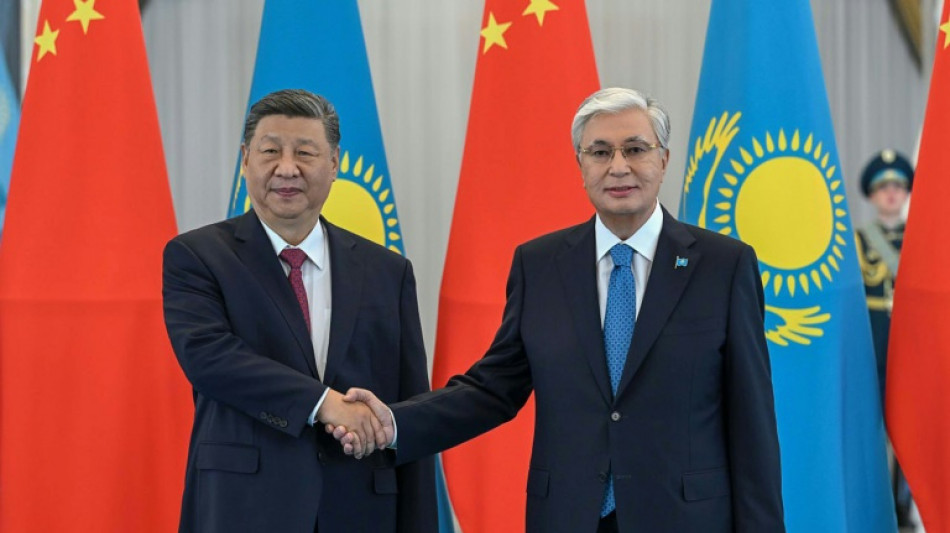
China's Xi in Kazakhstan to cement Central Asia ties / Photo: Handout - KAZAKHSTAN'S PRESIDENTIAL PRESS SERVICE/AFP

Chinese President Xi Jinping will meet Central Asian leaders at a summit in Kazakhstan on Tuesday, his second trip to the region in under a year as Beijing competes with Russia for influence there.
The summit in the Kazakh capital brings together Xi -- who arrived in Astana on Monday -- and the leaders of Kazakhstan, Kyrgyzstan, Uzbekistan, Tajikistan and Turkmenistan.
Under Russia's orbit until the fall of the Soviet Union in 1991, the five countries of Central Asia have courted interest from major powers including China and the United States since becoming independent.
The region is rich in natural resources and strategically located at the crossroads of Europe and Asia.
While Central Asian leaders continue to view Russia as a strategic partner, ties with Moscow have loosened since the war in Ukraine.
The five nations are taking advantage of the growing interest in their region and coordinating their foreign policies.
They regularly hold summits with China and Russia to present the region as a unified bloc and attract investment.
The "5+1" format high-level talks have also been organised with the European Union, the United States, Turkey and other Western countries.
"The countries of the region are balancing between different centres of power, wanting to protect themselves from excessive dependence on one partner," Kyrgyz political scientist Nargiza Muratalieva told AFP.
- Biggest trade partner -
Russia says China's growing influence in the region does not pose a threat.
"There is no reason for such fears. China is our privileged strategic partner, and the countries of Central Asia, naturally, are our natural historical partners," Kremlin spokesman Dmitry Peskov told reporters on Monday.
But China has now established itself as Central Asia's leading trading partner. Trade volume with the region was estimated at $95 billion in 2024, according to Chinese customs.
That figure is far ahead of the European Union (around $64 billion according to the EU Council in 2023) and Russia, with $44 billion.
Central Asia is also an important target for China in its Belt and Road initiative -- which uses huge infrastructure investments as a political and diplomatic lever.
Xi's visit to Kazakhstan will "(open) up more room for the joint construction of the Belt and Road", Chinese foreign ministry spokesman Guo Jiakun said on Monday.
Construction of the Uzbekistan-Kyrgyzstan-China railway and the China-Tajikistan highway, which runs through the Pamir Mountains to Afghanistan, are among the planned investments.
New border crossings and "dry ports" have already been built to process trade, such as Khorgos in Kazakhstan, one of the largest logistics hubs in the world.
"Neither Russia nor Western institutions are capable of allocating financial resources for infrastructure so quickly and on such a large scale, sometimes bypassing transparent procedures," said Muratalieva.
Developing transport corridors in Central Asia allows China to reduce delivery times by sending goods to Europe via the Caspian Sea, bypassing Russia.
Chinese companies are also increasingly present in Central Asia's energy sector, seeking contracts for gas in Turkmenistan, uranium in Kazakhstan and rare earths in Tajikistan, among others.
Kazakhstan said last week that Russia would lead the construction of its first nuclear power plant but that it wanted China to build the second.
"Central Asia is rich in natural resources such as oil, gas, uranium, gold and other minerals that the rapidly developing Chinese economy needs," Muratalieva said.
"Ensuring uninterrupted supplies of these resources, bypassing unstable sea routes, is an important goal of Beijing," the analyst added.
- Human rights -
China also positions itself as a supporter of the predominantly authoritarian Central Asian leaderships.
At the last Central Asia-China summit, Xi called for "resisting external interference" that might provoke "colour revolutions" that could overthrow the current leaders in the region.
"Central Asia directly borders Xinjiang... Beijing sees the stability of the Central Asian states as a guarantee of the security of its western borders," Muratalieva added.
Beijing is accused of having detained more than a million Uyghurs and other Muslims as part of a campaign which the UN has said could constitute "crimes against humanity".
Central Asia remains sparsely populated and has just 80 million inhabitants despite being as geographically large as the European Union.
This is far less than the 1.4 billion Chinese population, now exempt from visa requirements in some countries of the region.
Some in Central Asia are concerned by this arrangement and fear a loss of sovereignty.
(A.Lehmann--BBZ)